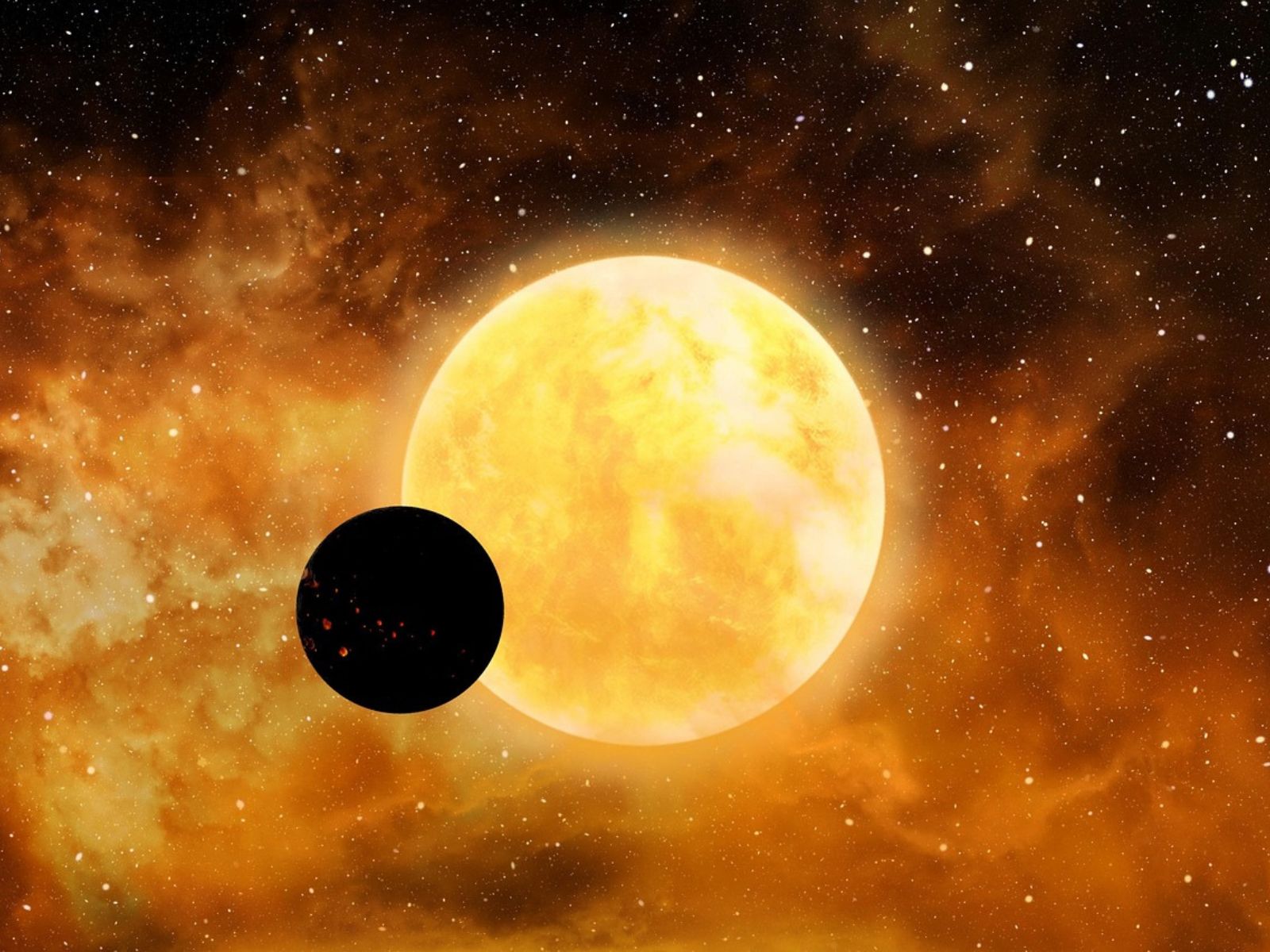
Astronomers are puzzling over a strange dimming event from a faraway star that appeared stable for years—until its light suddenly dropped and stayed low for an astonishingly long time. The star, known as ASASSN-24fw, sits about 3,200 light-years from Earth and is roughly twice as massive as our Sun. What makes it so intriguing is the duration of the fade: its brightness declined over around 200 days, placing it among the longest dimming events ever recorded for a star like this.
So what could block a star’s light for that long?
One leading explanation points to an unusual companion object: a brown dwarf wrapped in a massive ring system. A brown dwarf is often described as a “failed star” because it’s too small to sustain hydrogen fusion like true stars, yet much more massive than a planet—typically between about 13 and 75 times the mass of Jupiter. In this scenario, ASASSN-24fw’s light would be partially obscured not simply by the brown dwarf itself, but by wide, saucer-like rings around it. Researchers suggest these rings could stretch more than 26 million kilometers, large enough to create a prolonged, dramatic dimming as they pass in front of the star from our point of view.
However, that’s not the only possibility. Astronomers also consider the chance that the culprit might be a gigantic exoplanet—potentially even larger than Jupiter—moving across the star’s face. While the object’s true identity remains uncertain, scientists do have one important clue about the star’s environment: ASASSN-24fw appears to be surrounded by gas and dust fragments, thought to be the remnants of ancient collisions between exoplanets. That kind of debris can complicate observations and also hints at a dynamic, possibly chaotic system where big objects and material could be moving around in ways that create rare eclipses.
To get closer to an answer, researchers plan additional observations using the Very Large Telescope. By measuring the star’s age and composition more precisely, they hope to better understand what’s orbiting it—and why the dimming happened in the first place.
Even more intriguing is the suggestion that this may not be a one-time event. Based on current estimates, another major dip in brightness could occur again in about 42 or 43 years. If that prediction holds, ASASSN-24fw could become one of the most valuable long-term targets for astronomers studying unusual eclipses, giant ring systems, and the hidden companions that can lurk around distant stars.