AMD’s newest dual 3D V-Cache flagship, the Ryzen 9 9950X3D2, is already making noise in the overclocking scene—this time by landing top spots across multiple synthetic benchmark leaderboards while running on ASRock’s high-end AM5 platform.
With Zen 5 now firmly in enthusiasts’ hands, CPU world records are starting to fall at a rapid pace. Even though the Ryzen 9 9950X3D2 hasn’t shown major gaming gains compared to some of its smaller X3D siblings, it does appear to offer a measurable uplift in synthetic performance. Early results have placed it roughly 2% to 10% ahead in several benchmarks versus the prior flagship, which is exactly the kind of improvement that makes competitive overclockers eager to push frequencies, memory tuning, and overall system optimization to the edge.
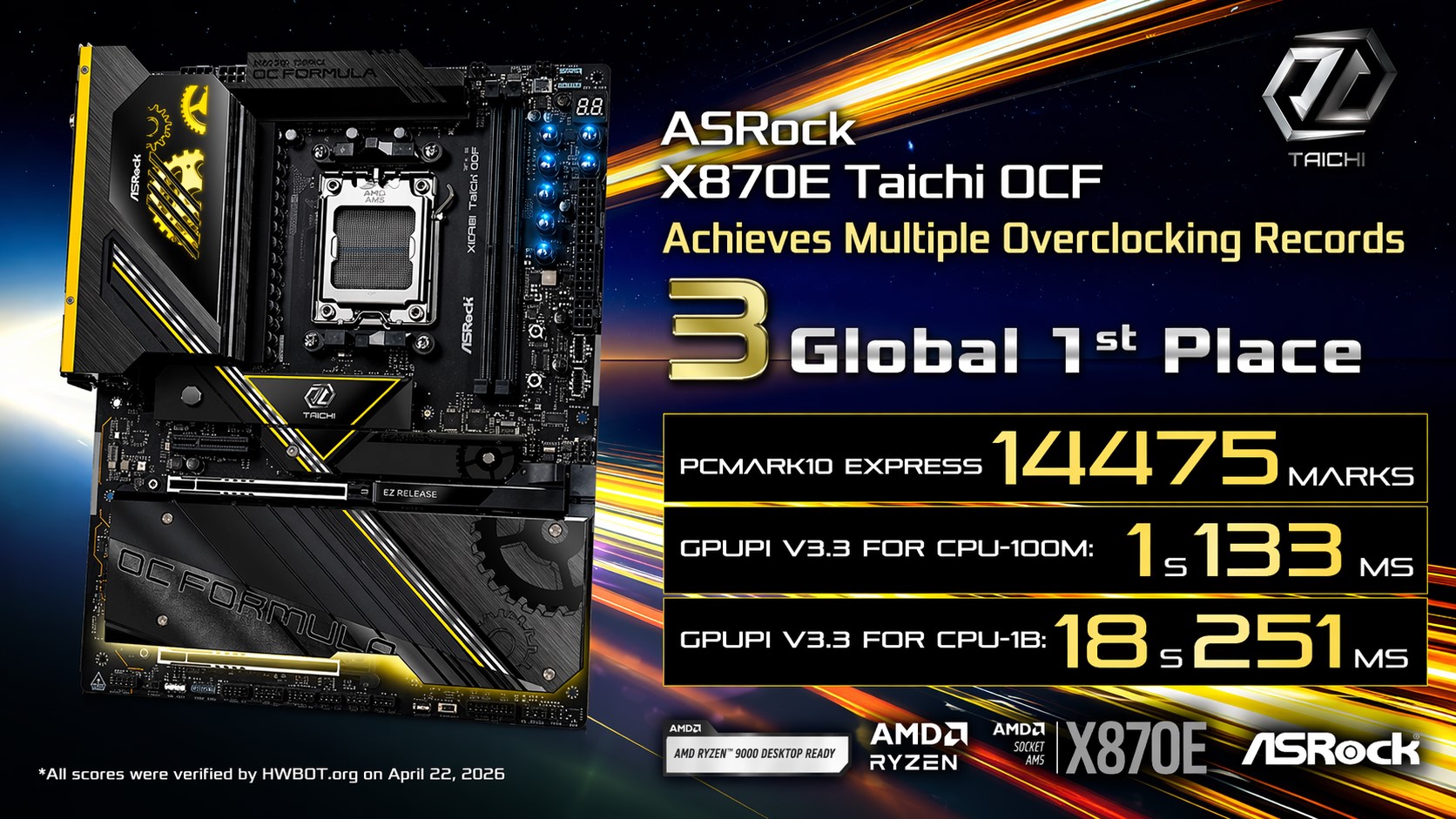
Much of the spotlight here is on ASRock’s X870E Taichi OCF, a flagship AM5 motherboard built specifically with extreme overclocking in mind. Two well-known overclockers, AKM and l0ud_sil3nc3, have used the Ryzen 9 9950X3D2 on this board to capture leading placements across multiple tests, along with additional top-10 finishes in a wider set of benchmarks.
According to the posted results, the pair reached number-one positions in PCMark 10 Express, GPUPI v3.3 for CPU-100M, and GPUPI v3.3 for CPU-1B. In PCMark 10 Express specifically, the overall highest score still sits above their run, but the result is strong enough to stand as a top entry in the 16-core category—an important distinction for leaderboard rankings where core counts and hardware classes matter.
Beyond those first-place finishes, the Ryzen 9 9950X3D2 and X870E Taichi OCF combination also delivered top-10 results in a variety of popular synthetic workloads. That includes compression and productivity testing in 7-Zip, video encoding runs in HWBot x265 (both 1080p and 4K), render-focused scoring in Cinebench R15, and heavy math stress tests like y-cruncher Pi 2.5b, among others.
ASRock attributes these results to what it calls the board’s extreme overclocking focus and stability tuning. The company highlights features such as robust power delivery, higher-end components, and an optimized PCB layout designed to keep the platform steady under demanding loads—exactly the conditions competitive overclocking creates.
More records may follow soon, since the chip is still new and many enthusiasts are only beginning to experiment with the best settings for voltage, thermals, memory, and boost behavior. It’s also worth repeating the obvious caution: extreme overclocking is a niche hobby, and chasing world-record scores can permanently damage hardware if you don’t know what you’re doing.
For most PC builders, the practical value proposition will likely favor more mainstream X3D options. Paying several hundred dollars more for an extra couple of percentage points in select benchmarks usually doesn’t make much sense unless you’re specifically building for competitive overclocking or leaderboard runs.


