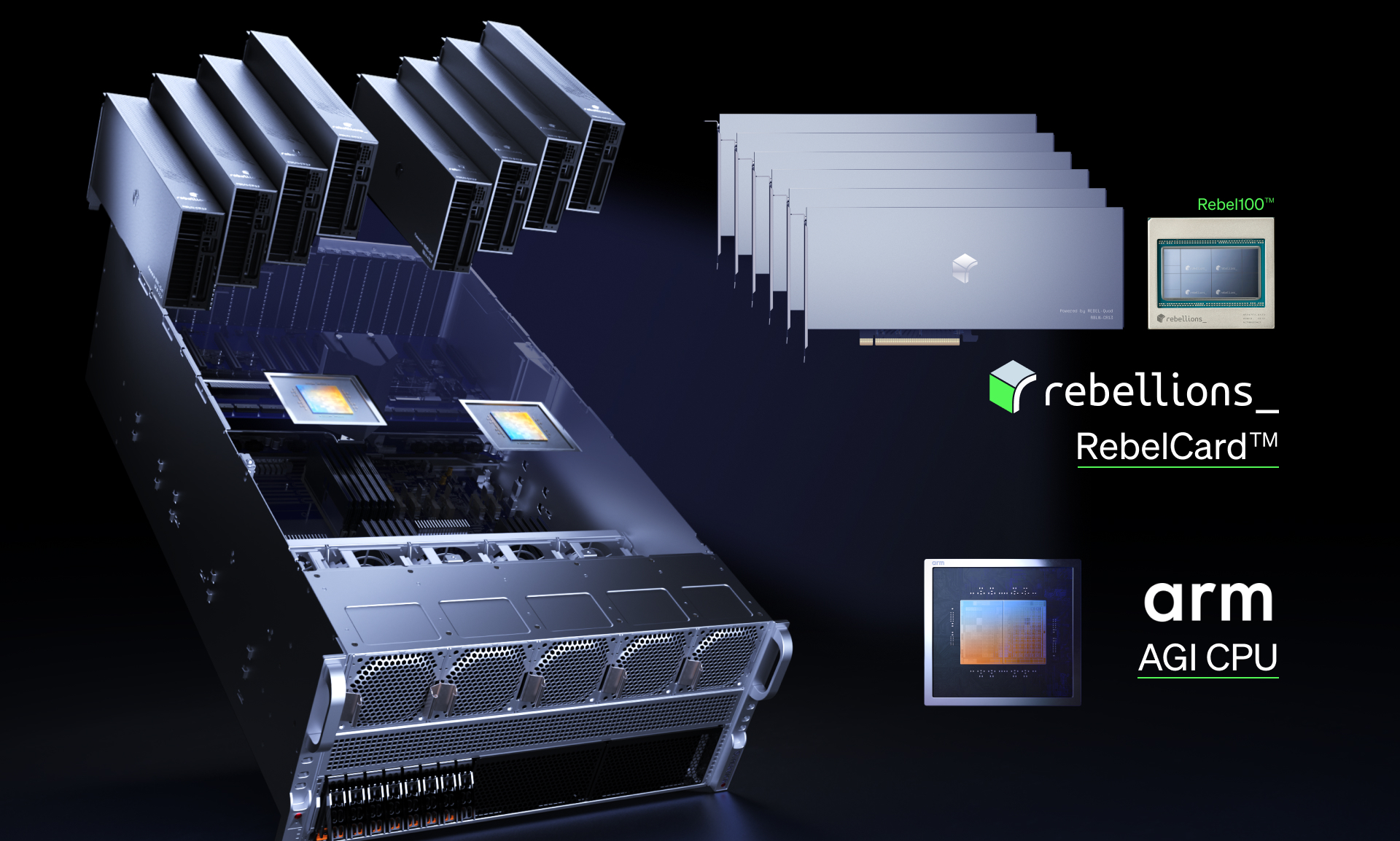
Arm’s newly introduced AGI CPU is stepping into the spotlight as the foundation for a major new push in agentic AI and telecom-focused AI infrastructure, thanks to a partnership between SK Telecom (SKT), Arm, and AI chip company Rebellions.
The three companies are joining forces to build AI inference infrastructure aimed at sovereign AI deployments and telecommunications-grade AI data centers. At the center of the project is a new AI server platform that pairs the Arm AGI CPU, Arm’s first in-house designed data center CPU, with Rebellions’ AI accelerators. The plan is to validate this combined system inside SKT’s real AI data center environment first, then move toward broader deployment in global markets.
This collaboration is designed to answer one of the biggest challenges in AI right now: surging demand for inference. While training large models gets much of the attention, inference is where AI meets the real world—serving responses, powering assistants, analyzing large streams of data, and supporting always-on services. That’s especially critical for telecom operators, where performance, reliability, and energy efficiency can directly impact service quality and operating costs.
A full-stack approach, not just hardware
Rather than stopping at simply plugging chips into a server, the partners say they will co-develop the entire software stack needed to make the platform production-ready. That includes firmware and the broader system software required for stability and performance in data center operations.
The new server design combines the Arm AGI CPU, built on Arm Neoverse CSS V3, with Rebellions’ RebelCard accelerator hardware. Once integrated, the platform will be deployed in SKT’s live data center environment to evaluate real-world performance and stability across two main areas: sovereign AI models and telco-specific large-scale data processing workloads. The companies also plan to review running SKT’s proprietary foundation model, A.X K1, on the new server infrastructure.
What makes Rebellions’ accelerator platform notable
The effort also highlights Rebellions’ next-generation accelerator technology, which is positioned as a high-efficiency alternative for large AI data centers that need strong throughput without runaway power costs.
Key features highlighted for the accelerator platform include:
Energy efficiency and performance gains through higher compute density and better utilization, targeting improved performance per watt.
A chiplet-based architecture using what’s described as the world’s first adoption of UCIe-Advanced, designed for power-efficient data transfer between chiplets.
Large high-bandwidth memory capacity and bandwidth, including 144GB of HBM3E with 4.8TB/s bandwidth—enough to handle models with tens of billions of parameters on a single chip.
Rebellions RebelCard: built for modern AI workloads
Rebellions’ RebelCard is a module-style accelerator card built around the company’s next AI semiconductor, Rebel 100 (previously referred to as Rebel-Quad). The card integrates four NPU chiplets along with HBM3E memory to deliver high compute performance while emphasizing energy efficiency—an increasingly important requirement for operators trying to scale AI inference without exploding power and cooling budgets.
The RebelCard is also described as being optimized for today’s most demanding model types, including ultra-large multimodal models and Mixture of Experts (MoE) architectures. High-speed chip-to-chip communication is a key part of that, helping the platform handle complex inference workloads efficiently at scale.
What happens next
After technical validation is completed in SKT’s data center environment, the partners plan to explore wider commercial deployment. Rebellions, in particular, is targeting the global sovereign AI data center market, with an emphasis on building momentum across Asia. A major focus is expected to be telecom companies and public sector organizations that want customized, stability-proven AI infrastructure they can operate independently.
If this initiative delivers on its goals—high-performance AI inference with strong energy efficiency and telecom-grade stability—it could become a meaningful blueprint for the next wave of sovereign AI and operator-ready AI data centers worldwide.