Arm AGI Server Processor Targets AI Data Centers With 136 Cores and Massive Memory Bandwidth
Arm is making a bigger push into the high-performance server market with its newly introduced AGI server processor, a chip built specifically for modern data centers, AI workloads, and memory-intensive computing. With up to 136 Neoverse V3 cores, support for as much as 6 TB of DDR5 memory per socket, and up to 844.8 GB/s of memory bandwidth, AGI is designed to challenge traditional x86 server processors in some of the most demanding enterprise environments.
The new Arm AGI processor is aimed at AI servers, cloud infrastructure, and agentic AI systems where fast data access, low latency, and strong performance per watt are increasingly important. Commercial shipments are expected to begin in the coming months, positioning Arm for a stronger role in a server CPU market long dominated by Intel Xeon and AMD EPYC platforms.
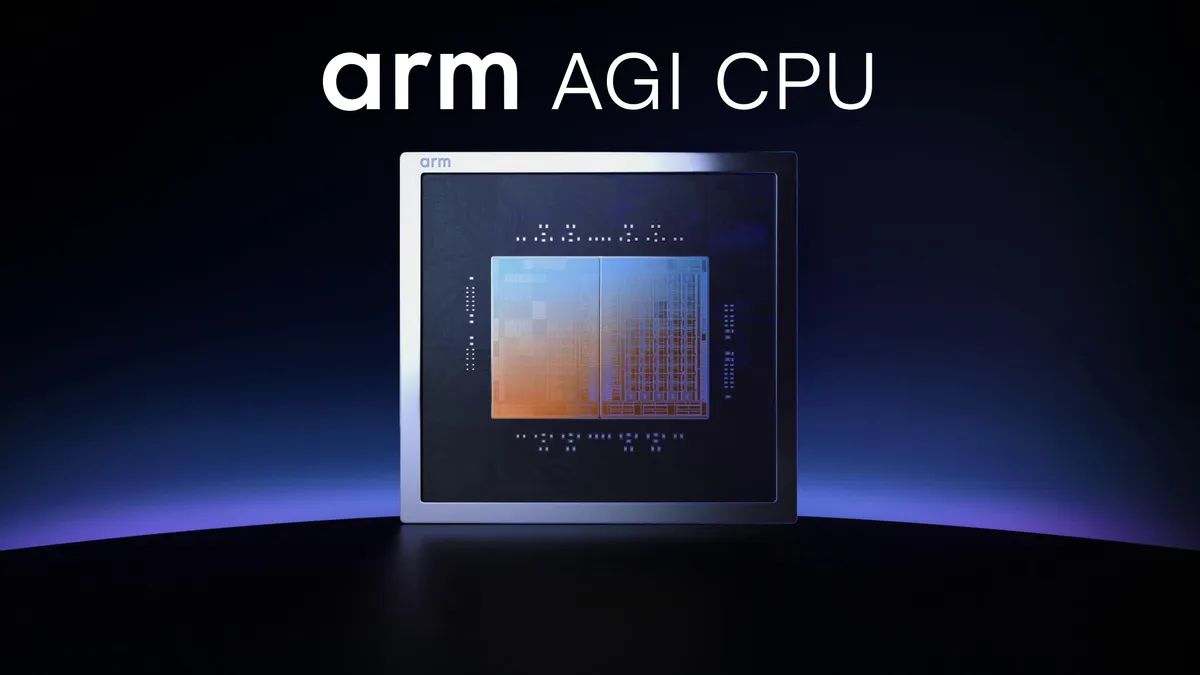
At the heart of Arm AGI is a dual-chiplet design. Each chiplet is manufactured using TSMC’s advanced N3P process and contains its own compute cores, memory controllers, and I/O resources. This approach helps reduce dependency on cross-chiplet communication, allowing the processor to access local memory more efficiently and with lower latency.
AGI will be offered in configurations with 64, 128, or 136 Neoverse V3 cores. These cores are expected to run between 2.8 GHz and 3.7 GHz, depending on the model and workload conditions. Each chiplet physically includes 70 cores, but in the top 136-core version, four cores are disabled to improve production yields. This is a common strategy in advanced chip manufacturing, especially for large processors with many cores.
Each Neoverse V3 core includes two 128-bit vector engines, making the chip better suited for compute-heavy workloads such as AI inference, data analytics, scientific computing, and large-scale cloud services. Every core also receives 2 MB of L2 cache, while the full processor can include up to 272 MB of system-level cache. That cache capacity is especially important in server environments where keeping frequently accessed data close to the cores can improve performance and reduce memory bottlenecks.
One of the most important features of Arm AGI is its memory subsystem. Each chiplet includes a six-channel DDR5 memory controller, giving the full processor a total of 12 DDR5 memory channels. With support for DDR5-8800, AGI can deliver up to 844.8 GB/s of combined memory bandwidth. It also supports up to 6 TB of memory per socket, making it suitable for workloads that require large datasets to remain close to the processor.
Memory bandwidth and latency are critical for AI-focused servers. Many AI workloads, especially inference and agentic AI applications, rely on moving large amounts of data quickly between memory, CPUs, accelerators, and storage devices. Arm says AGI can achieve local DRAM access latency below 100 nanoseconds, helped by the chiplet architecture that keeps memory access local whenever possible.
The two chiplets are connected through UCIe running at 32 GT/s, providing up to 2 TB/s of aggregate interconnect bandwidth. While chiplet-based processors can sometimes suffer from higher latency when data must travel between separate pieces of silicon, Arm’s design attempts to minimize this issue by giving each chiplet its own major subsystems. Local memory access does not need to cross the chiplet interconnect, which should help maintain responsiveness in latency-sensitive workloads.
Arm has also built in mechanisms to prioritize memory traffic and manage contention between CPU cores and I/O devices. This is important in dense AI servers, where CPUs, accelerators, network adapters, and storage controllers may all compete for access to memory and data pathways.
For expansion, Arm AGI includes 96 PCIe 6.0 lanes with CXL 3.0 support. CXL is becoming increasingly important in modern server platforms because it enables advanced memory expansion, memory pooling, and tighter connections between CPUs and accelerators. The processor also includes four PCIe 4.0 lanes along with I3C, I2C, and SPI interfaces for additional platform connectivity.
Despite its high core count and large memory subsystem, AGI is rated at a 300 W TDP. That places it firmly in the high-end server CPU category, but power efficiency will be one of the key areas to watch once real-world systems become available. Arm is promoting the chip as a strong option for performance-dense AI servers, claiming that AGI-based systems could deliver up to twice the performance per rack compared with systems using current x86 processors. However, that claim is based on Arm’s own estimates and will need to be confirmed through independent testing once commercial hardware is available.
Reference server designs with two AGI processors could provide up to 272 cores in a single system. Combined with high memory capacity, wide PCIe 6.0 connectivity, and CXL 3.0 support, such servers could appeal to cloud providers, AI infrastructure companies, and enterprises building next-generation data center platforms.
The launch of AGI shows Arm’s growing ambition in the server CPU space. Arm-based processors have already gained traction in cloud computing thanks to their efficiency and scalability, but AGI appears to be aimed at more demanding workloads where memory bandwidth, high core counts, and advanced I/O are essential.
If Arm can deliver strong real-world performance, competitive platform support, and broad software compatibility, AGI could become a serious option for AI servers and high-density data center deployments. With commercial availability expected soon, the processor may mark another important step in the shift toward more diverse server architectures beyond traditional x86 systems.