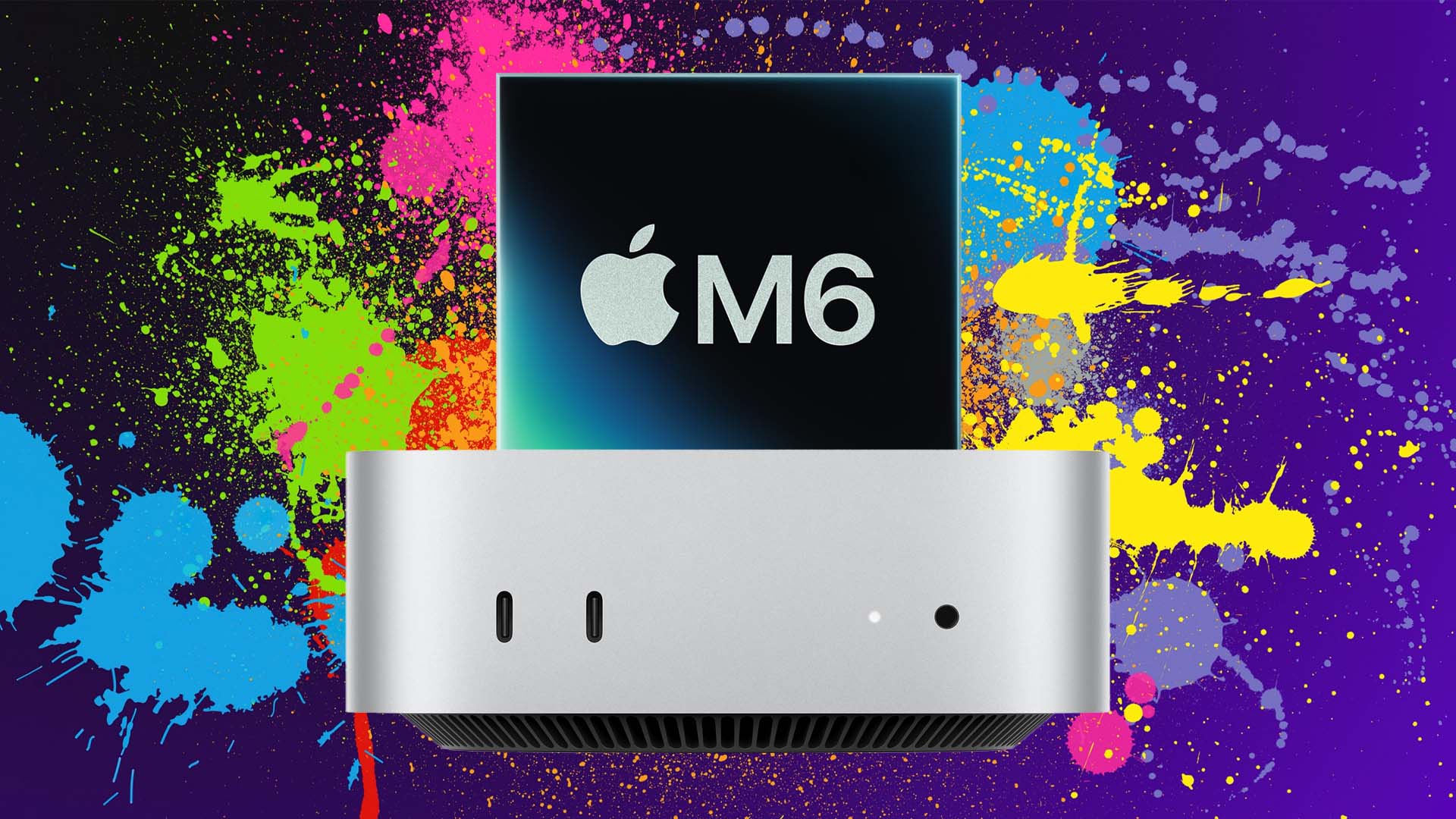
Apple M6 Debuts as a 2nm Chip With Major CPU, GPU, and AI Upgrades for the New Mac Mini
Apple has introduced its next-generation M6 chip, marking a major step forward for its Mac lineup. The new silicon is described as Apple’s first 2nm system-on-chip and one of the first mainstream processors built on TSMC’s cutting-edge 2nm manufacturing process. Alongside the M6, Apple also revealed the M5 Ultra and a refreshed Mac Studio, but the M6 stands out as the chip designed to bring big performance gains to a new Mac mini.
The Apple M6 focuses on faster everyday performance, stronger graphics power, and improved AI processing. It features a new 12-core CPU made up of two super cores, four performance cores, and six efficiency cores. Apple says this design delivers the company’s fastest single-threaded performance so far, while multi-threaded performance is up to 20 percent faster than the M5.
That performance boost should make the new Mac mini more capable for demanding workloads, including software development, creative production, multitasking, and AI-based tasks. The additional CPU power also gives professional users more room to run heavier applications without moving up to a larger desktop system.
Graphics performance is another major focus of the M6. The chip includes a 12-core GPU, with each GPU core featuring a Neural Accelerator, similar to the M5. Thanks to architectural improvements, Apple claims the M6 delivers up to a 30 percent increase in peak GPU compute performance.
Apple has also introduced a new graphics architecture that improves geometry processing. According to the company, the M6 can offer up to a 50 percent increase in geometry rates, which should help with complex 3D graphics, game development, visual effects, rendering, and other GPU-heavy workflows.
AI performance is getting a significant upgrade as well. The M6 includes a new dual 16-core Neural Engine, designed to accelerate machine learning and on-device artificial intelligence tasks. This should benefit users working with large language models, image processing, video tools, coding assistants, and other AI-powered software.
The M6 supports up to 32GB of unified memory, with memory bandwidth increased to 170GB/s. That represents a 10 percent improvement over the M5. While the jump may not sound huge on paper, faster unified memory can make a noticeable difference in workloads that rely on quick data access, especially AI models, high-resolution media projects, and multitasking with professional apps.
Apple’s refreshed Mac mini can be configured with either the M6 or the more powerful M5 Pro. The compact desktop also includes a solid selection of ports, making it suitable for both home and professional setups. Connectivity options include 2.5Gb Ethernet, two USB-C ports with USB 3 speeds, three Thunderbolt 4 ports on the back, and HDMI.
Wireless connectivity has also been upgraded. The new Mac mini supports Wi-Fi 7 and modern Bluetooth standards, giving users faster wireless networking and improved accessory support.
Pricing has changed compared to the previous generation. The M6 Mac mini starts at $899, while students can get it for $799. The M5 Pro version starts at $1,699, with student pricing set at $1,599. Pre-orders are available now, and the new Mac mini is scheduled to launch on September 22.
With the M6, Apple appears to be pushing the Mac mini into a more powerful category. The combination of a 2nm chip, faster CPU cores, stronger graphics, improved AI acceleration, higher memory bandwidth, Wi-Fi 7, and updated connectivity makes this one of the most significant Mac mini upgrades in recent years. For users who want a compact desktop with serious performance, the M6 Mac mini could become one of Apple’s most appealing new Macs.