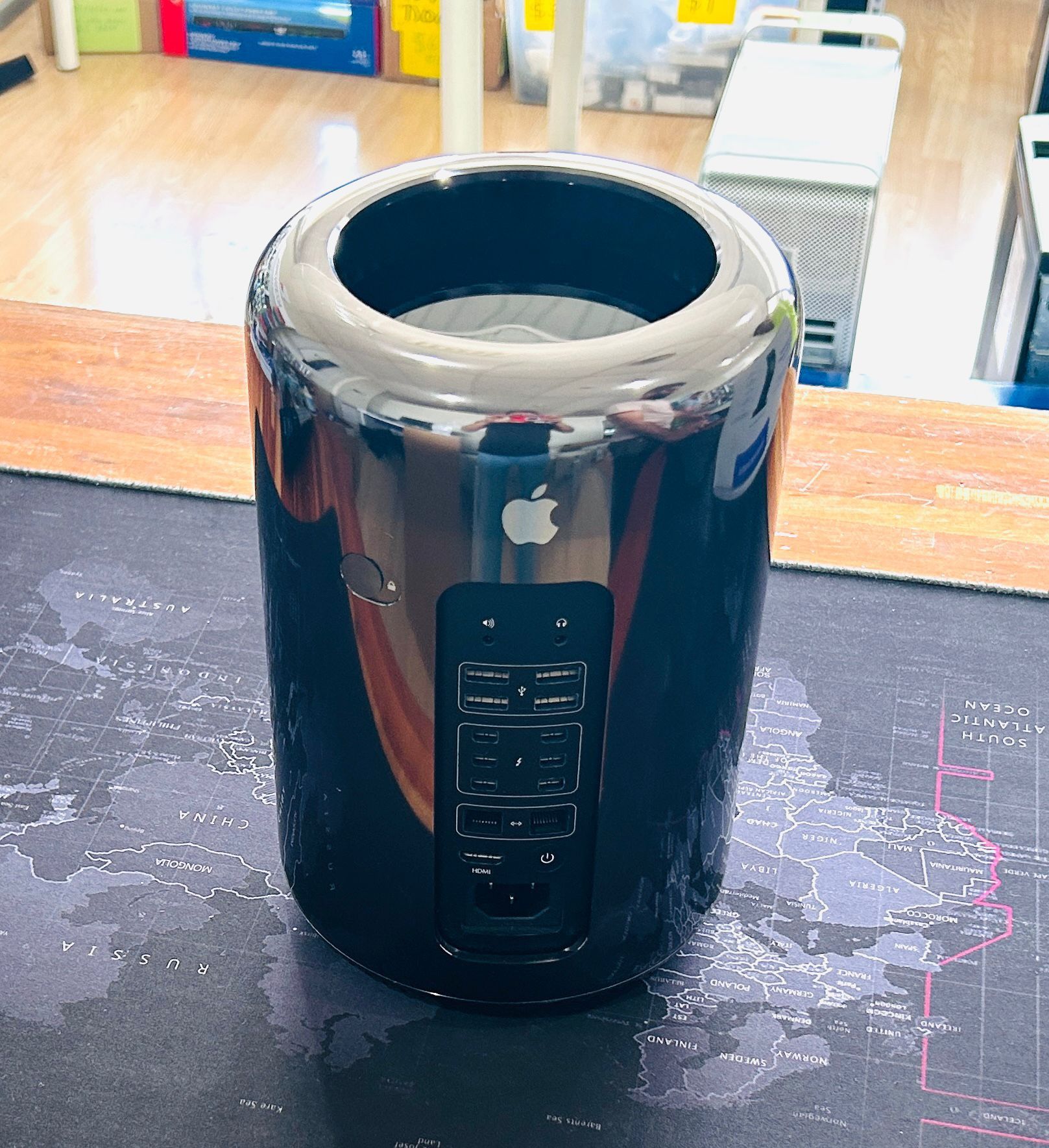
Apple didn’t just introduce a new Mac Pro in 2013—it made a statement. With a dramatic, cylindrical aluminum body and a confidence-laced soundbite from Phil Schiller (“Can’t innovate anymore, my ass.”), Apple positioned the redesigned Mac Pro as proof that even the most traditional “workstation” computer could be reinvented.
But what followed is now a cautionary tale in Apple hardware history. The device quickly earned the “Trashcan” nickname, and while it looked futuristic and ran quieter than many expected, its real-world usefulness for professional users didn’t live up to the bold promise.
The 2013 Mac Pro was built around a striking idea: concentrate the internal components around a central thermal core, then use a single large fan to pull air upward from the bottom. On paper, this was elegant engineering. Instead of relying on multiple smaller fans spinning faster and generating more noise, the Mac Pro could keep temperatures under control with less turbulence and noticeably quieter operation.
Apple also went all-in on compactness. By pairing Intel Xeon processors with dual AMD FirePro GPUs and wrapping it all into a small cylinder, the Mac Pro took up only a fraction of the space of the older tower design—roughly one-eighth the volume. It was a powerful-looking machine that fit neatly into modern studios and offices, and for a moment it felt like a genuine “next step” for pro desktops.
Then professionals tried to actually use it long-term.
The same unified core concept that made the Mac Pro so visually distinctive also limited its future. Expansion options were a major pain point. With no internal slots for meaningful upgrades—especially for graphics and memory—the system couldn’t evolve with the rapidly changing needs of creative and technical workflows. That meant the machine aged faster than many pro buyers expect, particularly for people who rely on upgrading components over time to keep their workstation relevant.
Connectivity didn’t help matters, either. Many users were frustrated by the limited peripheral support, which depended heavily on Thunderbolt 2. In practice, that pushed pro setups into a web of external add-ons and dongles, creating clutter and cost that felt at odds with the “clean” pro desktop ideal.
Years later, Apple effectively admitted the design missed the mark. In 2017, the company acknowledged the shortcomings, and in 2019 it reversed course with a Mac Pro redesign that returned to a modular, tower-style approach—restoring the expandability and flexibility many professionals wanted in the first place.
Now Apple finds itself facing a familiar kind of pressure again. Just as it did in the early 2010s, critics are questioning whether the company is pushing the envelope—or playing it safe. Much of the chatter centers on artificial intelligence, where Apple is widely seen as lagging behind the pace of innovation, especially compared with rivals moving quickly on consumer-facing AI features.
Reports also suggest Apple has felt the heat internally. Analyst Ming-Chi Kuo has said Apple is aware of how it’s being perceived and is shifting toward more aggressive innovation in the iPhone lineup in response. If that’s the strategy, the same mindset arguably needs to apply to the Mac Pro too—because the Mac Pro isn’t just another Mac. It’s Apple’s flagship for the people who build, design, edit, render, compose, develop, and produce at the highest levels.
If Apple wants to avoid repeating the “Trashcan” era, the lesson is clear: break-the-mold design only works when it doesn’t break what professionals actually need. Quiet, compact, and beautiful is great—but pro buyers also demand longevity, flexibility, and upgrade paths that keep a premium workstation worth its premium price.
Apple has been at this crossroads before. The next Mac Pro moment—whenever it comes—will show whether the company can pair bold ideas with the practical, expandable foundation pro users won’t compromise on.