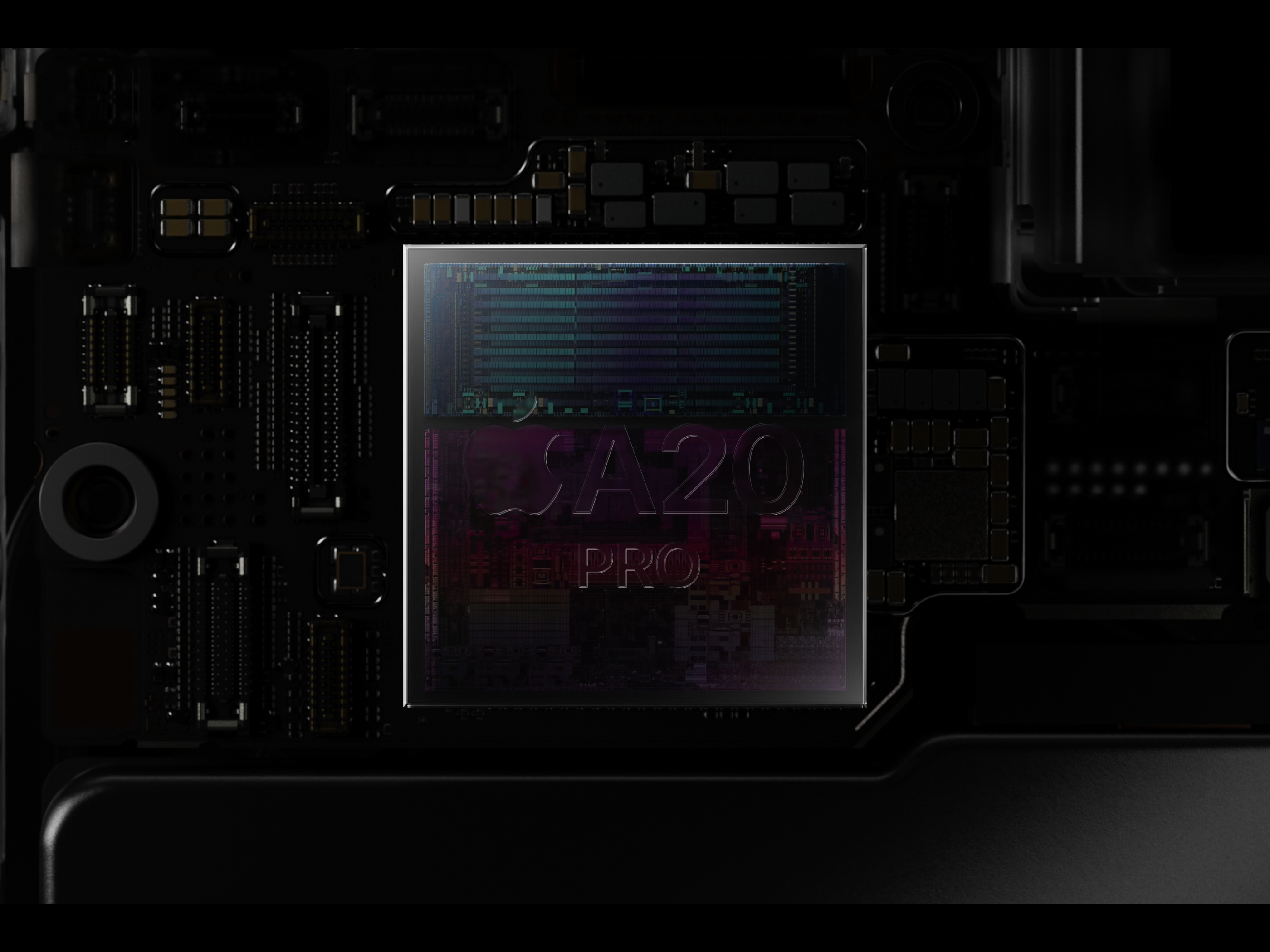
Apple A20 Pro Debuts With 7-Core GPU, 32-Core Neural Engine, and Major Performance Gains
Apple has officially introduced the A20 Pro, its latest flagship mobile chip built for the iPhone 18 Pro and iPhone 18 Pro Max. The new processor brings some of the biggest year-over-year upgrades Apple has made in recent generations, including a more powerful CPU, a stronger GPU, a significantly larger Neural Engine, and a major boost in memory bandwidth.
The Apple A20 Pro is manufactured on a 2 nm process, though Apple has not named the exact foundry node used. Industry rumors have widely pointed to TSMC’s N2 process. This puts Apple’s new iPhone chip at the front of the mobile processor race, even as upcoming rivals such as the Snapdragon 8 Elite Extreme Gen 6 and MediaTek Dimensity 9600 Pro are expected to use newer variants of 2 nm technology.
At the heart of the A20 Pro is a six-core CPU layout, continuing Apple’s familiar design approach. However, this time, Apple is introducing two new “Super” cores alongside four efficiency cores. The company describes these high-performance cores as desktop-class, suggesting a strong focus on demanding workloads such as gaming, video editing, multitasking, and AI-powered apps.
Graphics performance is also getting a major upgrade. The A20 Pro features a 7-core GPU, up from the 6-core GPU used in the previous-generation A19 Pro. Apple claims the new graphics system can deliver up to 40% faster GPU performance, which should make a noticeable difference in high-end mobile games, creative apps, augmented reality experiences, and advanced visual effects.
Another major improvement comes from memory bandwidth. Apple says the A20 Pro offers 50% more memory bandwidth than the A19 Pro. While Apple has not officially shared the memory bus configuration, earlier reports suggested the chip may use a 96-bit LPDDR5X memory interface, compared with a 64-bit interface on the previous generation. More bandwidth can help the chip move data faster, improving performance in graphics-heavy tasks, AI processing, and professional workflows.
The Neural Engine receives one of the biggest upgrades of all. Apple has doubled the dedicated Neural Engine from 16 cores on the A19 Pro to 32 cores on the A20 Pro. This should give the iPhone 18 Pro models a major boost in machine learning and AI-based features, including image processing, voice recognition, generative AI tools, real-time translation, computational photography, and on-device intelligence.
Apple is also combining the upgraded Neural Engine with Neural Accelerators inside the GPU. This means AI workloads can be handled across multiple parts of the chip rather than relying on one processing block alone. As mobile AI becomes more important, this could help the iPhone 18 Pro and iPhone 18 Pro Max deliver faster and more efficient on-device AI performance.
Sustained performance is another area where Apple is making bold claims. According to the company, the iPhone 18 Pro with the A20 Pro can deliver up to 40% better sustained performance than the iPhone 17 Pro with the A19 Pro. Apple also says it can offer twice the sustained performance of the iPhone 16 Pro with the A18 Pro. These figures sound impressive, but real-world testing will be needed to confirm how the chip performs under extended workloads such as long gaming sessions, 4K video editing, and heavy multitasking.
Battery life is also being highlighted with the new iPhone 18 Pro lineup. Apple advertises up to 36 hours of video playback for the iPhone 18 Pro and up to 45 hours for the iPhone 18 Pro Max. While the A20 Pro’s improved efficiency likely plays a role, battery capacity, display technology, software optimization, and other hardware changes also contribute to these numbers.
Overall, the Apple A20 Pro appears to be a major leap forward for the iPhone 18 Pro series. With a 2 nm manufacturing process, new Super CPU cores, a 7-core GPU, 50% more memory bandwidth, and a 32-core Neural Engine, Apple is clearly positioning the chip for the next wave of mobile performance and AI-driven features.
For users interested in gaming, photography, video creation, artificial intelligence, and long battery life, the iPhone 18 Pro and iPhone 18 Pro Max could represent one of Apple’s most meaningful performance upgrades in years.