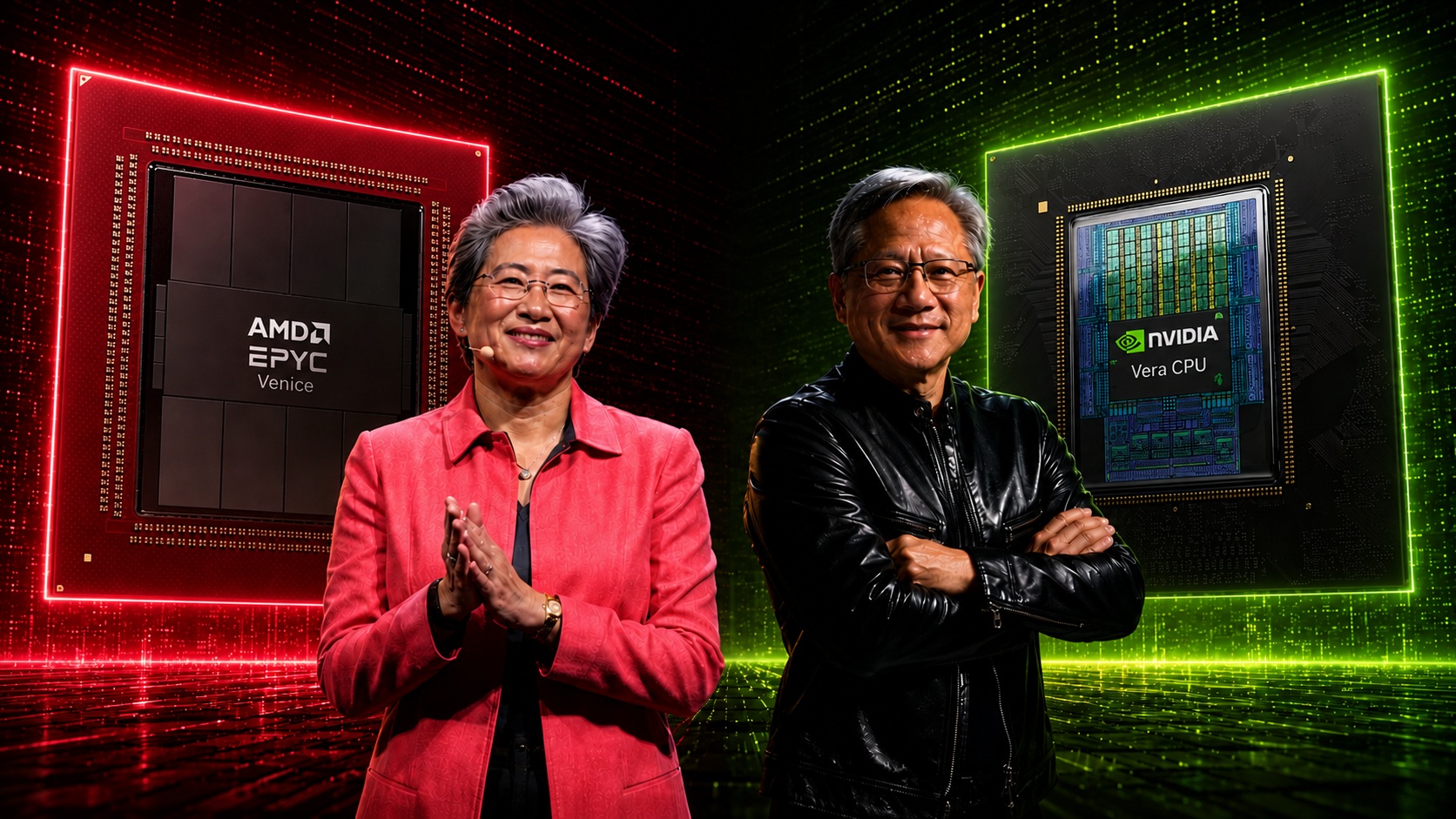
NVIDIA is expected to remain TSMC’s biggest advanced packaging customer in 2027, but AMD’s next-generation EPYC Venice CPUs could become a major threat in the data center race.
The battle for AI computing power is no longer only about GPUs. As agentic AI workloads grow more demanding, CPUs are becoming a much larger part of the infrastructure needed to train, run, and coordinate advanced AI systems. That shift is increasing demand for TSMC’s advanced packaging technologies, especially CoWoS, which is now a critical part of high-performance AI and data center hardware.
According to estimates from Morgan Stanley, TSMC could reach a CoWoS wafer capacity of around 200,000 wafers per month by 2027. That expansion is expected to support the next wave of AI accelerators, server CPUs, and high-performance computing products from major chipmakers.
NVIDIA is forecast to keep its position as TSMC’s top CoWoS customer in 2027. The company relies heavily on TSMC’s CoWoS-L packaging for AI GPUs such as Blackwell and Rubin, while CoWoS-R is expected to support its Vera CPUs. Demand for NVIDIA’s AI hardware remains extremely strong, and its CoWoS-L consumption could climb to roughly 910,000 units in 2027, representing an increase of about 40% year over year.
NVIDIA’s Vera CPU shipments are also expected to grow sharply. Morgan Stanley estimates that Vera could reach around 5.75 million units in 2027, a significant figure for a relatively new CPU platform. NVIDIA is positioning Vera for the agentic AI era, where systems need fast CPU-GPU communication, high memory bandwidth, and efficient data center-scale performance.
This growth could help NVIDIA’s data center revenue rise by an estimated 52% year over year in 2027. With Blackwell, Rubin, and Vera all tied to the company’s AI roadmap, NVIDIA appears set to remain one of the most important customers for TSMC’s most advanced packaging capacity.
However, AMD is not standing still. Its upcoming EPYC Venice processors, based on the Zen 6 architecture, are expected to be a major force in the server CPU market. Morgan Stanley projects that AMD EPYC Venice shipments could reach 6.75 million units in 2027, which would be around 17% higher than NVIDIA’s projected Vera CPU volume.
That would be a dramatic jump for AMD, especially compared with the estimated 1.25 million Venice units expected in 2026. If those projections hold, AMD could see more than five times the shipment volume for Venice within a single year.
EPYC Venice is expected to use TSMC’s advanced 2nm process technology, while NVIDIA’s Vera platform is tied to a slightly older process class in current expectations. This could give AMD an efficiency and performance-per-watt advantage, especially in large-scale data centers where power consumption and operating costs are crucial.
AMD’s strategy also differs from NVIDIA’s in an important way. Vera is being designed primarily around AI infrastructure, especially for agentic AI systems. EPYC Venice, on the other hand, is expected to target both AI and high-performance computing workloads. That broader positioning could help AMD appeal to cloud providers, enterprise customers, supercomputing centers, and companies building hybrid AI-HPC environments.
The rising demand for CoWoS packaging shows how much the AI hardware market is changing. Advanced packaging is now just as important as the chip itself. GPUs, CPUs, accelerators, and memory must be connected with extremely high bandwidth and low latency, and traditional packaging is no longer enough for the most powerful AI systems.
For TSMC, this creates a massive opportunity. As NVIDIA, AMD, and other chipmakers fight for capacity, TSMC’s CoWoS technology is becoming one of the most valuable resources in the semiconductor industry. The company’s ability to scale advanced packaging production could shape the competitive landscape of AI hardware through 2027 and beyond.
Still, NVIDIA and AMD may face an even bigger challenge than each other: custom silicon.
Major AI companies and cloud providers are increasingly designing their own chips to reduce dependence on external suppliers. Companies such as OpenAI, Google, Amazon, and others are either developing or expanding custom AI processor programs. These in-house chips could change how data centers allocate spending between general-purpose GPUs, server CPUs, and specialized accelerators.
Custom silicon will not eliminate demand for NVIDIA and AMD products overnight. The need for AI compute remains enormous, and many companies will continue buying high-performance GPUs and CPUs from established chipmakers. But as more AI firms build their own processors, competition for TSMC capacity could become even more intense.
By 2027, the AI hardware market could look very different from today. NVIDIA may still dominate TSMC’s advanced packaging orders thanks to its AI GPU strength and the rise of Vera CPUs. At the same time, AMD EPYC Venice could outperform Vera in shipment volume and strengthen AMD’s position in next-generation data centers.
The real winner may be TSMC, as every major player in AI, cloud computing, and high-performance computing competes for access to its most advanced manufacturing and packaging technologies.


