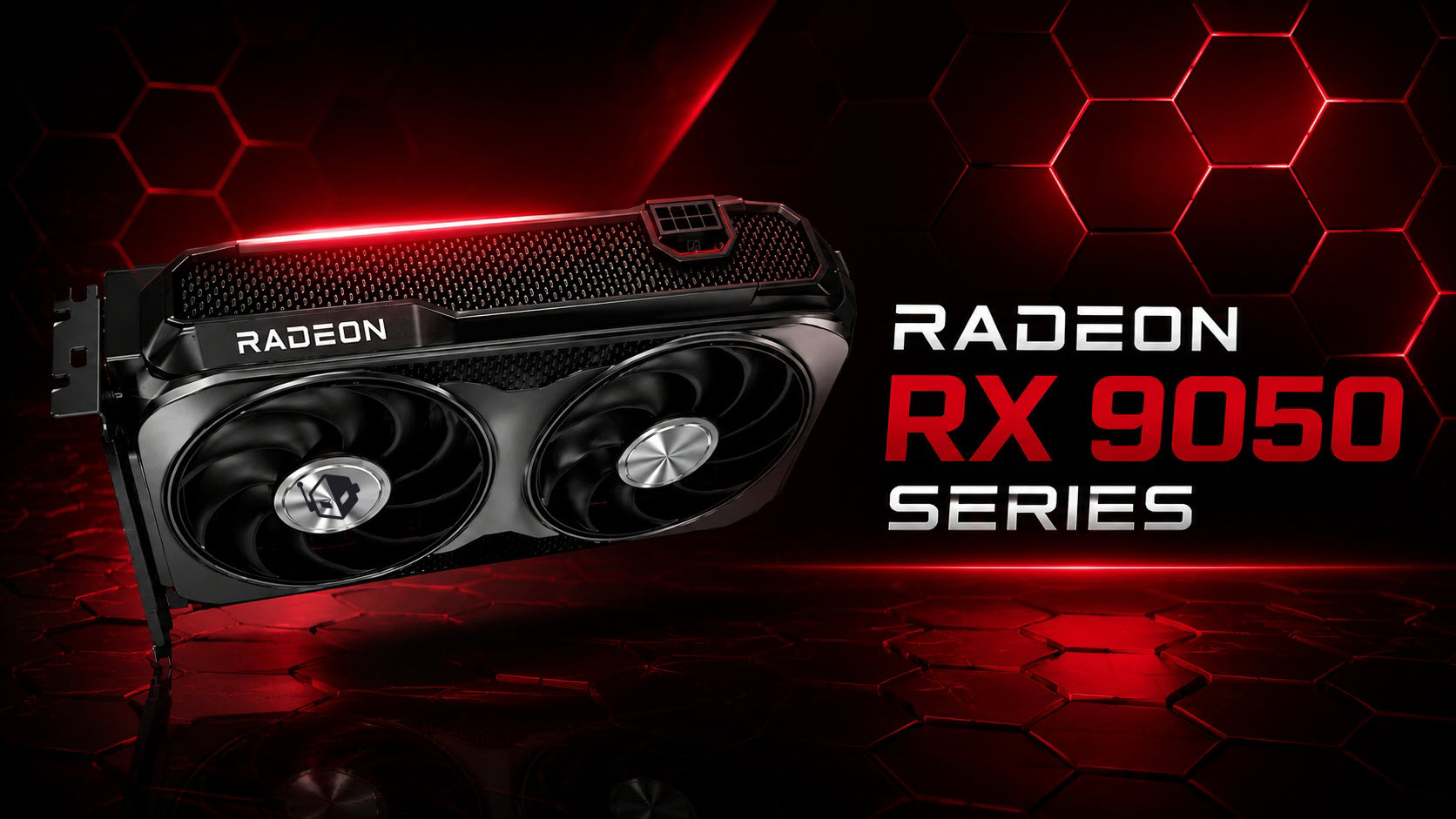
AMD Radeon RX 9050 could bring RDNA 4 to budget gaming PCs with 8GB and 4GB models
AMD appears to be preparing a new entry-level graphics card series under its latest RDNA 4 family. The upcoming Radeon RX 9050 lineup is expected to target budget PC builders and casual gamers, with two memory options: an 8GB version and a lower-cost 4GB model.
If the early specifications are accurate, the Radeon RX 9050 will sit below the Radeon RX 9060 series and become the most affordable RDNA 4 graphics card range in AMD’s current-generation lineup. That could make it an important release for users looking for a modern GPU for esports titles, compact systems, media PCs, and affordable 1080p gaming builds.
The Radeon RX 9000 series is already split across several models, including the Radeon RX 9070 and Radeon RX 9060 families. The RX 9070 range includes higher-end 16GB and 12GB variants, while the RX 9060 series covers the mid-range with multiple memory and power configurations. The addition of the Radeon RX 9050 would expand the lineup further, though it may also make AMD’s naming structure harder for buyers to follow.
The Radeon RX 9050 is expected to use AMD’s RDNA 4 graphics architecture and a cut-down Navi 44 GPU. Reports point to 16 compute units, 1024 stream processors, 64 texture units, and 16 ray accelerators. That would give it roughly half the core count of the full Navi 44 configuration used in stronger RX 9060-class cards.
This clearly positions the RX 9050 as a budget GPU rather than a performance-focused gaming card. It should be best suited for lighter 1080p gaming, esports titles, older AAA games, and general desktop use. Buyers expecting strong performance in modern demanding games with high-resolution textures may need to look at 8GB or higher-end options.
The biggest difference between the two Radeon RX 9050 models will likely be memory. The 8GB version is expected to feature GDDR6 memory on a 128-bit bus, while the 4GB version may use a narrower 64-bit bus. That difference could have a major impact on gaming performance.
The 8GB model should offer a more balanced experience for modern 1080p gaming, especially in titles that require more video memory. The 4GB model, however, may face limitations in newer games due to its smaller VRAM capacity and reduced bandwidth. With many modern PC games already pushing beyond 4GB of VRAM at 1080p, the lower-memory version could suffer from texture pop-in, stuttering, or inconsistent frame rates when settings are pushed too high.
Memory speeds are expected to land around 18Gbps to 20Gbps depending on the final configuration. If the cards use 18Gbps GDDR6, the 4GB 64-bit model would deliver around 144GB/s of bandwidth, while the 8GB 128-bit version would offer around 288GB/s. That wider memory bus could make the 8GB Radeon RX 9050 significantly more appealing for gamers.
Because of this large memory gap, the two versions may feel like very different products despite sharing the same Radeon RX 9050 name. The 8GB model could serve as a reasonable entry-level gaming GPU, while the 4GB model may be more suitable for basic PCs, esports-focused builds, and users upgrading from very old graphics cards or integrated graphics.
Power consumption is another area to watch. The Radeon RX 9060 reportedly sits around the 130W to 140W range, so the Radeon RX 9050 could fall near or below 100W. If AMD can tune the 4GB model down to around 75W, it could become especially interesting for small-form-factor systems and prebuilt PCs because it may not require an external PCIe power connector.
That would make the Radeon RX 9050 4GB more attractive as a simple drop-in upgrade for older desktops. Many budget office PCs and compact systems have limited power supplies, so a low-power RDNA 4 card could fill a useful niche if priced correctly.
Early board designs are said to include dual-fan, dual-slot models measuring up to around 249mm in length. That suggests some versions may still be fairly standard-sized rather than ultra-compact, though smaller designs could arrive later from AMD’s board partners.
Pricing will be one of the most important factors for the Radeon RX 9050. As an entry-level graphics card, it should ideally land in the $100 to $150 range, especially for the 4GB model. However, current graphics card market conditions and memory supply pressure may push pricing higher than expected.
Early expectations suggest the Radeon RX 9050 series could appear somewhere around $200 to $300 depending on the model and market conditions. If that happens, AMD may face criticism because budget GPUs need aggressive pricing to make sense. At higher prices, buyers may compare the RX 9050 against faster previous-generation cards or discounted mid-range models.
Expected Radeon RX 9050 specifications include RDNA 4 architecture, Navi 44 GPU silicon, TSMC 4nm manufacturing, 16 compute units, 1024 stream processors, 32 AI accelerators, 16 ray accelerators, boost clocks possibly around 2600MHz, and PCIe 5.0 x8 support. The 8GB version is expected to use a 128-bit memory interface, while the 4GB version is expected to use a 64-bit interface.
Compared with the Radeon RX 9060, the RX 9050 will likely offer much lower compute performance, less memory bandwidth, and reduced gaming capability. However, it could still be a practical option for users who do not need ultra settings or high refresh rates in demanding titles.
The key question is whether AMD can make the Radeon RX 9050 affordable enough. A low-cost 8GB RDNA 4 graphics card could be attractive for budget 1080p gaming PCs. A 4GB version could work for very low-cost systems, but only if the price reflects its limitations.
For now, the Radeon RX 9050 looks like AMD’s next step toward expanding RDNA 4 into the entry-level GPU market. If the final pricing is competitive, it could become a useful option for budget gamers and PC builders. If prices climb too close to stronger cards, however, the RX 9050 may struggle to stand out despite its modern architecture.