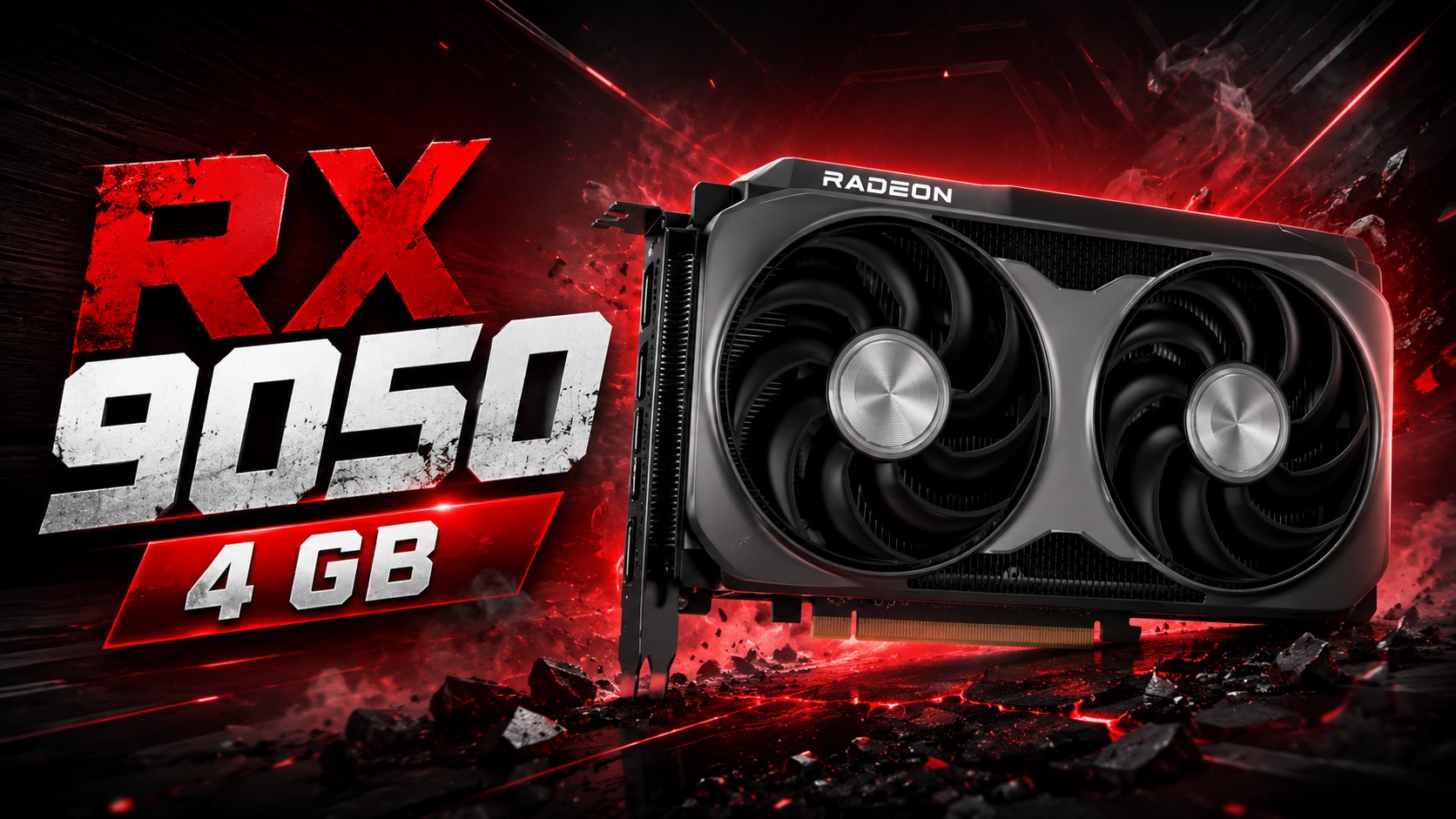
AMD Radeon RX 9050 4GB specifications confirm major memory cuts for the entry-level RDNA 4 GPU
AMD has published the official product page for the Radeon RX 9050 4GB, confirming the full specifications of its most entry-level RDNA 4 discrete graphics card. The listing gives a clearer look at how this model differs from the Radeon RX 9050 8GB, despite both cards sharing the same GPU name.
The Radeon RX 9050 sits at the bottom of AMD’s RX 9000 lineup and is designed for basic desktop graphics, light gaming, and OEM systems rather than high-performance PC gaming. AMD has introduced the card in two versions: one with 8GB of memory and another with 4GB. While the two models appear similar at first glance, the 4GB edition comes with a heavily reduced memory setup that will likely have a noticeable impact on performance.
According to AMD’s official specifications, the Radeon RX 9050 4GB features 16 Compute Units and 1,024 Stream Processors, matching the 8GB version in core configuration. However, the biggest difference is found in the memory subsystem.
The 4GB version uses GDDR6 memory on a 64-bit memory bus. By comparison, the 8GB model uses a wider 128-bit bus. This change cuts the available memory bandwidth in half, dropping it from 288 GB/s on the 8GB card to 144 GB/s on the 4GB model.
That is a significant reduction, especially for modern games and applications that depend heavily on memory bandwidth. A narrower bus can limit how quickly the GPU can access data, which may result in lower frame rates, weaker texture performance, and bigger performance drops at higher resolutions.
AMD has also reduced the Infinity Cache on the Radeon RX 9050 4GB. The 8GB version includes 32MB of Infinity Cache, while the 4GB card comes with just 16MB. Infinity Cache is designed to help improve memory efficiency and reduce reliance on external memory bandwidth. With both the memory bus and cache size cut in half, the 4GB model is expected to perform noticeably below the 8GB version in memory-sensitive workloads.
The 4GB memory capacity is another important limitation. Many modern PC games now require more than 4GB of VRAM for smooth performance, especially when using higher-quality textures or playing at 1080p and above. While the Radeon RX 9050 4GB may still be suitable for esports titles, older games, media playback, office systems, and compact prebuilt PCs, it is unlikely to be an ideal choice for demanding modern games.
AMD’s decision appears to position the Radeon RX 9050 4GB as a cost-focused GPU for OEM manufacturers. The card is expected to remain exclusive to prebuilt systems, while the Radeon RX 9050 8GB may become available as a standalone graphics card in select regions.
In short, the Radeon RX 9050 4GB brings RDNA 4 architecture to AMD’s lowest-end discrete GPU segment, but its reduced 64-bit memory bus, 144 GB/s bandwidth, 4GB VRAM capacity, and smaller 16MB Infinity Cache make it a much more limited option than the 8GB model. For users looking at an RX 9050-based system, the 8GB version should offer a far better experience, especially for gaming and graphics-heavy tasks.