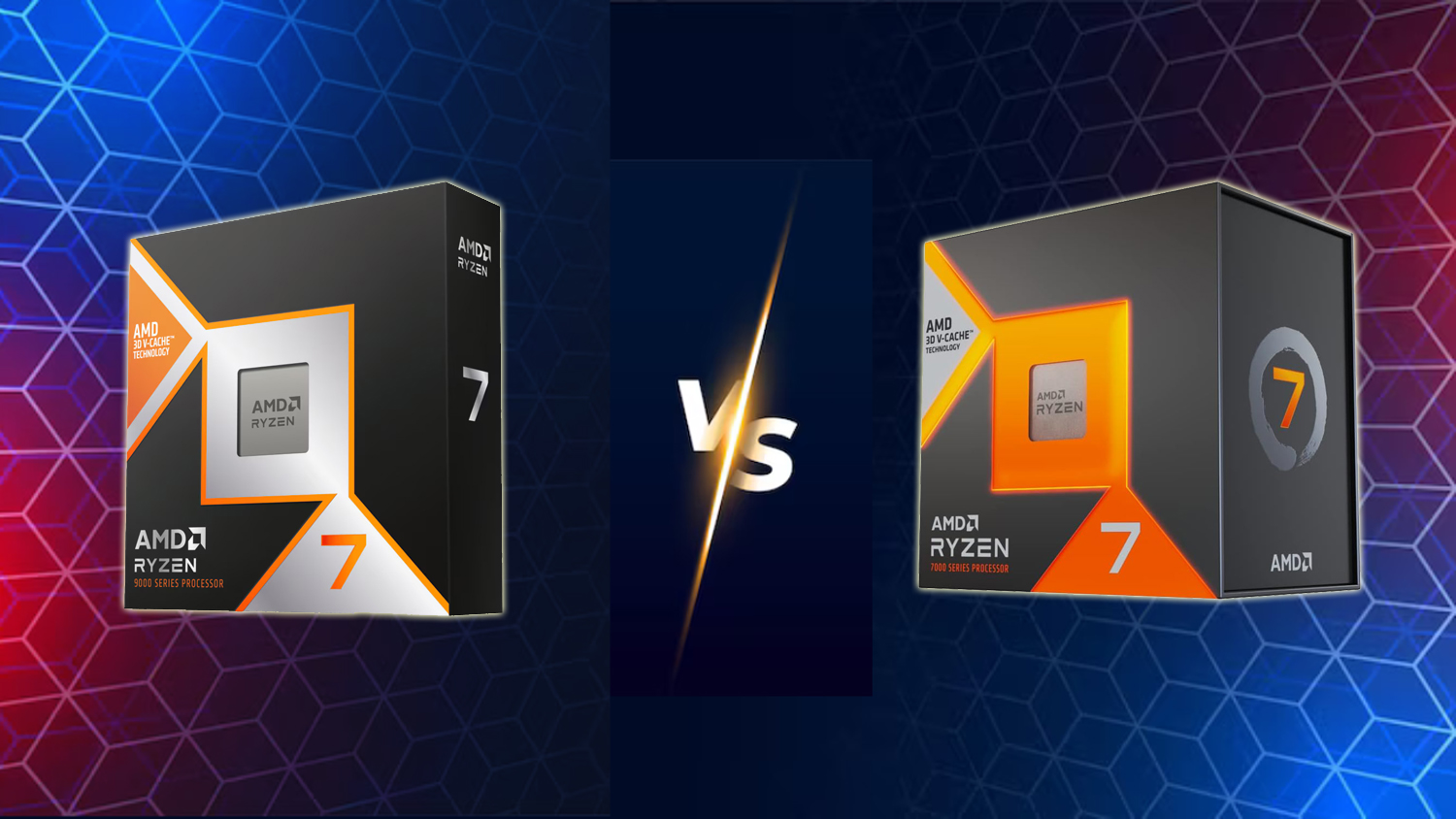
Chasing the absolute highest frame rates is second nature for many PC gamers, and that’s exactly why the Ryzen 7 9800X3D has become a best-seller. It arrived about a year and a half after the wildly popular Ryzen 7 7800X3D and quickly took the “best gaming CPU” crown in many charts. But here’s the twist: even in 2025, the 7800X3D remains a phenomenal choice—and for a lot of builds, it may still be the smarter buy.
If you’re deciding between these two 8-core, 16-thread gaming powerhouses, the right pick comes down to more than raw benchmark wins. Architecture, thermals, power efficiency, display resolution, and price trends all tip the scales in different ways.
Specifications snapshot
– Ryzen 7 7800X3D: Zen 4, TSMC 5 nm, 8C/16T, 4.2/5.0 GHz, 96 MB L3, DDR5-5200 support, 120 W TDP, RDNA 2 iGPU (2 cores up to 2.2 GHz), 89°C max, launch price $449
– Ryzen 7 9800X3D: Zen 5, TSMC 4 nm, 8C/16T, 4.7/5.2 GHz, 96 MB L3, DDR5-5600 support, 120 W TDP, RDNA 2 iGPU (2 cores up to 2.2 GHz), 95°C max, launch price $479
Platform and memory
– Both CPUs drop into the AM5 platform and are widely supported on 600- and 800-series motherboards with current BIOS updates.
– The 9800X3D’s memory controller is more capable (officially DDR5-5600 vs DDR5-5200), and it supports up to 192 GB versus 128 GB on the 7800X3D. For most gaming rigs, 32–64 GB remains the sweet spot, so capacity isn’t a deciding factor for typical builds.
– Integrated graphics remain unchanged on both: a basic RDNA 2 solution that’s fine for display output and troubleshooting, not for serious gaming.
Zen 5 versus Zen 4: what changes in practice
– Zen 5 delivers a wider front-end, better branch prediction, higher floating-point throughput, more execution resources, and increased cache bandwidth, translating to roughly a 16% IPC uplift over Zen 4.
– The second-generation 3D V-Cache design in the 9800X3D places the cache beneath the CCD rather than on top of it. This lets CPU cores contact the heat spreader directly, improving heat transfer and enabling higher sustained clocks without the strict downclocking older X3D chips needed.
– The 9800X3D is fully unlocked for overclocking and generally maintains close to 5.2 GHz on all cores with capable cooling. Its maximum operating temperature also aligns with non-X3D Zen 5 parts at 95°C, compared to 89°C on the 7800X3D.
Real-world gaming performance
– With a GeForce RTX 4090 at 1080p across eight tested titles, the Ryzen 7 9800X3D averaged about an 11% lead over the 7800X3D. At triple-digit frame rates, that gap can be difficult to feel in actual gameplay. For example, 358 FPS versus 329 FPS will look identical to most eyes.
– At 1440p, the difference typically shrinks to roughly 4–5%, and at 4K it’s often around 2% or less as the GPU becomes the limiting factor.
– Expect a similar story with next-gen flagship GPUs: absolute numbers rise, but the perceptual gap between these CPUs remains small at high frame rates. If your goal is 4K max settings, investing more of your budget in the GPU usually pays off more than chasing the last few percent from the CPU.
Power efficiency and thermals
– Both chips carry a 120 W TDP. Independent testing broadly suggests the 7800X3D is the more efficient gaming CPU in frames per watt, often edging out the 9800X3D in energy efficiency.
– The 9800X3D tends to run hotter under load. On premium liquid cooling, it can approach 80°C at stock and climb a bit higher with PBO enabled, while the 7800X3D typically stays cooler in the same scenarios. If you opt for the 9800X3D, plan for strong cooling and good case airflow to keep noise and temperatures in check.
Cost per frame and current value
– At launch pricing—$449 for the 7800X3D and $479 for the 9800X3D—both offered a similar cost per frame at 1080p.
– Street prices have shifted. The 7800X3D is frequently found near the mid-$300s, while the 9800X3D often sits around the mid-$400s. That discount makes the 7800X3D an outstanding value play, especially if you prioritize efficiency and quieter operation.
Who should buy which
– Pick the Ryzen 7 9800X3D if you want the absolute fastest gaming CPU in its class, play competitive titles at very high refresh rates, or plan to overclock and extract every last frame.
– Pick the Ryzen 7 7800X3D if you want the best gaming performance per dollar, prefer cooler and quieter builds, or primarily game at 1440p or 4K where the performance gap is minimal.
Bottom line
The Ryzen 7 9800X3D is the new performance leader among 8-core gaming chips, but the Ryzen 7 7800X3D remains the champion of value. If you’re chasing every possible frame and can justify the premium, go 9800X3D. If you want top-tier gaming performance with better efficiency and a friendlier price tag, the 7800X3D is still the smarter buy for most builds.