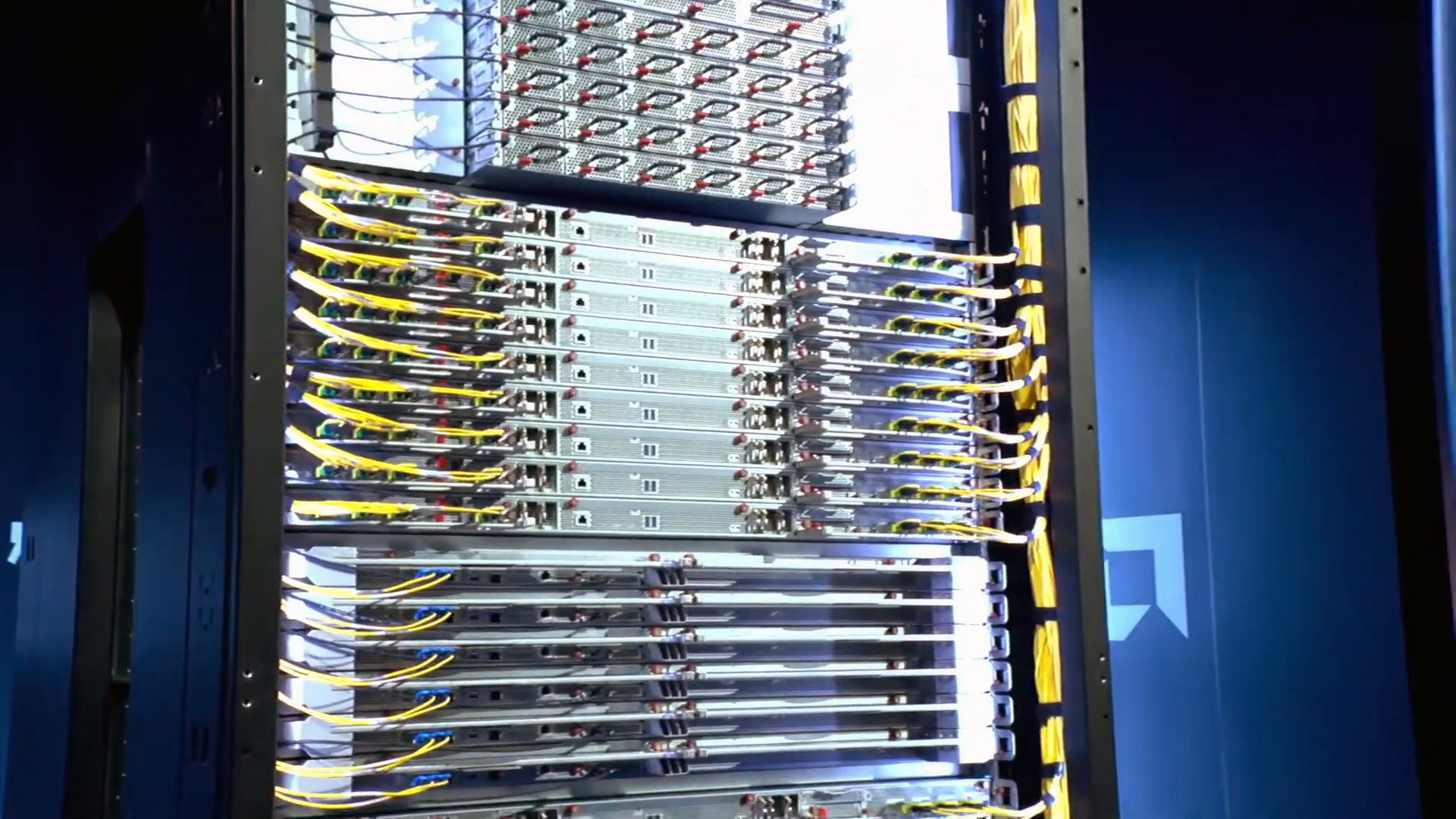
AMD’s next-generation Instinct MI400 series has become the center of a fresh industry debate after a report suggested the timeline for its biggest deployment may be slipping. The spotlight is on the Instinct MI455X, a key part of AMD’s push to win more hyperscaler AI and data center customers—and to finally narrow a gap that many believe widened further with NVIDIA’s Blackwell generation.
A recent report claimed that while AMD is preparing engineering samples for the MI455X in the second half of 2026, large-scale customer rollout could arrive much later than expected—potentially drifting into 2027. That suggestion drew attention because the MI455X is positioned as one of AMD’s most important opportunities to convert customers currently locked into NVIDIA’s ecosystem. AMD has been making bold statements around the MI400 family’s architectural upgrades, with the implication that the product and platform improvements should make switching harder to argue against.
AMD, however, is pushing back. Anush Elangovan, AMD’s Corporate VP of Software Development, publicly denied the idea that deployments are being delayed to the degree described in the report, signaling that the company remains confident in its schedule.
So why are delay rumors circulating at all? The report points to challenges around “N2 integration.” In practical terms, moving to a more advanced manufacturing node can introduce new risks and complexities—especially when transitioning from established FinFET processes to newer gate-all-around (GAA) approaches. Early on, tiny manufacturing defects and lower initial yields can slow the ramp to meaningful volume. On top of that, scaling the platform-level interconnect for large systems can become more difficult at cutting-edge nodes, where factors like line resistance and capacitance can turn into real obstacles for signal integrity and power efficiency.
The competitive timing matters because NVIDIA’s next platform, Vera Rubin, is expected to be ready for hyperscaler integration in the second half of 2026. If AMD’s MI455X were to slip to around Q2 2027, NVIDIA could once again be first with a next-generation infrastructure platform, strengthening its position with customers that prioritize predictable roadmaps and early access.
This pressure arrives as AMD continues working to expand its data center and AI footprint. The company has faced familiar hurdles: ramping enough volume, matching expectation levels around its software ecosystem, and competing against NVIDIA’s head start in customer commitments. On paper, the Instinct MI455X looks like a serious contender. The big question now is whether AMD can smoothly move from sampling to real-world deployments on schedule—because in hyperscaler AI, timing can be just as important as performance.