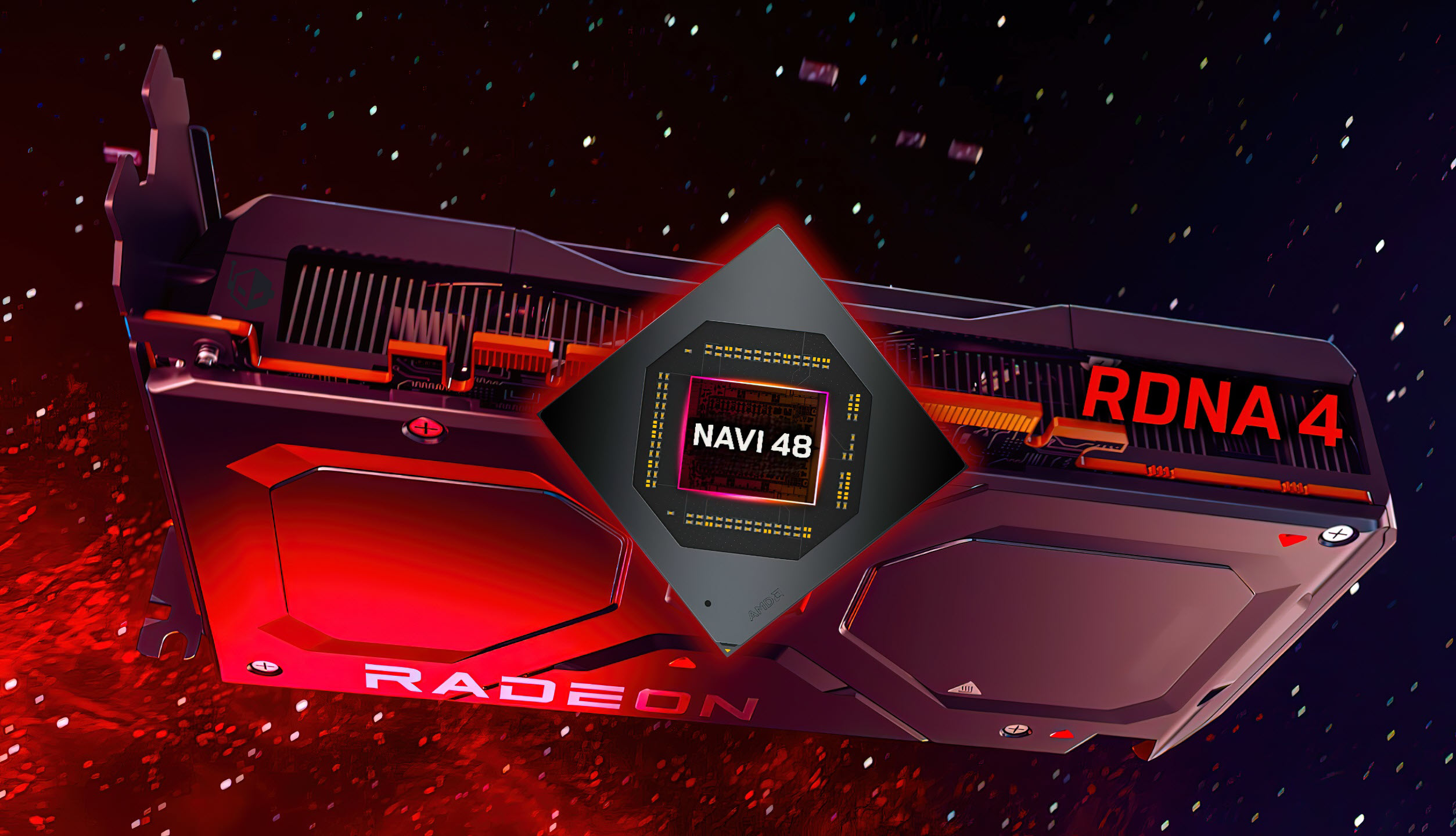
AMD’s upcoming flagship offering in the Radeon RX 8000 series, codenamed “RDNA 4,” has recently been spotted, suggesting the company is progressing towards its future graphics card lineup. Reports indicate that the card will feature the high-end Navi 48 XTX GPU, potentially heralding a new era in AMD’s graphics technology.
The Navi 48 XTX GPU was listed as a “REVB-PRE” which signifies it’s a reference evaluation board using the A0 silicon. Rumored production dates suggest a very recent development of these boards, hinting at an impending release. Speculation is rife about whether Samsung’s involvement pertains to a process node technology or the provision of Samsung GDDR6 memory, with the former possibility carrying greater weight.
The top-tier Navi 48 XTX GPU is distinct within the RDNA 4 family, which is also rumored to include the Navi 44 GPUs. These GPUs are categorized under the families “GFX1201” for Navi 48 and “GFX1200” for Navi 44, respectively.
Insights from shipping documents reveal four distinct PCB IDs related to the RDNA 4 GPU family, with a specific mention of the PCB, ID “102-G28201,” which is associated with the Navi 48 XTX GPU. These newer graphics cards are expected to boast a refined architecture with a revolutionary ray-tracing engine, diverging noticeably from the specifications of RDNA 3 GPUs. This ray-tracing enhancement is poised to bolster performance, enabling AMD products to better compete with NVIDIA and Intel counterparts, and will likely be integrated into next-generation gaming consoles from Sony and Microsoft.
Predictions about its performance suggest that the AMD Navi 48 XTX “RDNA 4” GPUs will have a performance parallel to the existing Navi 31 SKUs, but with improved power efficiency. Furthermore, the affordability of these new GPUs may shake the market, with Navi 31 “Radeon RX 7900” series performance expected to be available at or below $500 US.
Regarding memory technology, AMD is contemplating the use of GDDR7 to deliver a responsive and lifelike gaming experience, potentially making it the standard memory for the RDNA 4 GPU family. Speculation suggests an 18 Gbps GDDR7 memory specification for the RX 8000 models. While AMD has not been very vocal about the Radeon RX “Gaming” specifications in their keynote addresses, announcements are anticipated as the release date draws closer.
Below is an outline of AMD’s Radeon GPU lineup evolution, showcasing the transition from the RDNA 1 architecture to the eagerly awaited RDNA 4:
– Radeon RX 5000 series, based on RDNA 1 architecture, utilized a 7nm process node and introduced the Navi 1X GPU family.
– Radeon RX 6000 series, featuring RDNA 2 architecture, continued with the 7nm process node, heralding the Navi 2X GPU family, with Navi 21 being the flagship offering.
– Radeon RX 7000 series combined RDNA 3/2 architectures over 5nm/6nm process nodes and debuted the Navi 3X GPU family, with the Navi 31 model as its flagship.
– Radeon RX 8000 series, the speculated successor, is expected to introduce RDNA 4 architecture, may be utilizing a 5nm/3nm process node, and is anticipated to roll out the Navi 4X GPU family.
For those following the development of AMD’s graphics technology, these advancements point to not only a step forward for the gaming industry but also improved performance and efficiency for a broad spectrum of graphical applications. As the launch date approaches, further details and specifications are expected to emerge, offering a clearer vision of the capabilities of these highly anticipated graphics cards.