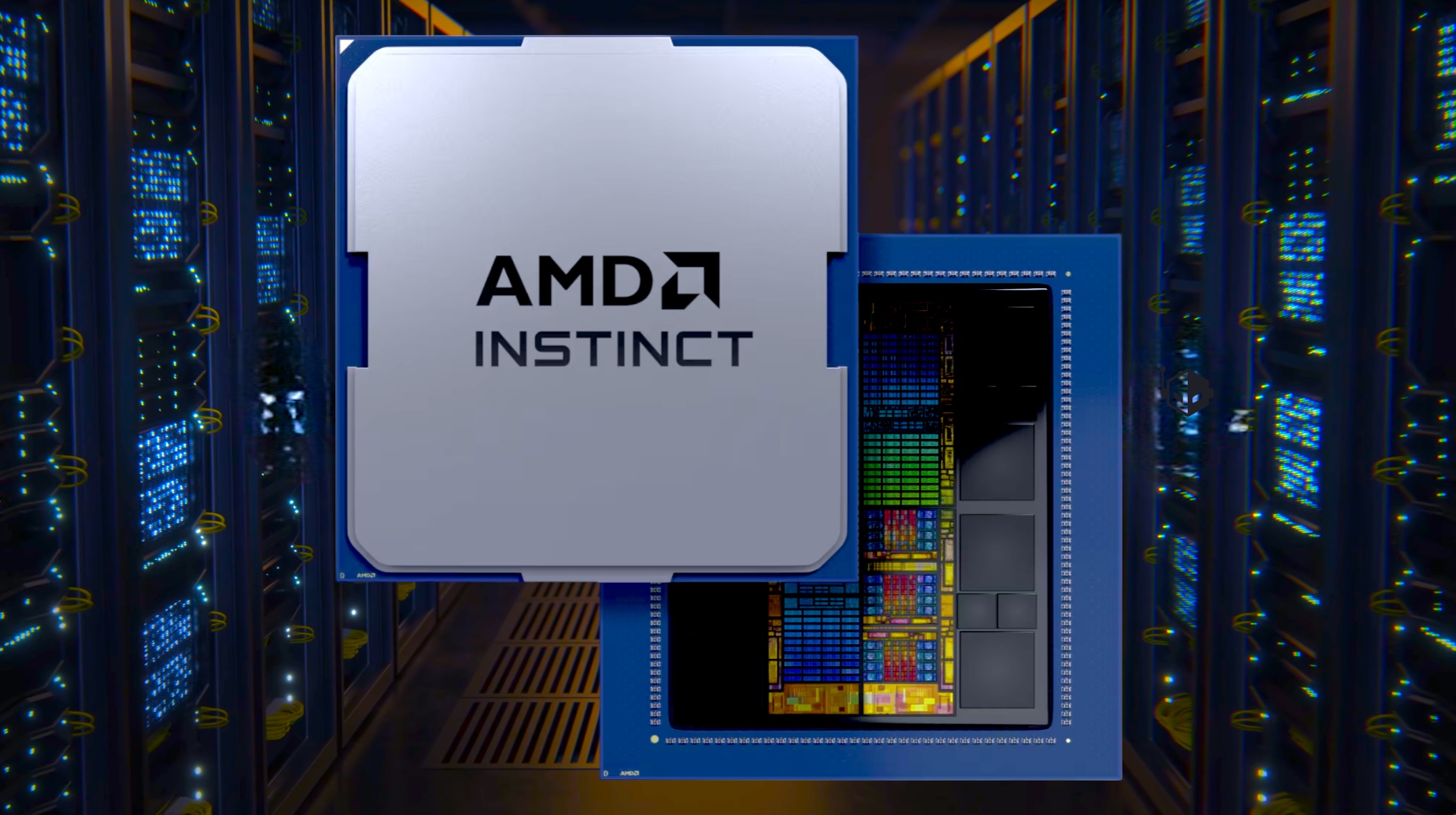
AMD has lifted the curtain on the Instinct MI430X, one of the first accelerators in its MI400 family, and it’s clearly engineered for the next wave of high-performance computing and large-scale AI. Designed for HPC system buildouts, the MI430X leans into massive memory capacity, extreme bandwidth, and robust FP64 performance to power everything from scientific simulations to generative AI training.
At the heart of the MI430X is AMD’s next-generation CDNA architecture, widely expected to be CDNA 5. The accelerator pairs that design with 432 GB of cutting-edge HBM4 and a staggering 19.6 TB/s of memory bandwidth. For workloads starved by memory throughput, that combination is a major leap forward. AMD positions the MI430X as a true successor to the Instinct MI300A, which made headlines powering the El Capitan supercomputer; on paper, the MI430X pushes compute and memory performance to new territory for data centers.
The MI430X targets demanding, hardware-based FP64 tasks—exactly the kind of double-precision math that underpins climate modeling, energy research, materials science, and large-scale AI. AMD is aligning the accelerator with next-gen EPYC “Venice” CPUs to create balanced, power-efficient platforms that scale from training to inference.
Early deployments highlight how the accelerator will be used:
– Discovery at Oak Ridge National Laboratory: As one of the United States’ first AI Factory supercomputers, Discovery combines Instinct MI430X GPUs with next-gen EPYC “Venice” CPUs on the HPE Cray GX5000 platform. The system is designed to train, fine-tune, and deploy large AI models while accelerating scientific computing across energy, materials, and generative AI research.
– Alice Recoque in Europe: This exascale-class system integrates Instinct MI430X GPUs and next-gen EPYC “Venice” CPUs using Eviden’s BullSequana XH3500 platform. Its architecture emphasizes double-precision HPC performance, AI scalability, huge memory bandwidth, and strong energy efficiency to drive scientific breakthroughs within tight power envelopes.
Beyond the MI430X, AMD’s roadmap points to sustained momentum in AI compute. The upcoming Instinct MI455X is positioned to challenge rival accelerators, including NVIDIA’s Rubin generation, as the competition intensifies around training performance, inference efficiency, and total cost of ownership. AMD’s focus on performance-per-watt and high-bandwidth memory is aimed squarely at organizations building AI factories and supercomputers where every watt and every byte per second counts.
Why this matters: modern AI and HPC applications are increasingly bottlenecked by memory capacity and bandwidth, not just raw FLOPS. With 432 GB of HBM4 per accelerator and nearly 20 TB/s of bandwidth, the MI430X is purpose-built to keep massive models and datasets on-GPU, reduce communication overhead, and boost utilization across complex pipelines. When paired with next-gen EPYC CPUs and advanced platforms from HPE and Eviden, it forms the backbone of scalable, energy-conscious compute infrastructure.
In short, the AMD Instinct MI430X brings next-gen CDNA architecture, HBM4, and strong FP64 capabilities to supercomputers and AI factories, making it a compelling option for researchers and enterprises that need to train and deploy large models at scale. With the MI455X on the horizon, the data center GPU race is set to get even more competitive.