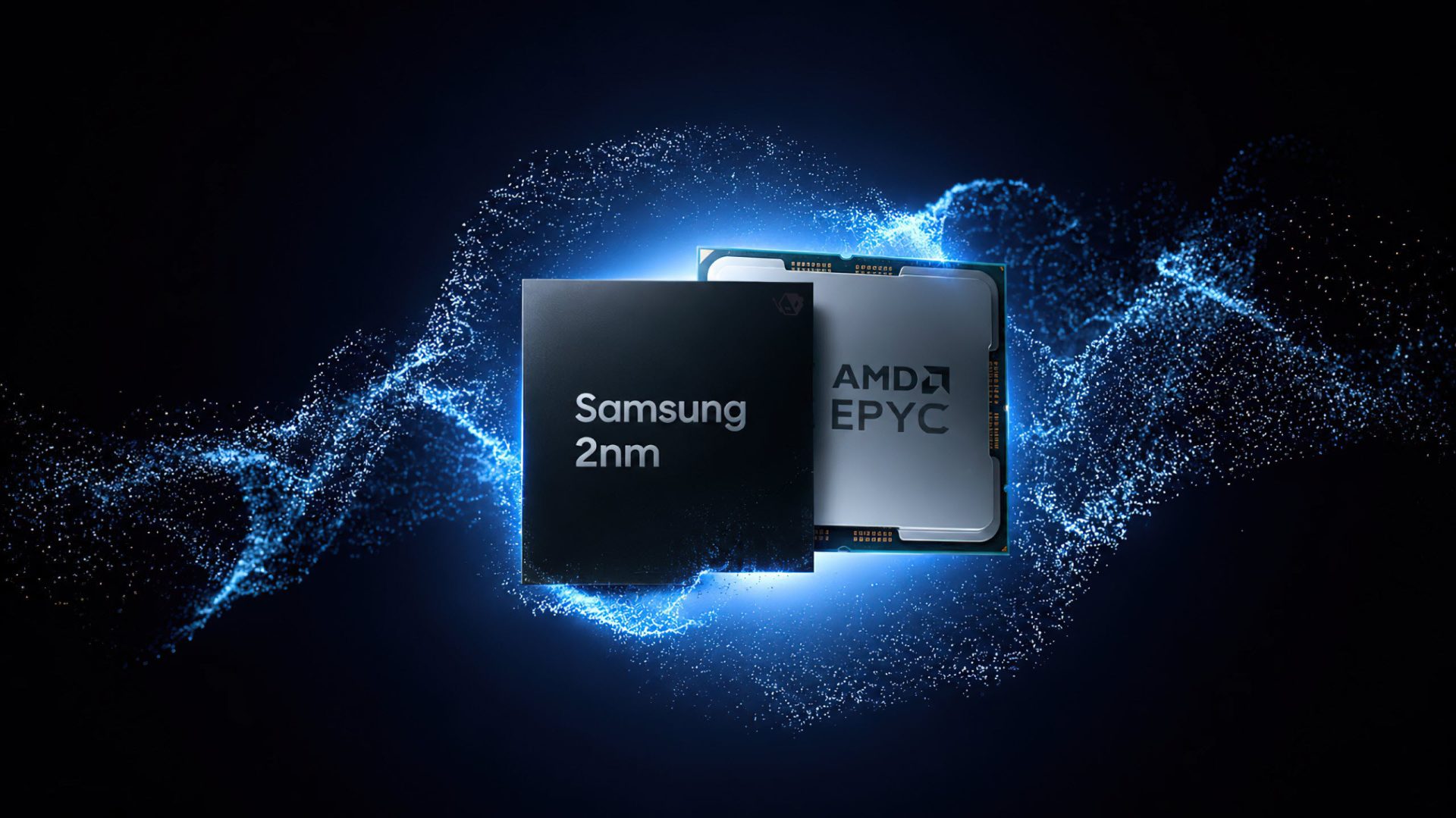
AMD is reportedly in advanced discussions with Samsung to tap the company’s 2nm chipmaking technology for upcoming AI-focused CPUs and accelerators, a move that highlights just how intense the race for leading-edge manufacturing capacity has become.
With demand for AI datacenter hardware accelerating, AMD has acknowledged that strong order volume is colliding with real-world supply constraints—and those constraints aren’t expected to disappear anytime soon. Up to now, AMD has leaned heavily on TSMC for both cutting-edge process nodes and advanced packaging, a partnership that has powered much of AMD’s momentum in CPUs and GPUs for modern compute workloads. But as competition for the most advanced wafers tightens, AMD appears to be pushing for a second source to protect long-term production plans.
According to a report from Korea, Samsung’s foundry business has recently stepped up talks with AMD around 2nm manufacturing. The discussions are said to have gained traction after AMD CEO Dr. Lisa Su visited Korea in March and toured Samsung Electronics’ Pyeongtaek foundry site—an important signal that AMD is actively evaluating Samsung’s ability to manufacture its next wave of high-end silicon.
The timing is especially notable because TSMC’s leading-edge 2nm capacity is widely viewed as heavily constrained, with industry chatter pointing to wafer allocation being effectively booked out years in advance. For companies building AI datacenter roadmaps, that kind of limited availability can translate into delayed launches, reduced volume, or less flexibility to respond to market demand. Diversifying foundry partners is one of the few levers available to reduce that risk.
If an agreement comes together, AMD is expected to use Samsung’s 2nm process for next-generation CPUs tied to its Zen 6 era, including parts referenced as Venice and Verano. Venice is described as a compute-optimized Zen 6 offering, while Verano is positioned as a tailored variant aimed at agentic AI workloads such as inference. In parallel, TSMC has already been confirmed as the manufacturer for AMD’s Venice CCD using its N2 nanosheet process technology, suggesting AMD may be exploring a multi-foundry approach rather than a single, exclusive supplier.
Samsung has also been associated with future AI chip production for other major customers alongside TSMC, which adds to the narrative that Samsung is working to expand its presence at the most advanced nodes. Still, the broader industry view has been that Samsung is often treated as a backup option rather than a primary alternative to TSMC, largely due to concerns that its cutting-edge yields may not yet match its rival’s. A major deal with a high-profile customer like AMD could help shift perception and boost confidence among additional potential clients.
This isn’t happening in isolation. The foundry landscape is in the middle of a high-stakes reshuffle as companies scramble for every available slice of advanced capacity to meet AI-driven demand. Alongside Samsung and TSMC, Intel is also pushing to become a viable option with its latest manufacturing and packaging technologies. The bottom line is clear: AI is not only reshaping products and services, it’s reshaping the supply chain—and chipmakers like AMD are making strategic moves now to ensure they can actually build what the market is asking for over the next several years.