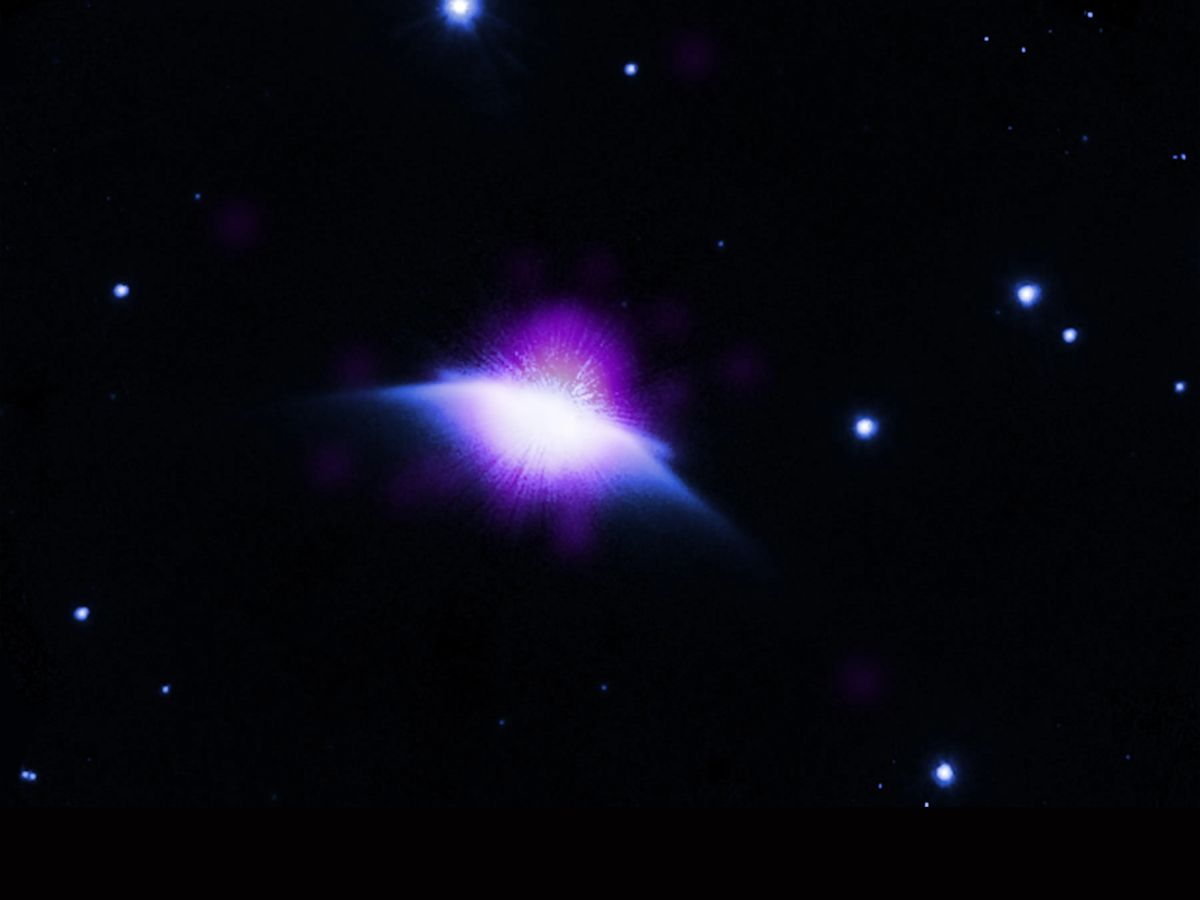
NASA’s Chandra X-ray Observatory has captured a remarkable look at a nearby star that offers clues to what our own Sun may have been like in its early years. The star, known as HD 61005, sits about 120 light-years from Earth and closely matches the Sun in both mass and temperature. The big difference is age: HD 61005 is only around 100 million years old, while the Sun is roughly 5 billion years old. That makes this star a rare and valuable stand-in for a “young Sun.”
HD 61005 is often nicknamed “the moth” because of the striking, wing-like shape of the dust surrounding it. But the latest Chandra observation adds an even more exciting detail: a clearly visible astrosphere stretching out to about 200 times the distance between Earth and the Sun. An astrosphere is a vast bubble around a star, created when its stellar wind pushes outward into surrounding space, shaping and sweeping up nearby gas and dust.
What makes this astrosphere easier to spot is just how intense the star’s stellar wind is compared to the Sun’s today. Scientists found that the stream of particles coming off HD 61005 moves about three times faster and is roughly 25 times denser than the solar wind we experience now. A stronger, heavier wind creates a bigger impact when it collides with the colder material around the star, making the boundary of the astrosphere stand out.
Chandra detected this activity through X-rays produced when hot gas from the stellar wind slams into cooler dust and gas in the surrounding environment. That X-ray glow helps reveal the structure of the astrosphere in a way that’s extremely difficult to do for our own Sun from an external viewpoint.
Our Sun has its own version of this protective bubble, called the heliosphere. It extends far beyond Pluto and plays a major role in shielding the solar system from a significant amount of cosmic radiation. Even so, astronomers can’t easily image the heliosphere from the outside, which is why observing a similar system elsewhere is such a breakthrough.
By studying HD 61005 and its powerful astrosphere, researchers get a more direct look at how stellar winds evolve over time. In other words, this image doesn’t just show a distant star—it provides a realistic glimpse into what the Sun’s environment may have looked like billions of years ago, when the young solar system was taking shape.