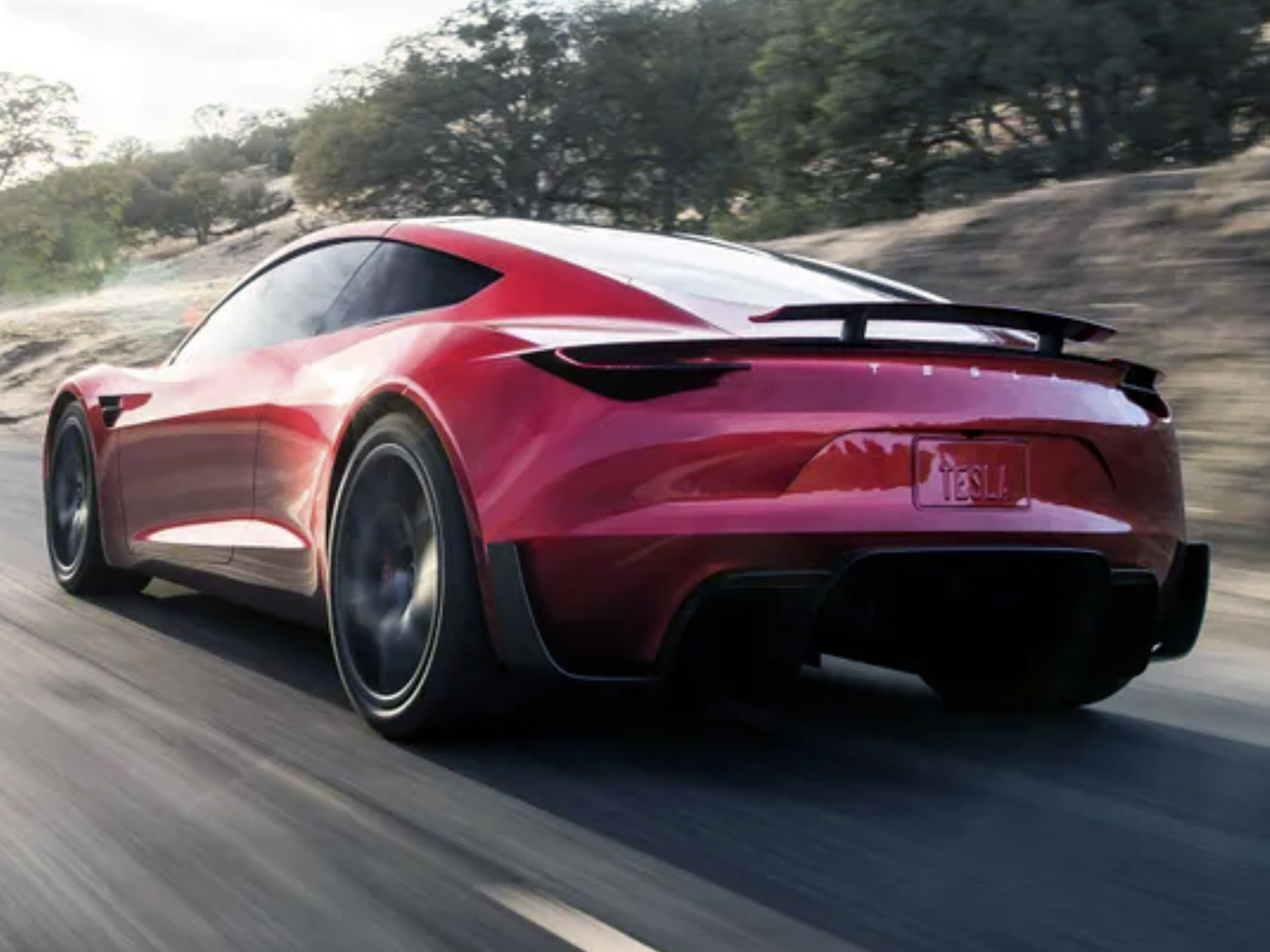
Tesla Roadster 2 May Get a Wild SpaceX Thruster Demo in 2026
Tesla’s long-awaited Roadster 2 has been delayed so many times that it has almost become a legend in the electric vehicle world. But one of the biggest reasons behind the wait may also be the feature that makes the next-generation Roadster so unusual: a SpaceX-inspired thruster system.
Former Tesla president Jon McNeill has said the idea of adding a rocket-style thruster package to the Roadster dates back to a 2016 brainstorming session. At the time, Tesla was reportedly focused on building a production car capable of sprinting from 0 to 60 mph in roughly 1.6 to 1.8 seconds, a figure that would have put it far ahead of nearly everything else on the road.
Elon Musk has since suggested that the optional thruster system could push acceleration to an almost unbelievable 1.1 seconds from 0 to 60 mph. The setup is said to use compressed gas rather than combustion, making it more like a high-pressure propulsion system than a traditional rocket engine.
The reported concept involves directing compressed gas downward, allowing the car to briefly rise off the ground. That means the Roadster would not “fly” in the normal sense, but it could potentially hover or lift for a short moment during a controlled demonstration.
Because such a system would likely be extremely loud and potentially dangerous at close range, any public demo may be handled remotely, without a driver inside the vehicle. Spectators would likely need to watch from a safe distance, possibly hundreds of yards away.
McNeill did not confirm that Tesla will actually make the Roadster fly during the next reveal, but he did suggest that hovering is within the realm of possibility. Tesla is currently targeting August 2026 for the next major Roadster showcase, though expectations remain cautious after years of delays.
The second-generation Tesla Roadster was first shown in 2017, and since then, its launch timeline has shifted repeatedly. Musk has continued to hype the project, recently describing the technology as “crazy, crazy,” which has only increased curiosity around what Tesla plans to reveal.
If the Roadster 2 does manage to lift off the ground, even for a few seconds, it could become one of the most talked-about automotive demonstrations in modern history. It would also give Tesla a powerful way to reframe the Roadster not just as another electric supercar, but as something closer to a futuristic performance machine.
However, Tesla is no longer alone in pushing the limits of electric vehicle performance. Chinese EV makers are quickly moving into the same territory, with several companies experimenting with extreme acceleration, advanced suspension systems, and unconventional vehicle stunts.
BYD has already shown a vehicle capable of briefly jumping over road obstacles such as potholes and spikes, while Dreame has teased a hypercar concept that appears to follow a similar thruster-assisted performance idea. That prototype is claimed to accelerate from 0 to 60 mph in just 0.99 seconds and could become a direct rival if it arrives as planned in 2027.
For now, the Tesla Roadster 2 remains one of the most anticipated electric cars in the world. Whether it finally arrives in 2026 or faces yet another delay, the promise of SpaceX-style thrusters, record-breaking acceleration, and possible hovering has made it far more than a typical supercar launch.


