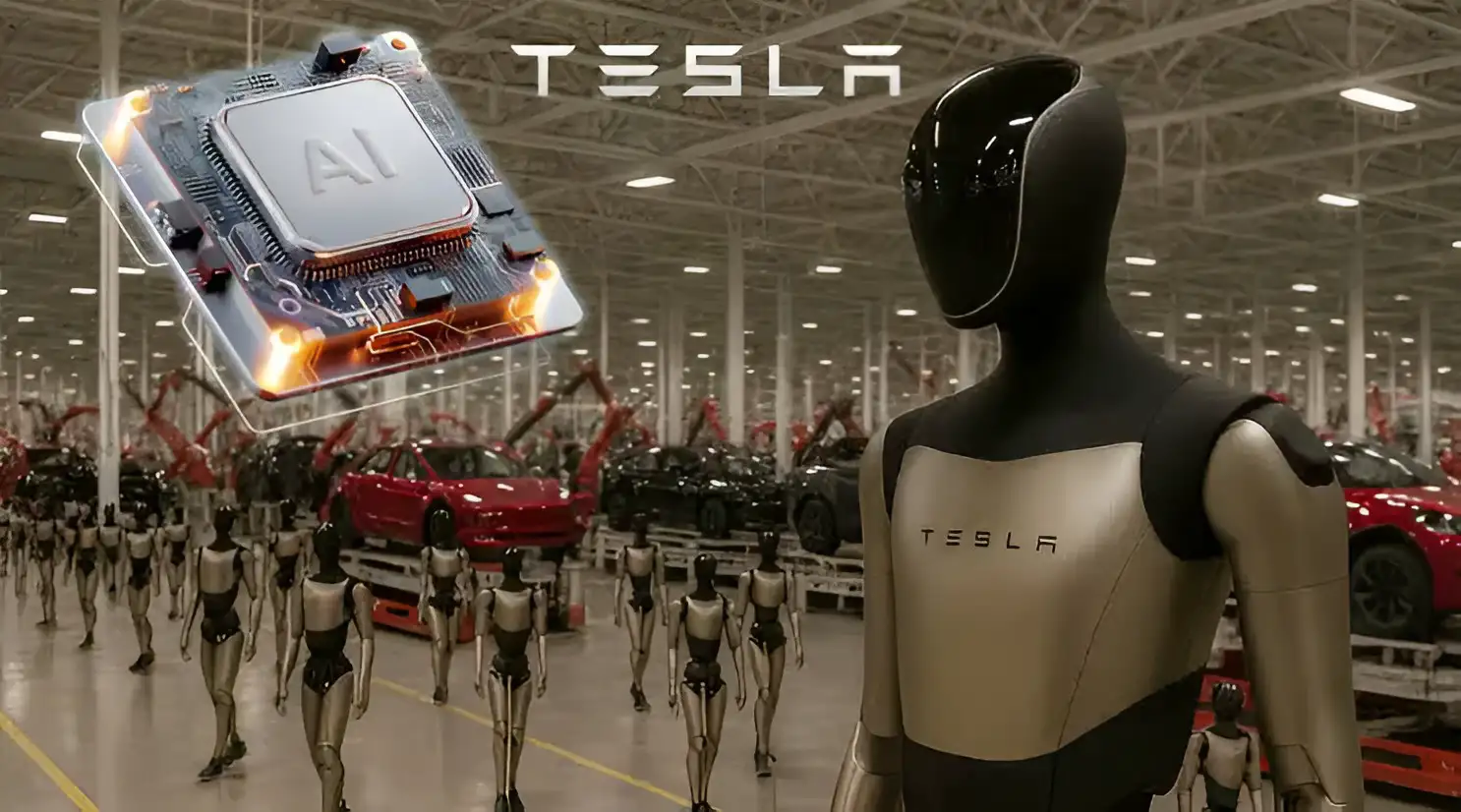
Elon Musk Plans “Optimus Academy” as Tesla Pushes Toward Mass Robot Production and Its Own AI Chip Future
Tesla CEO Elon Musk has shared a clearer look at the company’s ambitious roadmap for humanoid robots, AI training, and chip manufacturing. During Tesla’s third-quarter earnings call, Musk said the company is preparing to build what he described as an “Optimus academy,” a dedicated training environment where Tesla’s humanoid robots can learn and practice a wide range of real-world tasks.
The plan is part of Tesla’s larger effort to turn Optimus into a mass-produced product powered by advanced artificial intelligence and custom chips. Musk also gave fresh updates on Tesla’s Terafab project, a major chip manufacturing initiative expected to support the company’s future AI systems, including the AI5 chips that could power Optimus.
Tesla’s Terafab project moves toward test chips and 2028 production
Musk said Tesla is making progress on its Austin-based research fab for the Terafab project. According to him, the company expects to begin commissioning machinery in the first half of next year. If the process goes smoothly, Tesla could attempt to produce its first test chip around May or June.
The initial goal is modest: prove that the facility can manufacture a working chip. But the long-term ambition is far larger. Musk said Tesla hopes to produce a useful chip at volume around the third quarter of 2028.
Terafab has drawn attention because of its scale and strategic importance. Musk has previously discussed a future in which Tesla produces up to 100,000 wafers per month at first, with the possibility of scaling to one million wafers per month over time. Earlier plans suggested that the first phase would focus on smaller production runs of a few thousand wafers per month to test ideas and refine the process.
Musk remains highly optimistic about the project’s potential. He suggested that if Terafab succeeds, it could generate enormous economic value, placing it among the most significant industrial projects in the world.
Intel is expected to play a major role in the project through its 14A process technology, a next-generation manufacturing node. Intel has previously indicated that 14A volume production is planned for the first quarter of 2028. Musk did not provide detailed comments on how 14A will fit into Tesla’s 2028 production targets, but Terafab appears central to Tesla’s broader strategy for AI hardware independence.
Optimus robot production depends on “ten thousand things” going right
Musk also used the earnings call to explain how challenging it will be to bring Tesla Optimus robots into large-scale production. He said the process depends on “ten thousand things” going right, and that overall progress will move only as fast as the slowest part of the system.
That includes everything from robot design and manufacturing equipment to actuators, sensors, joint modules, supply chains, AI training data, and factory ramp-up. Musk said Tesla is confident it can eventually reach production of one million Optimus robots per year, but he cautioned that achieving that annualized rate could take at least a year, and possibly longer, after the production line is in place.
Tesla is reportedly already preparing for that scale. Musk said much of the equipment for a million-unit-per-year production line has landed in Fremont. Reaching that level would mean producing around 20,000 humanoid robots per week.
The timeline has evolved over time. Musk previously suggested Tesla could build between 5,000 and 10,000 Optimus robots in 2025 before scaling production significantly. He has also discussed the possibility of building one million robots in 2026, though his latest comments suggest that the ramp may take longer than originally hoped.
Supply chain development will be critical for Optimus
To make Optimus a mainstream product, Tesla will need a massive global supply chain. Musk emphasized that scaling humanoid robot production is not just about final assembly. It requires a reliable supply of specialized parts, including motors, actuators, sensors, gear systems, and precision components.
Reports from Asia have suggested that Tesla is already exploring suppliers for Optimus components. Companies in Taiwan have reportedly been linked to potential production roles involving harmonic drives, joint modules, actuators, automation systems, and optical components.
Musk said Tesla must also make sure the robot’s design is safe and reliable before mass production begins. He indicated that major design issues could be solved by the end of 2027, setting the stage for a broader manufacturing push.
Musk has repeatedly described Optimus as a product with extraordinary potential. During the call, he again expressed confidence that the humanoid robot could become one of the largest products in the world.
Tesla wants to build an “Optimus academy” for AI training
One of the most important challenges facing Tesla is training Optimus to perform useful tasks in real environments. Musk said Tesla still has work to do on the AI architecture needed to make the robot capable, adaptable, and efficient.
A major obstacle is training data. For a humanoid robot to become useful across homes, factories, warehouses, and other environments, it needs massive amounts of data showing how to complete tasks safely and effectively.
Musk said Tesla will need to build a large number of early Optimus robots, which he referred to as “Optimi,” to generate this data. He estimated that Tesla may need around 10,000 to 20,000 bots participating in training and self-play scenarios.
That is where the “Optimus academy” comes in. The concept appears to be a dedicated training facility where Tesla robots can practice many different tasks, collect data, improve through repetition, and feed that information back into Tesla’s AI systems.
Musk described this as a flywheel: the more robots Tesla builds, the more training data it can collect; the more data it collects, the better Optimus becomes; and the better Optimus becomes, the easier it is to expand production and usefulness.
This approach mirrors Tesla’s broader AI strategy, which has relied heavily on real-world data to improve its vehicle autonomy systems. With Optimus, however, the task may be even more complex because humanoid robots must interact physically with the world in countless unpredictable ways.
Musk says scaling GPU infrastructure is harder than it looks
Musk also commented on the broader AI compute market, particularly the challenge of bringing large numbers of GPUs online reliably. His own AI infrastructure projects have moved quickly, with hundreds of thousands of GPUs being deployed and plans to bring even more compute capacity online.
However, Musk warned that scaling AI data centers is extremely difficult. In response to discussion about strong hyperscaler demand and whether that creates a bullish environment for cloud compute startups, Musk said the opportunity exists only if companies can get their compute online and keep it reliable at scale.
That comment comes as some AI infrastructure companies face pressure from investors and markets. A South Korean cloud computing company saw its stock fall sharply after its market debut, while another AI-focused cloud company in Australia recently canceled its public listing plans and chose private funding instead.
The message from Musk is clear: demand for AI compute may be huge, but execution is everything. Buying GPUs is only one part of the problem. Companies must also solve power, cooling, networking, reliability, deployment speed, and cost management.
Tesla’s AI future now depends on robots, chips, and compute
Tesla’s latest updates show how far the company’s ambitions have moved beyond electric vehicles. Musk is positioning Tesla as an AI and robotics company with three major pillars: Optimus humanoid robots, custom AI chips, and large-scale compute infrastructure.
The Optimus academy could become a key part of Tesla’s robot training strategy, helping the company generate the real-world data needed to make humanoid robots practical. Meanwhile, Terafab could give Tesla more control over the chips needed to power its AI systems.
Still, Musk’s own comments show that the path will not be easy. Tesla must solve manufacturing, supply chain, AI training, chip production, and infrastructure challenges all at once. If it succeeds, Optimus could become one of Tesla’s most important products. If it falls behind on any major piece, the ramp to mass production could take longer than expected.
For now, Tesla’s roadmap points toward a future where humanoid robots are trained in specialized academies, powered by custom chips, and produced at a scale normally associated with consumer electronics or automobiles. Musk believes Optimus can become a defining product for Tesla, but reaching that future will require thousands of moving parts to come together at exactly the right time.


