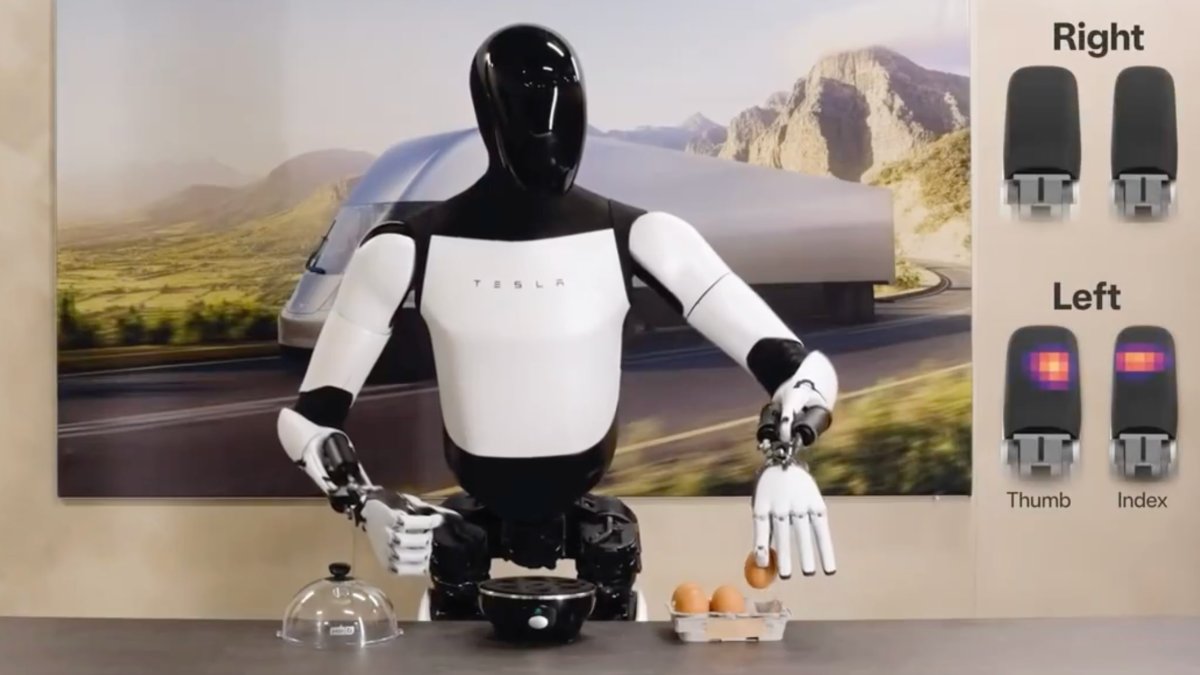
Tesla is reportedly preparing to scale up production of its Optimus humanoid robot, with new supply chain activity pointing to a broader push into robotics alongside the company’s electric vehicle and artificial intelligence ambitions.
According to reports from Taiwan’s manufacturing sector, Tesla has been working with suppliers in the region to secure key robot components, including harmonic reducers, joint modules, actuators, and optical parts. These components are essential for humanoid robots because they help deliver precise movement, balance, vision, and control.
The development comes as Elon Musk continues to position Tesla as more than just an electric vehicle company. Throughout 2025, Musk repeatedly emphasized that Tesla’s future could be heavily shaped by robotics and AI, with Optimus expected to become one of the company’s most important long-term products.
Taiwanese automation company Mirle Automation is said to be among the suppliers involved in Tesla’s humanoid robot supply chain. The company has reportedly started providing harmonic reducers and joint modules, two critical parts used in robotic motion systems. Harmonic reducers allow robots to move with high precision while maintaining strength and compactness, making them especially important for humanoid arms, legs, and joints.
Mirle has also formed a joint venture with Shenzhen Kedali Industry in Thailand. The new operation is expected to be based in Rayong, a major industrial and automation hub. The facility is reportedly focused on producing harmonic reducers, robotic actuators, and other precision components. Since the project involves an existing facility, production could ramp up sooner than a completely new plant would allow.
Asia Optical is also expected to have a role in Tesla’s Optimus robot program. The company is reportedly connected to the robot’s vision system, supplying spherical and aspherical lens technology. These optical components could support the robot’s “eyes,” helping Optimus process its surroundings, identify objects, and navigate real-world environments more effectively.
Musk has previously described the next-generation Optimus robot as a major leap forward. In March, he said Optimus 3 would be “by far the most advanced robot in the world,” adding that he had not seen robot demonstrations that matched what Tesla was developing.
Tesla’s production timeline appears ambitious. Musk has said low-volume production of Optimus could begin in the summer, while high-volume output is expected to start in 2027. Reports from the supply chain suggest that some newer component production schedules are also targeting the second half of this year and 2027, aligning closely with Tesla’s broader robot manufacturing plans.
During Tesla’s 2025 annual shareholder meeting, Musk said the company was building a one-million-unit production line in Fremont, California. He also mentioned plans for a much larger production line at Gigafactory Texas, capable of producing up to ten million units per year.
If Tesla can execute on that scale, Optimus could become one of the largest humanoid robot manufacturing programs in the world. The company’s strategy appears to combine its expertise in AI, battery systems, manufacturing automation, and real-world data from its vehicle business to create robots that could eventually be used in factories, warehouses, homes, and other labor-intensive environments.
While mass production of humanoid robots remains a major engineering challenge, the latest supply chain activity suggests Tesla is moving beyond prototypes and preparing for industrial-scale manufacturing. The coming years will be crucial in determining whether Optimus becomes a practical commercial product or remains an ambitious robotics experiment.


