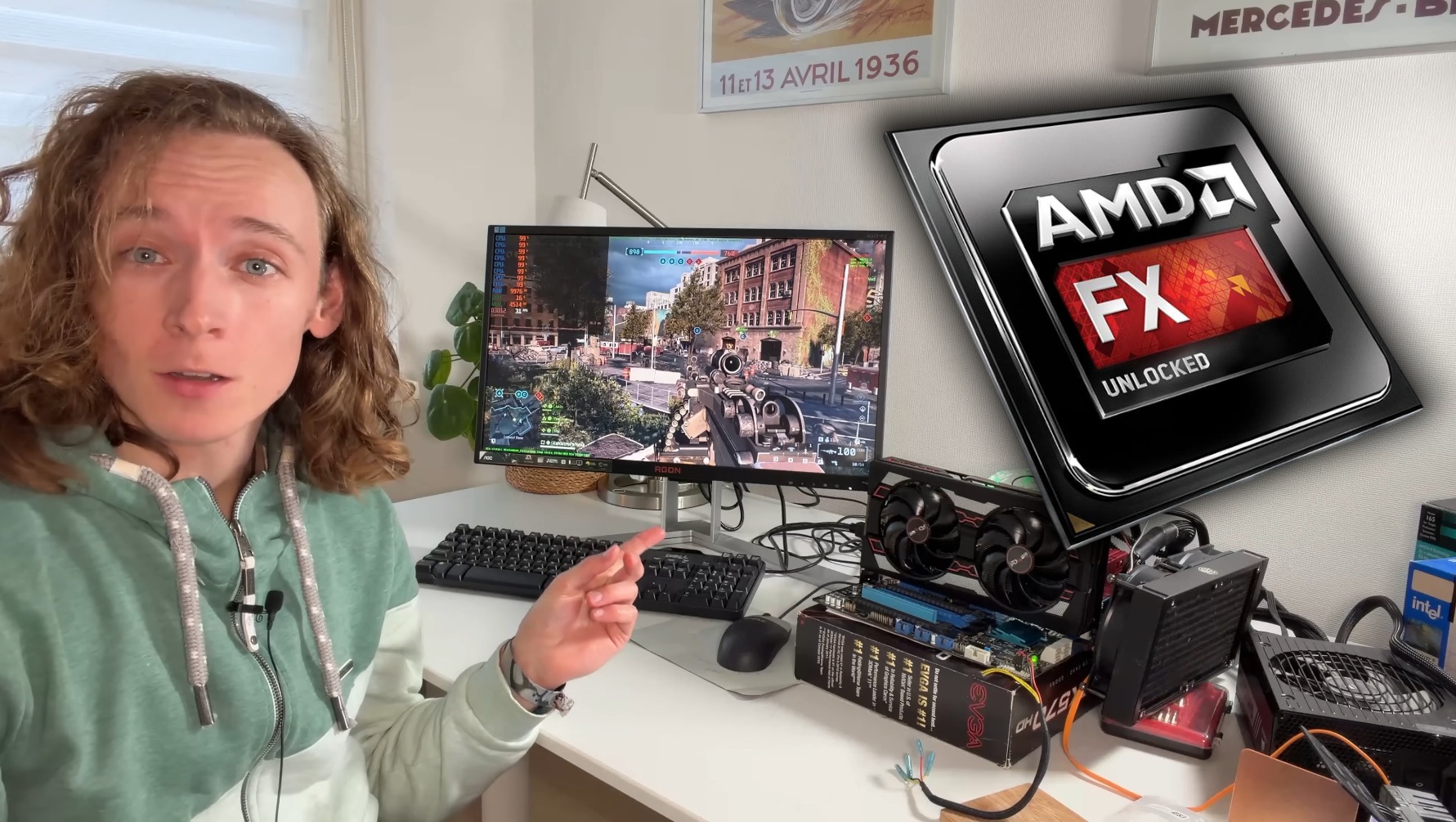
A 12-year-old AMD FX-9590 has pulled off a surprise: it can run Battlefield 6 in a mostly playable state, even though it falls well below the game’s listed minimum CPU requirements.
Launched in 2012, the FX-9590 was a flagship 8-core chip built on AMD’s Piledriver architecture and became the first consumer CPU to hit a 5 GHz boost clock. While modern processors now flirt with 6.0+ GHz, the last decade has shown that raw frequency gains have slowed, with real performance coming from smarter architecture and larger caches. For context, clock speed highlights over time include Pentium 4 at 3.0 GHz in 2002, FX-4170 at 4.2 GHz and FX-9590 at 5.0 GHz in 2012, and recent top-end parts like the Core i9-14900K at 6.0 GHz and 14900KS at 6.2 GHz.
YouTuber Fluffy Buffered demonstrated Battlefield 6 running on an FX-9590 paired with an ASUS 990FX motherboard, an AMD Radeon RX 5700 8 GB, and 16 GB of DDR3-1866, tested at 1080p. In large 64-player Conquest, frame rates landed around 30–35 FPS, while 24-player Rush came in a bit smoother at roughly 35–40 FPS. The experience isn’t flawless—occasional simulation hitches pop up—but it’s playable.
There’s a key reason this old setup can launch the game at all: the 990FX platform supports Secure Boot, which Battlefield 6 requires. Older platforms like Intel’s Sandy Bridge on Z68 lack Secure Boot and TPM, preventing the game from running regardless of raw CPU grunt.
Performance is clearly CPU-limited. The FX-9590 sits at near-total utilization, while the RX 5700 is underused to the point that its fans reportedly stop spinning. GPU frame rates hover in the 120–140 FPS range in isolation, but the processor can’t feed the graphics card fast enough in real gameplay. That mismatch explains the frame caps and intermittent stutters in busy scenes.
The takeaway is equal parts impressive and practical. It’s remarkable that a decade-old, first-to-5 GHz chip can still load up a modern, demanding shooter and offer a serviceable experience with the right platform features. However, for consistent performance and higher frame rates, sticking close to the published minimums—such as an AMD Ryzen 5 2600 or Intel Core i5-8400—remains the smarter path.
If you’re trying something similar on aging hardware, a few tweaks can help:
– Favor 24-player modes over 64-player battles to reduce CPU load.
– Lower CPU-heavy settings first, like mesh quality, terrain detail, and world simulation options.
– Consider modest resolution scaling to keep frame times smooth without overtaxing the processor.
Still, as a proof of what’s possible with careful component pairing and platform support, this FX-9590 run is a fun reminder that not all older hardware is out of the fight just yet.