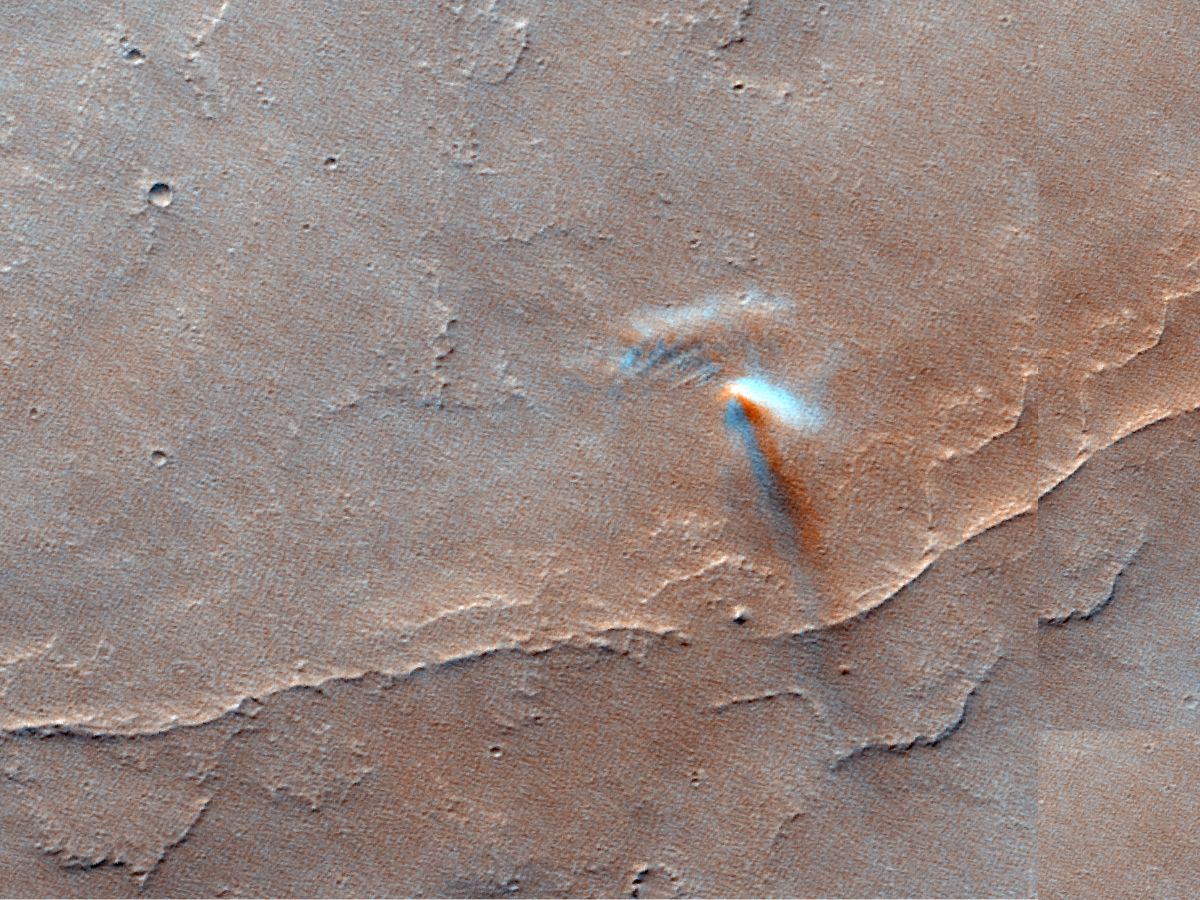
Scientists map Martian winds by tracking 1,039 dust devils
For years, Mars rovers have watched dust devils dance across the Red Planet’s surface. Now, scientists have gone a step further: they’ve measured how these tornado-like vortices move to create a first-of-its-kind map of Martian winds. The work, led by Valentin Bickel of the University of Bern, catalogs 1,039 dust devils and reveals the direction and travel speed for 373 of them—offering new insight into the planet’s day-to-day atmospheric behavior and providing valuable data for planning future missions.
The team combined observations from two European orbiters, Mars Express and the ExoMars Trace Gas Orbiter. By exploiting a quirk in how these spacecraft capture images, the researchers turned an imaging artifact into a powerful measurement tool. When a moving object like a dust devil is photographed, slight timing differences between color channels create “color offsets.” Those offsets reveal how far the dust devil shifted between exposures, allowing the team to calculate its speed and direction of travel across the surface.
What they found was striking. Some dust devils were racing along at up to 158 kilometers per hour (about 98 mph), far faster than winds typically recorded directly by rovers on the ground. That gap highlights the difference between point measurements taken at a rover’s location and broader regional winds that propel dust devils across the landscape. It also underscores how much energy these vortices can carry as they lift and transport fine particles, subtly reshaping the surface and influencing the Martian atmosphere.
The resulting map is more than a scientific curiosity. Understanding where dust devils form, how they move, and how fast they travel can help mission planners in several ways:
– Choosing landing sites that balance scientific interest with environmental safety
– Anticipating dust transport that could affect instruments and visibility
– Planning operations for surface vehicles and potential aerial scouts
– Improving models that predict local weather and regional dust activity
Rovers like Perseverance have captured detailed images and sounds of nearby dust devils, but they haven’t tracked their motion across long distances. By pairing orbital views with surface observations, researchers can now link what a rover experiences on the ground to broader wind patterns overhead. That connection helps refine models of Martian atmospheric circulation, especially in the daytime when the sun’s heating triggers strong convection and vortex formation.
This study turns an imaging imperfection into a window on Martian weather, transforming thousands of snapshots into a dynamic picture of wind in action. As datasets grow and more missions contribute complementary measurements, scientists expect even sharper forecasts of dust activity—knowledge that will be crucial for protecting hardware, planning traverses, and ultimately supporting human explorers on Mars.