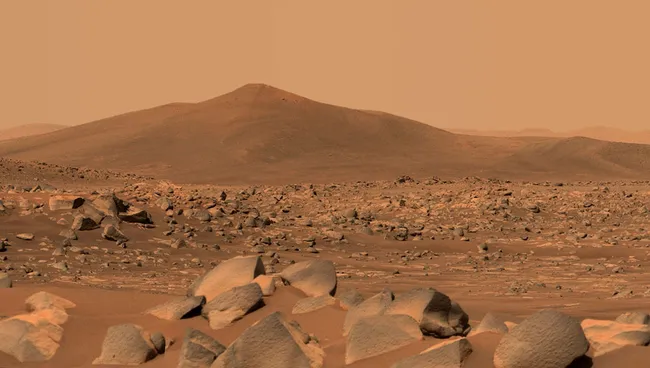
Mars, once a planet that housed flowing rivers and a robust atmosphere, is now a challenging terrain for any ambitions of colonization. Its smaller size led to the rapid cooling of its core, causing Mars to lose its magnetic field and most of its atmosphere. What remains is a dry, desolate landscape riddled with toxic perchlorates, presenting a significant hurdle for agricultural efforts on the Red Planet.
Visionaries are determined to overcome these obstacles. NASA’s Artemis program is set on establishing a self-sufficient human presence on Mars, while Elon Musk’s SpaceX aims to build a thriving Martian city within the next two decades. However, these plans face a major hurdle: the abundance of perchlorates in Martian soil.
Perchlorates, toxic salts composed of chlorine and oxygen, permeate the Martian landscape at rates a million times higher than on Earth, leading to Martian regolith—a near-inhospitable mix of sand, dust, and rock—unable to support plant life. Unlike Earth’s soil, Martian dirt lacks the organic materials necessary for plant growth.
Rafael Loureiro, a specialist in plant stress from Winston-Salem State University, emphasizes that tackling the perchlorate problem is critical for any agricultural pursuits on Mars. While hydroponics might sustain small crews, it won’t be sufficient as populations expand. The long-term solution lies in transforming Martian soil to support agriculture.
Researchers are exploring several methods to remove perchlorates from Martian soil. These include:
– **Thermal Decomposition**: This involves heating the soil to 750°F, though it demands high power, potentially from nuclear reactors.
– **Washing**: This method uses large quantities of water to rinse out perchlorates, but Mars’ scarce water supply makes this impractical.
– **Microbial Remediation**: This approach uses microorganisms to break down perchlorates, thus turning the soil into a viable growth medium for plants.
Microbial remediation shows the most promise for both Martian and Earth soils. NASA and the National Science Foundation are funding research in this area, exploring its potential to not only address Martian soil issues but also rehabilitate contaminated lands on Earth.
Anca Delgado, a microbiologist at Arizona State University’s Biodesign Institute, is leading a research team in this field. Their work is based on previous efforts to clean up toxic chemicals used in industries such as dry cleaning and metal degreasing.
Delgado’s team is growing microbes that can survive in perchlorate-rich environments, breaking these compounds into harmless substances. This process not only detoxifies the soil but also enhances its organic matter content, crucial for robust plant growth.
Supported by $1.9 million from NSF and NASA, this project is a collaborative effort involving Arizona State University, the University of Florida, and the Florida Institute of Technology. Each institution tackles various aspects, from reducing perchlorates and building organic matter to testing plant growth in treated Martian soil.
In lieu of actual Martian soil, scientists use the Mars Global Simulant (MGS-1), replicating the properties of Martian soil samples analyzed by the Curiosity rover.
As the quest to place humans on Mars progresses, resolving the perchlorate challenge is vital for achieving sustainable agriculture on the planet. The insights gained from this research could also provide valuable solutions to Earth’s agricultural troubles, turning barren, polluted lands into fertile spaces.