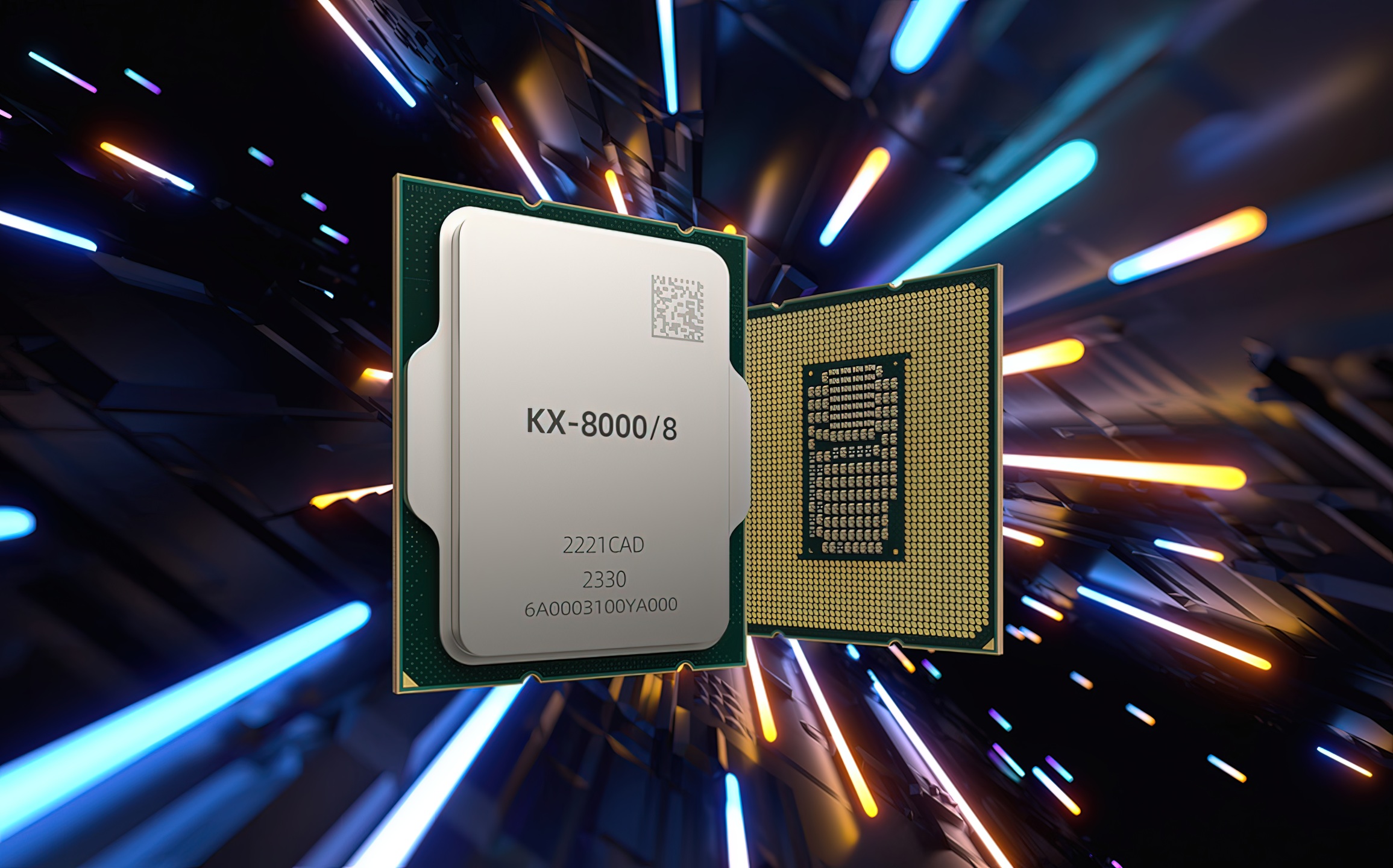
Zhaoxin has officially confirmed it’s working on its next-generation KaiXian KX-8000 consumer CPU series, signaling a major push into higher-performance PCs and embedded systems. The company says the new processors will deliver big gains in both computing performance and I/O capabilities—two areas that matter most to anyone building or buying a modern desktop.
To understand why the KX-8000 announcement is notable, it helps to look at where Zhaoxin is coming from. In 2023, the chipmaker introduced the KX-7000 lineup built on its x86 “Century Avenue” architecture using a 7nm manufacturing process. Those chips arrived with 8 CPU cores, boost clocks up to 3.7GHz, and 32MB of cache, while also supporting a mix of DDR4 and DDR5 memory. On the connectivity side, the platform offered up to 24 lanes of PCIe Gen4, putting it in line with mainstream PC expectations at the time.
Benchmarks for the KX-7000 started to surface later, showing a meaningful jump compared with the company’s prior generation. Even so, performance was generally viewed as closer to older mainstream competitors rather than the newest high-end desktop offerings. More recently, KX-7000 systems have begun appearing in prebuilt PCs intended primarily for China’s domestic market.
With the KX-8000 series, Zhaoxin is aiming substantially higher. In its latest announcement, the company positions KX-8000 as a high-performance PC and embedded processor family, promising “significantly improved performance.” One of the headline upgrades is clock speed: Zhaoxin states the KX-8000 will reach speeds in the 4GHz range, which would be a notable step up from the KX-7000.
The platform upgrades are just as important for PC buyers. Zhaoxin says KX-8000 will support DDR5 memory and mainstream modern I/O standards, specifically naming PCIe 5.0. That combination matters for next-generation graphics cards, ultra-fast NVMe SSDs, and overall platform longevity. The company also highlights “high-performance integrated graphics,” suggesting the built-in GPU will be a bigger focus than before—potentially improving everyday performance for users who don’t plan to buy a discrete graphics card.
While Zhaoxin hasn’t yet shared key specifications like core counts, detailed architecture changes, or official benchmark targets, there’s already growing interest around one particular claim circulating from company representatives: the KX-8000 family is expected to aim for performance in the range of AMD’s Zen 4 class processors while also offering strong efficiency. If that goal is met, it would represent a major leap compared to the previous generation, which was generally considered closer to Zen 3-era performance levels.
As for timing, Zhaoxin points to 2026 for the debut of the KX-8000 processor. Even with that window, consumers may need patience before they see widespread retail availability, as a broader rollout could extend into 2027 depending on production and system adoption.
For PC enthusiasts and industry watchers, the KX-8000 announcement is worth tracking for three reasons: a move toward 4GHz-class clocks, a modern DDR5 and PCIe 5.0 platform, and the company’s ambition to compete in a higher-performance segment than before. If Zhaoxin delivers on these promises, the KX-8000 could become one of the most important milestones yet in its consumer x86 CPU roadmap.