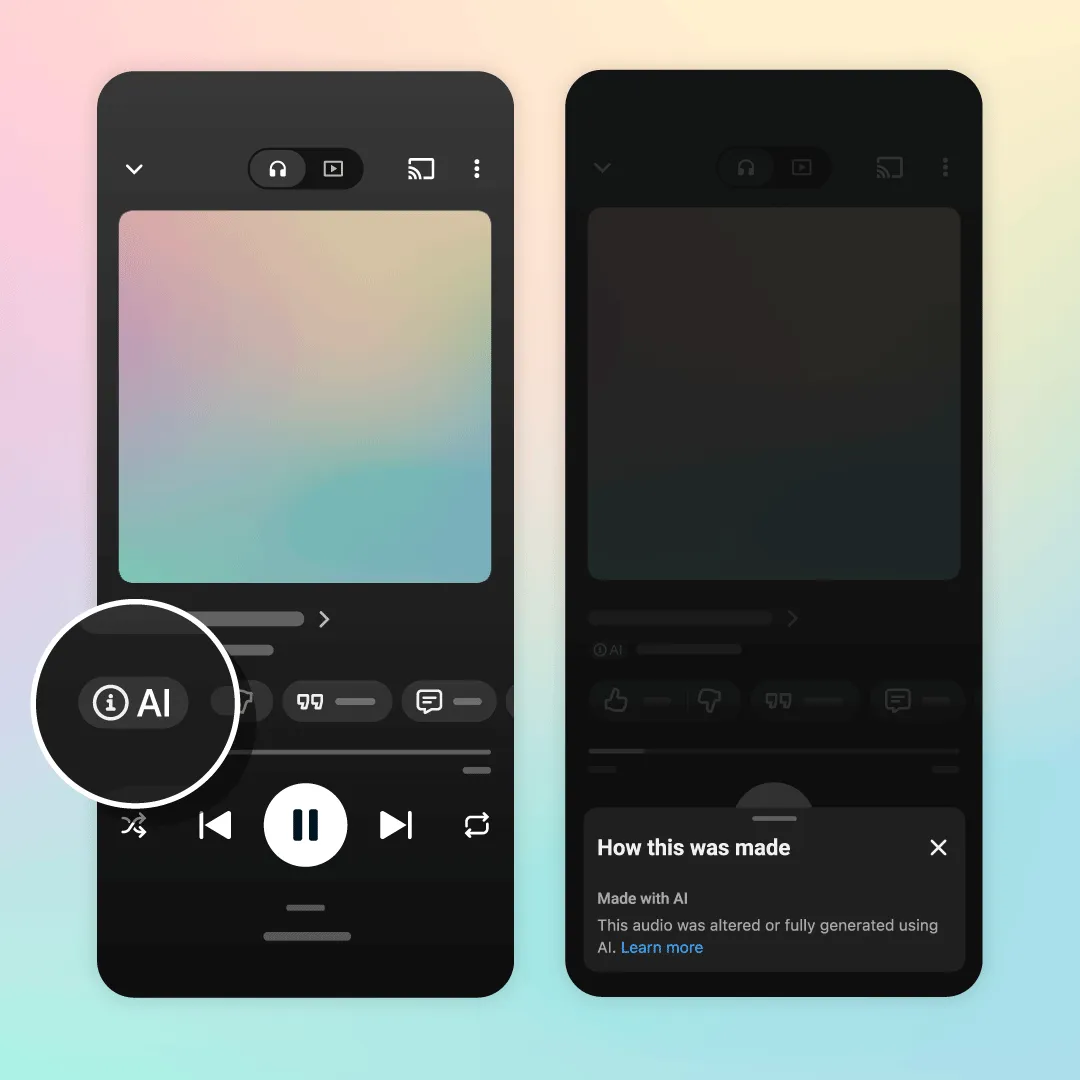
YouTube Music is rolling out new labels that will make it easier for listeners to spot songs created with the help of generative AI. The update is designed to bring more transparency to AI-generated music as the technology becomes a bigger part of the streaming landscape.
The new AI music label will appear directly on the player page in YouTube Music. When users tap or click the label, they will see more details about how artificial intelligence was used in the track, including whether AI played a role in the composition, vocals, or overall production. The same labeling system will also appear in the main YouTube app, giving users a clearer view of AI involvement across both platforms.
YouTube says the feature was developed in collaboration with music industry partners, along with its own detection systems. Music partners using YouTube will be able to declare how generative AI was used in their tracks through three categories: “Fully Gen AI,” “Partly Gen AI,” or “No Gen AI.”
“Fully Gen AI” will apply to tracks created entirely by artificial intelligence. “Partly Gen AI” will be used for songs that include AI-generated elements but also feature human-created or live-recorded parts. Meanwhile, “No Gen AI” covers tracks that do not use generative AI, even if they include standard production tools such as pitch correction or Auto-Tune.
The move arrives as AI-generated music continues to spread across streaming platforms. With more songs being created using artificial intelligence, music services are facing growing pressure to help listeners understand what they are hearing and how it was made. Some platforms are adding AI transparency labels, while others are introducing filters, restrictions, or royalty rules for fully AI-generated content.
YouTube Music appears to be taking a disclosure-first approach. Instead of banning or limiting songs simply because they use AI, the platform is focusing on giving listeners more information. AI involvement by itself will not automatically prevent a track from being monetized on YouTube.
This approach also fits with YouTube’s broader interest in AI-powered music tools. The company has already tested features that allow select creators to generate music with artificial intelligence, including tools that can create soundtracks using AI-generated versions of participating artists’ voices.
For listeners, the new labels could make music discovery more transparent. Fans who want to know whether a song features AI vocals, AI composition, or fully machine-generated production will have clearer information before they listen further. For artists and rights holders, the labels may also help set expectations around creative credit, authenticity, and monetization.
As generative AI becomes more common in music production, transparency is likely to become a major issue for streaming services. YouTube Music’s new AI labels are an important step toward helping listeners understand the growing role of artificial intelligence in the songs they stream every day.