A rare Intel processor that was never meant for typical desktop PCs has just been pushed into the spotlight thanks to an impressive BIOS mod that got it running Windows 11 on a mainstream motherboard.
A hardware enthusiast from the Overclock.net community, known as Kryptonfly, managed to boot Intel’s OEM-exclusive Core 9-273PQE on a standard Asus Z790 motherboard using the familiar LGA 1700 socket. That’s a big deal because this chip belongs to Intel’s Bartlett Lake-S family, a lineup designed for embedded and edge-focused AI workstations rather than everyday consumer desktops. Despite sharing the same socket and pin layout as popular Raptor Lake processors, Bartlett Lake has never been officially supported on consumer Z790 boards.
The breakthrough didn’t come from a simple plug-and-play swap. Kryptonfly reportedly built a custom BIOS microcode with the help of Claude AI, then continued refining the BIOS until the system could get beyond the usual roadblocks. Early attempts could reach POST and the BIOS screen, but stable Windows booting required deeper firmware work to avoid common failures like 5F error hangs and black screens.
What ultimately made it work was a clever workaround in the early initialization process. In simple terms, the modded BIOS “tricks” Intel’s firmware into treating the Bartlett Lake CPU like a Raptor Lake chip during critical early boot stages. Kryptonfly described successfully fixing system agent initialization by leveraging Raptor Lake SA/PEG initialization behavior, allowing the system to proceed normally through memory initialization and into Windows.
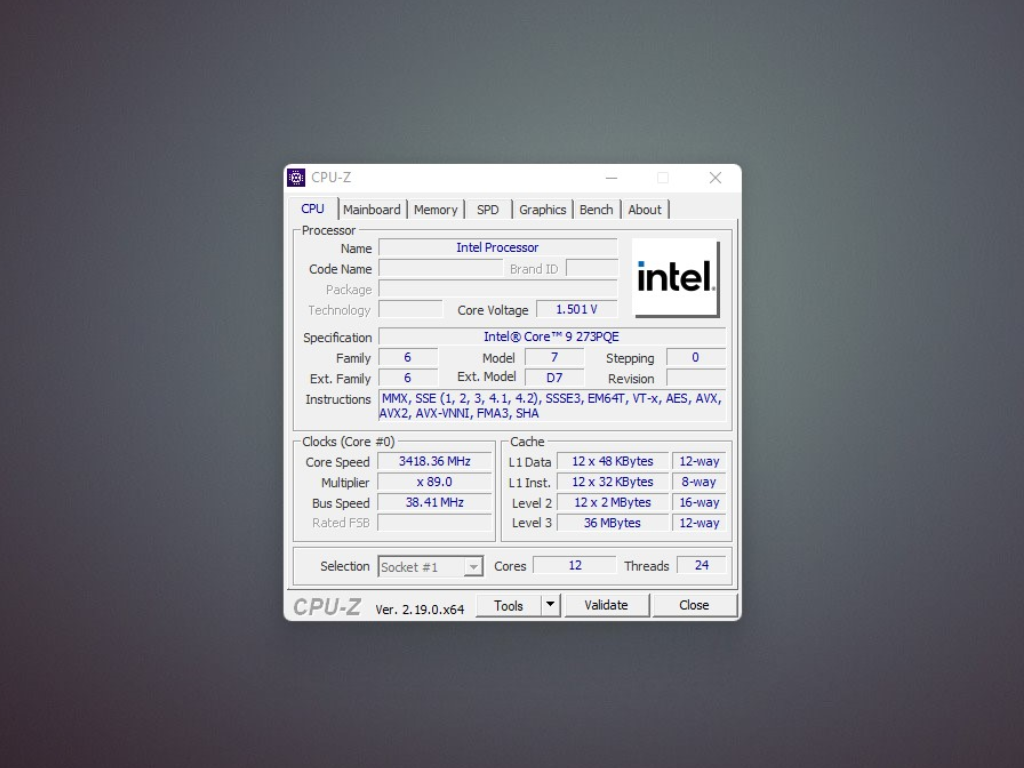
After the final round of patching and injecting missing microcode, the system reportedly booted into Windows 11 cleanly. Screenshots shared by the modder showed the Core 9-273PQE being properly detected in CPU-Z, including its 12 performance cores, 24 threads, and a clock speed around 3,418 MHz.
Part of what makes this processor so interesting is its configuration. Unlike many recent Intel desktop CPUs that mix performance cores (P-cores) and efficiency cores (E-cores), the Core 9-273PQE is an all P-core design with no efficiency cores at all. That pure performance-core layout is exactly the kind of thing PC enthusiasts love to speculate about, especially for workloads and gaming scenarios that benefit from consistent high-performance cores.
While this is ultimately a proof-of-concept and a win for the modding scene, there’s still a major catch: the Core 9-273PQE is OEM-only and not something most builders can simply buy at retail. Still, the fact that it can run on a consumer Z790 motherboard at all is likely to fuel more experimentation and raises an obvious question among enthusiasts—will Intel ever bring a similar all P-core processor to the regular consumer desktop market?