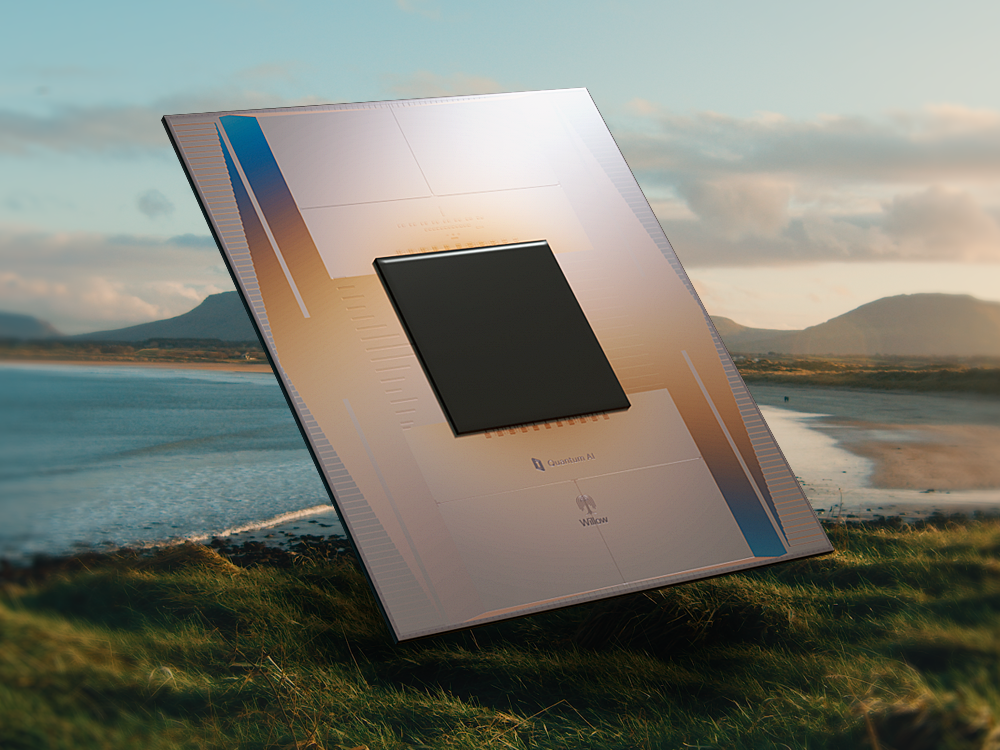
Google has unveiled its revolutionary 105-qubit Willow quantum processor, a breakthrough in computing performance and error correction. This quantum chip is poised to change the landscape with the ability to complete calculations in minutes that would traditionally require billions of years on classical supercomputers.
The Willow quantum processor boasts significant advancements in reducing quantum error rates, utilizing a sophisticated 7×7 qubit grid structure that significantly reduces errors with each scaled-up iteration. This achievement reaches below-threshold performance, a milestone in quantum error correction that scientists have been striving for since the mid-’90s.
In rigorous testing, the Willow processor executed tasks within five minutes that would have taken approximately ten septillion years on traditional systems like Frontier, one of the fastest supercomputers in existence. These tasks were part of the Random Circuit Sampling benchmark, a challenging test for any quantum computer.
Another impressive feature of the Willow processor is its enhanced qubit state retention, with T1 times now extending to nearly 100 microseconds, five times longer than its predecessors. This innovation was developed at Google’s specialized quantum facility in Santa Barbara, a cutting-edge center dedicated to quantum chip fabrication.
The impact of Willow extends beyond its numbers and capabilities. Google is on a mission to make quantum computing not only groundbreaking but also practical for solving real-world issues. The processor is already being integrated into scientific simulations and quantum modeling, with potential applications in fields like artificial intelligence, drug discovery, and energy efficiency improvements.
Despite these achievements, quantum computing, including Google’s Willow, remains in the experimental stage. The focus is on refining this technology, not just by adding more qubits, but ensuring reliability and practical applicability in various industries. This endeavor signifies a major leap towards the future of computing, promising innovations that could transform countless aspects of modern life.