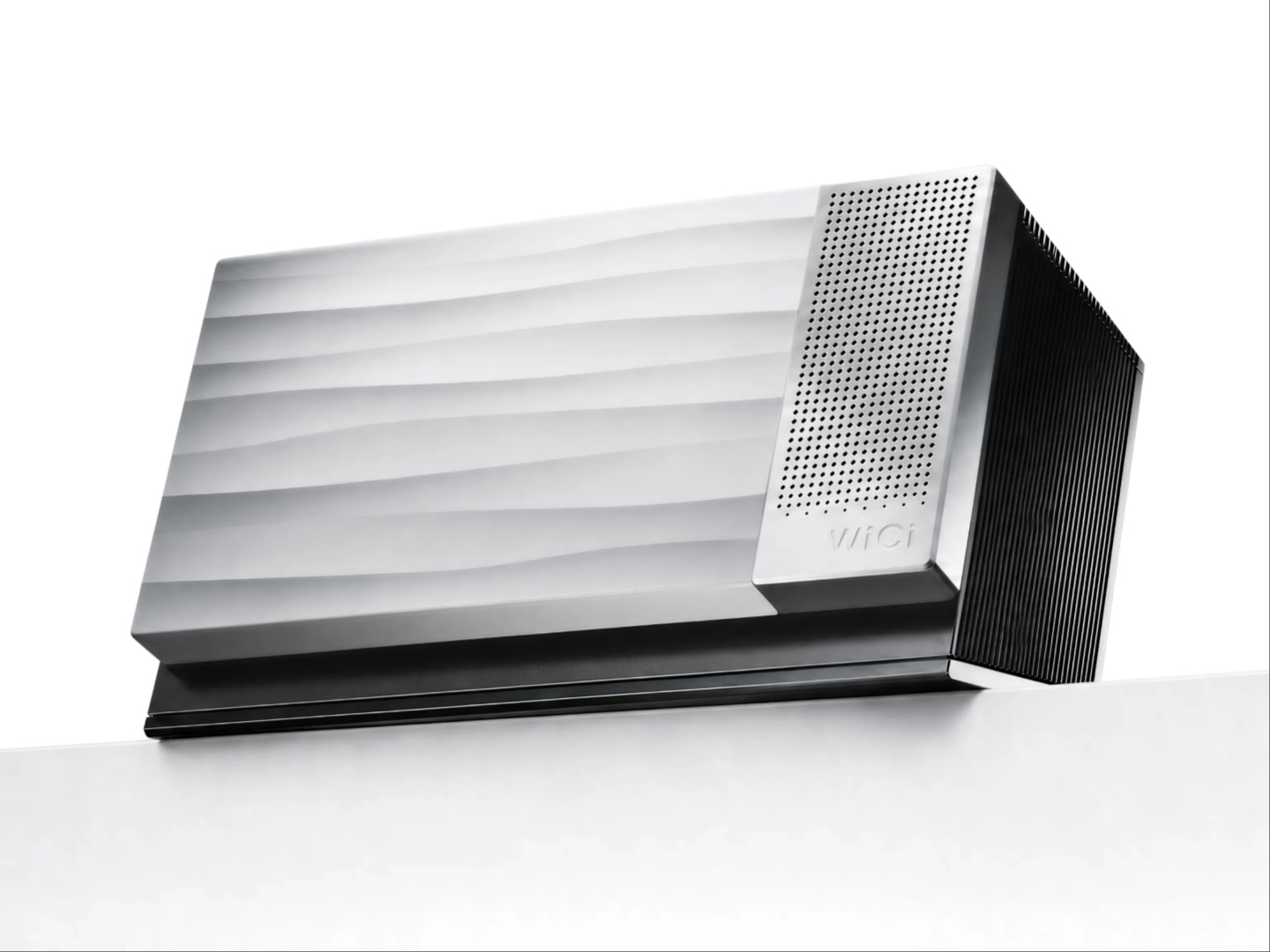
WiCi One Wireless eGPU Promises Desktop Graphics Power Over Wi-Fi 7
External GPUs have been around for years, but WiCi is trying to take the concept in a much more ambitious direction. The company has introduced the WiCi One, a wireless eGPU enclosure designed to deliver desktop-class graphics performance to laptops, mini PCs, handhelds, and other compatible devices without relying on a traditional cable connection.
Instead of using Thunderbolt or OCuLink, the WiCi One connects through Wi-Fi 7. That makes it one of the most unusual eGPU solutions announced so far, especially because it is not simply a game-streaming box. WiCi describes it as a real external graphics system with its own computing hardware, built to share GPU power wirelessly with host devices.
The showcased WiCi One configuration includes an Nvidia GeForce RTX 5060 Ti with 16GB of VRAM, an Intel Core 3 100U processor, and a 1TB NVMe SSD. All of this hardware is packed into a relatively compact enclosure that uses a Wi-Fi 7 4×4 MIMO 320 MHz connection to communicate with the main device.
WiCi is positioning the device as more than just a gaming accessory. While gamers are a clear target audience, the company is also aiming at creators, AI users, 3D artists, video editors, and developers working with large language models. The idea is to let thin-and-light laptops or lower-powered systems tap into stronger graphics and compute resources without needing a built-in dedicated GPU.
Another interesting feature is shared compute access. WiCi says multiple devices can make use of the WiCi One’s processing power, potentially making it useful in small studios, creative teams, or workspaces where several users need occasional access to GPU acceleration.
For gaming, WiCi has demonstrated Cyberpunk 2077 running on a laptop without dedicated graphics, then shown the same laptop using the WiCi One wirelessly. The RTX 5060 Ti model is claimed to reach around 80 FPS in Cyberpunk 2077 at 4K Ultra settings with DLSS 4 enabled. The company also claims around 60 FPS in Black Myth: Wukong at 4K Cinematic settings.
Those numbers sound impressive, but the big question is bandwidth. Wi-Fi 7 can offer very high theoretical speeds, but real-world wireless performance is usually more complicated than a wired connection. Thunderbolt 4, Thunderbolt 5, and OCuLink are still strong options for external GPU setups because they provide direct, stable physical links.
Wi-Fi 7 has a theoretical maximum bandwidth of up to 46 Gbps, while Thunderbolt 4 offers up to 32 Gbps and Thunderbolt 5 can reach up to 64 Gbps. OCuLink can also reach up to 64 Gbps. However, WiCi’s wireless setup reportedly has a physical layer rate of about 11.5 Gbps, which is far below the peak bandwidth available through some wired alternatives.
WiCi says it has addressed this limitation through its own protocol design. Rather than sending everything across the wireless connection, the system is said to transmit only the most important GPU-related requests. This approach is intended to reduce bandwidth demands and make wireless external graphics more practical.
The company is also preparing a more powerful version of the WiCi One featuring an RTX 5090, an Intel Core Ultra 7 255H processor, and 4TB of storage. That model could appeal to users who need much higher performance for AI workloads, rendering, advanced creative production, and high-end gaming.
The WiCi One with the RTX 5060 Ti is currently available in early access for $1,999. Once the early access period ends, the price is expected to rise to $2,599. WiCi says shipments are planned to begin in the fourth quarter.
If the WiCi One performs as promised, it could become one of the most exciting developments in the external GPU market. A wireless eGPU with desktop-class graphics would be especially appealing for users who want powerful performance at a desk while keeping their laptop light and portable on the go.
Still, real-world latency, stability, wireless interference, and sustained performance will determine whether this technology can truly compete with wired eGPU solutions. For now, the WiCi One is a bold step toward a future where external graphics power may no longer need a cable.


