WiCi One Debuts as a Wireless Local GPU for AI, Gaming, and Creative Workloads
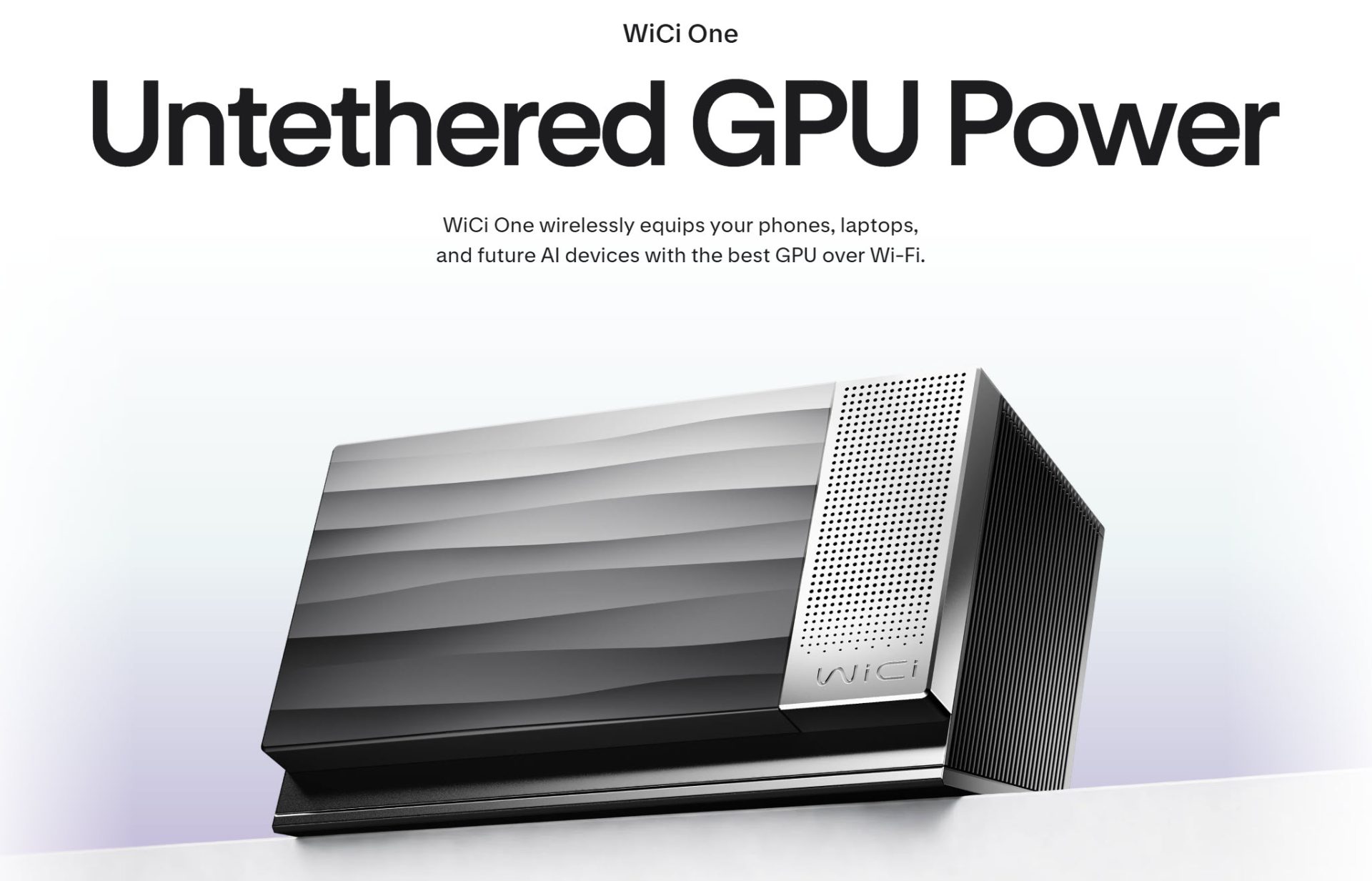
WiCi has introduced the WiCi One, a new wireless local-GPU system designed to bring dedicated graphics power to laptops, desktops, and other devices over Wi-Fi. The company describes it as the world’s first wireless local-GPU solution, aiming to deliver the benefits of a high-end graphics card without requiring a direct physical connection to the host machine.
The idea is simple but ambitious: instead of installing a powerful GPU inside every computer or connecting an external GPU enclosure through a cable, WiCi One places the graphics hardware in a separate enclosed device and shares that compute power wirelessly. For users working with AI models, creative software, or demanding games, this could make thin laptops and compact systems far more capable.
The WiCi One is being positioned as a local AI and GPU-sharing device that can appear to the operating system like a standard local graphics card through Driver Mode. It can also function as an API endpoint, allowing compatible AI applications to access the hardware with little to no code changes. That flexibility could make it useful for developers, creators, gamers, and households or offices that want to share GPU resources across multiple devices.
At launch, WiCi plans to offer a model equipped with an NVIDIA GeForce RTX 5060 Ti featuring 16GB of GDDR7 memory. A higher-end version with an NVIDIA GeForce RTX 5090 and 32GB of GDDR7 memory is also planned. The RTX 5060 Ti edition is expected to use an Intel Core 3 100U processor and 1TB of NVMe storage, while the RTX 5090 edition is set to feature an Intel Core Ultra 7 255H processor and 4TB of NVMe storage.
One of the most interesting parts of the WiCi One is its memory approach. The company says the system uses a Unified Hierarchical Memory design, and on the RTX 5090 model, its TurboStream weight paging technology can use up to 4TB of NVMe storage as working VRAM. This is aimed at large AI workloads, especially open-weight language models that require far more memory than a typical consumer GPU can provide on its own.
WiCi is promoting the device as a way to run large AI models locally without relying on cloud subscriptions, usage limits, or sending private data to remote servers. According to the company, the WiCi One 5090 edition can run large models such as Kimi K3 at 2.8 trillion parameters at around 5 tokens per second, DeepSeek V4 Flash at 284 billion parameters at around 20 tokens per second, and Gemma 4 at 26 billion parameters at more than 500 tokens per second. These figures are manufacturer-provided and will need independent testing to confirm real-world performance.
Beyond AI, WiCi is also targeting gamers and creative professionals. The company claims the device can stream demanding games such as Cyberpunk 2077 at high frame rates and can help accelerate video editing timelines in applications like Adobe Premiere Pro and DaVinci Resolve. That could make the WiCi One appealing to users with lightweight laptops who want desktop-class GPU performance without buying a new workstation.
The biggest difference between WiCi One and a traditional external GPU is the connection method. Most eGPU setups rely on wired interfaces such as USB, Thunderbolt, or OCuLink. WiCi One instead uses Wi-Fi 7 with 4×4 MIMO and a 320MHz channel, which the company refers to as a router-grade Air Link. The device is designed to share GPU resources wirelessly across multiple devices, potentially making it easier to place the GPU anywhere in the home or office.
However, wireless GPU computing comes with obvious challenges. Latency, signal stability, network congestion, and real-world Wi-Fi conditions can all affect performance. WiCi says it uses custom protocols, zero-trip caching, trace replay, and optimized networking routines to reduce the drawbacks of wireless transmission. Even so, the actual user experience will depend heavily on independent benchmarks and everyday testing across different environments.
The WiCi One supports multiple operating systems, including macOS, Windows, and Linux through its virtual GPU driver. It also offers SDK support for Python, JavaScript, and Swift, along with an OpenAI-compatible API mode for AI applications. This combination suggests WiCi wants the product to serve both casual users and developers building local AI workflows.
Pricing starts at $2,599, though early signups are expected to receive a discount that brings the price down to $1,999. That makes the WiCi One a premium product, especially compared with conventional GPU upgrades or wired eGPU solutions. Still, if the device performs as advertised, it could open the door to a new category of wireless GPU systems for local AI, gaming, and professional workloads.
On paper, the WiCi One is one of the more unusual and exciting GPU concepts to appear recently. A wireless box that can deliver dedicated graphics performance, run large AI models locally, and share compute power across multiple devices sounds highly attractive. The key question is whether Wi-Fi 7 and WiCi’s custom software can deliver the consistency and low latency users expect from a local GPU.
For now, the WiCi One is a promising concept with bold performance claims. If real-world testing backs them up, it could become an important step toward more flexible, shared, and cable-free high-performance computing at home and in small offices.