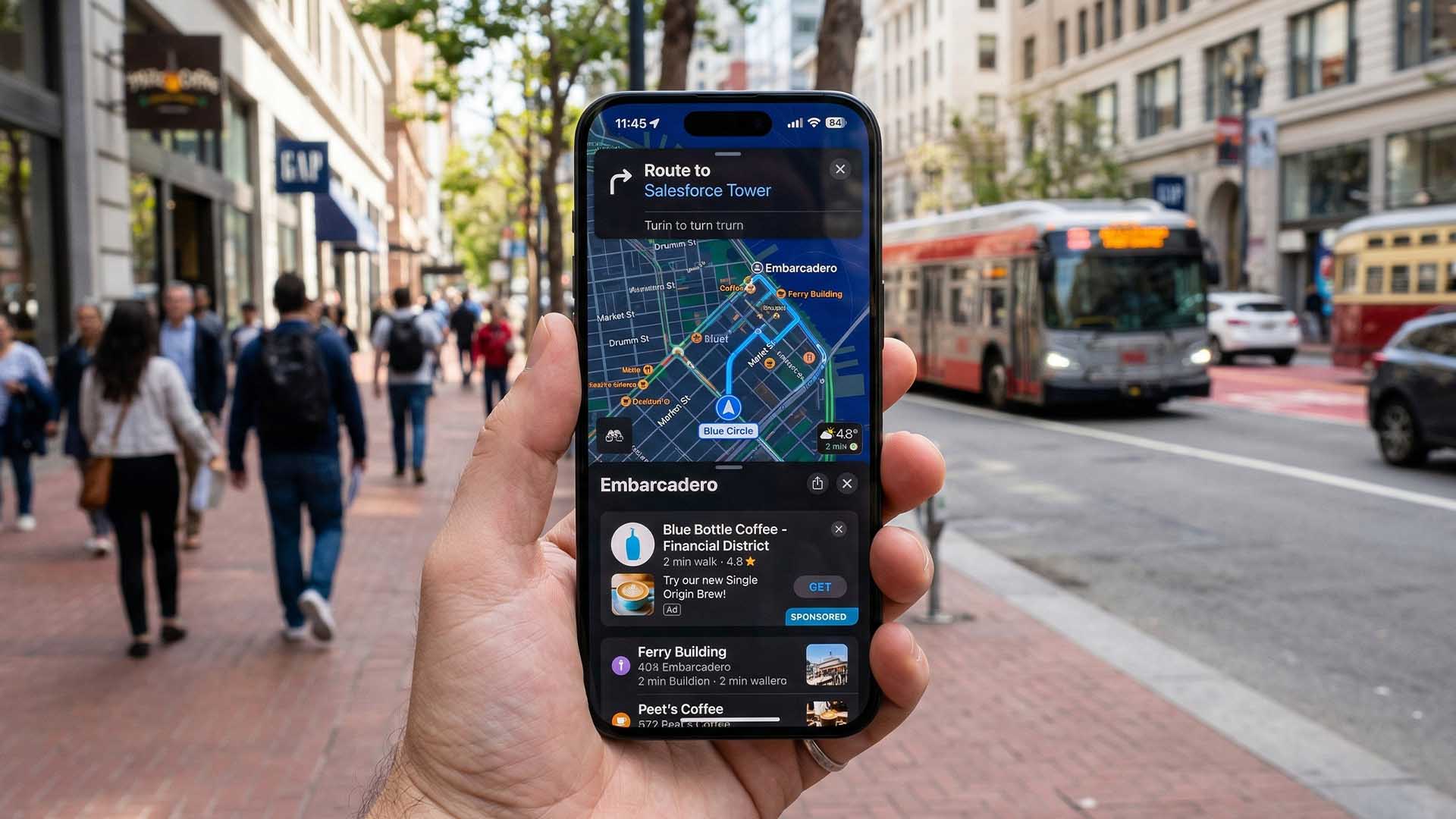
Apple is pushing its Services business harder than ever, and the numbers show why. In fiscal Q1 2026, Apple’s Services revenue climbed to $30 billion, up from $26.3 billion in Q1 2025. With growth like that, the company is looking for new ways to add recurring revenue streams—and one of the next big targets appears to be Apple Maps.
That move, however, could come with a serious downside: customer backlash. The idea of ads showing up inside Apple Maps has sparked fresh criticism, largely because Apple customers already pay premium prices for hardware. For many people, spending well over $1,000 on an iPhone, iPad, or Mac comes with the expectation of a cleaner, less commercial experience than what they might get elsewhere. Even if Apple tries to keep ads subtle, the presence of advertising in a core app like Maps could feel like an unwelcome shift in what users believe they’re paying for.
The concern isn’t only about annoyance—it’s also about trust. Industry watcher Mark Gurman has argued that Apple risks frustrating its own customer base by moving deeper into advertising, especially given the company’s long-standing positioning around better user experience and minimal reliance on ads. He also points to Apple’s history of suggesting certain platforms wouldn’t use advertising, only for the company to change course later.
Another part of the debate is whether Apple actually needs to take this step. Apple already runs ads in the App Store, and that business is widely estimated to bring in around $20 billion annually. If the App Store alone is generating that level of revenue, critics question why Apple would risk turning Apple Maps into another ad surface—particularly when Maps is a utility app people rely on for fast, accurate directions and local search results. For many users, even small changes that make results feel “paid” rather than purely relevant could affect how much they trust what they see on the screen.
From a pure business standpoint, Apple Maps is an attractive place for advertising. It’s directly tied to purchase intent: when someone searches for coffee, a gas station, a hotel, or a nearby restaurant, they’re often ready to spend money. That makes location-based ads especially valuable. And despite the common perception that “nobody uses Apple Maps,” there’s substantial audience scale. Data cited from Rio SEO estimates Apple Maps had roughly 918 million global users across 2024 and 2025, meaning the platform has plenty of traffic for Apple to monetize.
The real question is whether any revenue uplift is worth the potential cost to the Apple brand. Gurman’s view is that ads in Apple Maps don’t improve the user experience and could invite backlash. With Apple increasingly leaning on Services growth, the introduction of ads into more parts of its ecosystem may be only the beginning—leaving many users wondering where Apple draws the line.
If Apple does move forward, the success of Apple Maps ads will likely hinge on execution: how intrusive the ads feel, how clearly they’re labeled, and whether search results continue to feel genuinely helpful rather than pay-to-play. For a company built on premium positioning, Apple Maps advertising could become either a quiet new revenue win—or a very public reminder that even premium ecosystems aren’t immune to the ad economy.