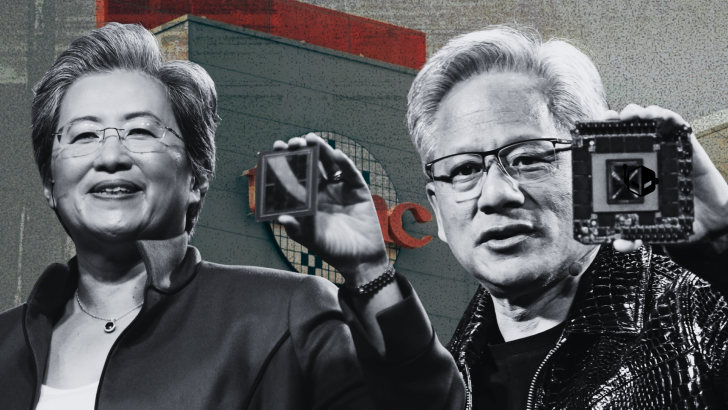
NVIDIA CEO Jensen Huang and AMD CEO Lisa Su are both highlighting the same turning point in modern chip history: their early decision to align closely with TSMC looked risky at the time, but it has become one of the biggest competitive advantages either company has today.
As demand for AI and high-performance computing hardware explodes, chips have become one of the most significant bottlenecks in the entire tech supply chain. Manufacturing capacity is tight, advanced production nodes are limited, and delivery schedules often can’t keep up with customer needs. In that environment, TSMC—the world’s largest semiconductor foundry—holds enormous influence. But what’s especially notable is how TSMC tends to prioritize long-term partners. That kind of “loyalty” can translate into earlier access to production lines, smoother ramp-ups to new process technologies, faster fulfillment, and close collaboration on critical manufacturing and IP developments.
This isn’t simply about who pays the most in the moment. It’s also about which companies committed early—back when betting on TSMC didn’t feel like the obvious move.
TSMC’s relationship-driven approach has roots in its early years. The foundry business didn’t start from a position of dominance. It had to rise in an era that featured major, established semiconductor giants, and building a world-class manufacturing operation from scratch required persistence, trust, and consistent execution. Over time, TSMC earned a reputation for treating customer relationships as a long game—reflected not only in how it works closely with key partners, but also in how it tends to manage pricing changes gradually rather than abruptly.
That context matters because Jensen Huang recently revisited the origin story of NVIDIA’s long partnership with TSMC. In an interview, he recalled telling TSMC founder Morris Chang early on that NVIDIA would become one of TSMC’s biggest customers. Even after setbacks during earlier manufacturing transitions, Huang stuck with that direction. Today, he notes that NVIDIA has indeed become TSMC’s largest customer—an outcome that underscores how long-term alignment can pay off in the semiconductor world.
Beyond the current AI boom, NVIDIA’s ability to secure leading-edge manufacturing has become one of the foundations of its dominance in accelerated computing. Close coordination with TSMC, supported by long-term supply agreements, has helped NVIDIA navigate a market where many companies struggle to get enough advanced chips. The result is not just access to capacity, but also strategic positioning when new manufacturing processes come online.
AMD’s story carries a similar lesson. Under Lisa Su’s leadership, AMD made a major pivot by deepening its reliance on TSMC as its primary manufacturing partner. That shift was especially significant because AMD once had its own fab operations, which were later separated into what became GlobalFoundries. Su has described the move toward TSMC as one of the major decisions of her tenure—one that has since supported AMD’s gains in critical markets like servers and enterprise computing.
The contrast with Intel is hard to ignore. Intel has faced prolonged challenges in its internal manufacturing execution, which has impacted product competitiveness and timelines. Even Intel has increasingly relied on TSMC for parts of its roadmap—an acknowledgment of just how central TSMC has become to advanced semiconductor production.
Stepping back, the takeaway is clear: TSMC sits at the heart of the AI hardware supply chain, and its partnerships can shape winners and losers in the race for compute. NVIDIA and AMD didn’t just choose a foundry—they committed early, worked through difficult transitions, and built relationships that now help them secure capacity in the most constrained manufacturing era the industry has seen.
It’s not an exaggeration to say that without TSMC’s manufacturing leadership and partner-first approach, neither NVIDIA nor AMD would likely be where they are today in AI, data center computing, and next-generation chip performance.