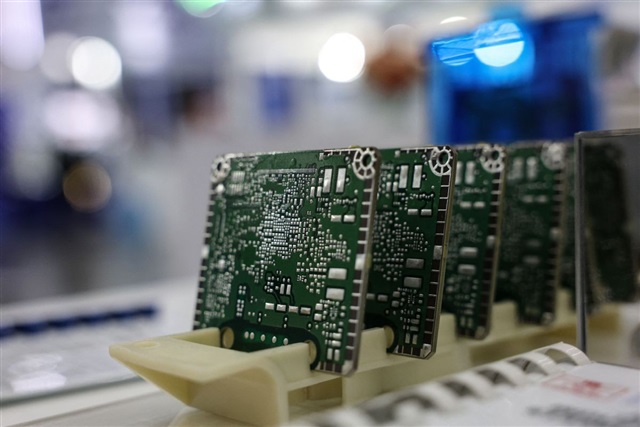
As artificial intelligence continues to reshape the global technology landscape, the spotlight has largely stayed on powerful GPUs, high-bandwidth memory, and advanced chip packaging. These components are essential for training large AI models and running demanding data center workloads. Yet another critical part of the AI hardware supply chain is now drawing growing attention: printed circuit boards, or PCBs.
PCBs may not attract the same level of public interest as cutting-edge processors, but they are the foundation that allows modern electronics to function. They connect chips, memory, power systems, sensors, and other components inside everything from AI servers and networking equipment to military systems and advanced communications hardware. Without reliable PCBs, even the most advanced chips cannot operate effectively.
This has made PCB manufacturing an increasingly important issue for the United States, especially as AI adoption accelerates across commercial, government, and defense sectors. The concern is not simply about performance or cost. It is about supply chain security.
China currently plays a major role in the global PCB industry, with a strong position in production capacity, supplier networks, and manufacturing scale. For years, this dominance has helped support the worldwide electronics market by keeping production efficient and costs competitive. However, as geopolitical tensions rise and technology becomes more closely tied to national security, US officials and defense planners are paying closer attention to the risks of relying too heavily on overseas PCB production.
The rapid growth of AI computing has made the issue more urgent. AI data centers require highly complex boards capable of handling extreme power demands, fast signal transmission, and dense component layouts. These are not simple commodity parts. Advanced PCBs used in AI servers and defense electronics often require specialized materials, precision manufacturing, and strict quality control.
In defense applications, the stakes are even higher. PCBs are used in radar systems, aircraft, missiles, satellites, secure communications, and command-and-control equipment. Any disruption in PCB supply could affect production timelines, maintenance, and readiness. There are also concerns about trust, traceability, and the need to ensure that critical hardware is built through secure and verifiable supply chains.
The growing focus on PCBs reflects a broader shift in how governments and industries view technology infrastructure. The semiconductor supply chain is no longer just about chips. It includes the entire ecosystem needed to build advanced electronics, from substrates and packaging to circuit boards and specialized components.
For the US, reducing dependence on foreign PCB manufacturing may require investment in domestic production, stronger partnerships with trusted allies, and incentives for companies to expand advanced electronics manufacturing closer to home. Building this capacity will not happen overnight. PCB manufacturing is capital-intensive, technically demanding, and supported by deeply established supply networks.
Still, the issue is becoming harder to ignore. As AI systems become more powerful and defense technologies become more connected, the importance of secure PCB supply will continue to grow. GPUs and memory may remain the headline components of the AI boom, but the circuit boards beneath them are becoming just as strategically important.
The next phase of AI hardware competition may not be defined only by who builds the fastest chips. It may also depend on who controls the essential manufacturing layers that allow those chips to function at scale. For the United States, PCBs are emerging as a key part of that equation.