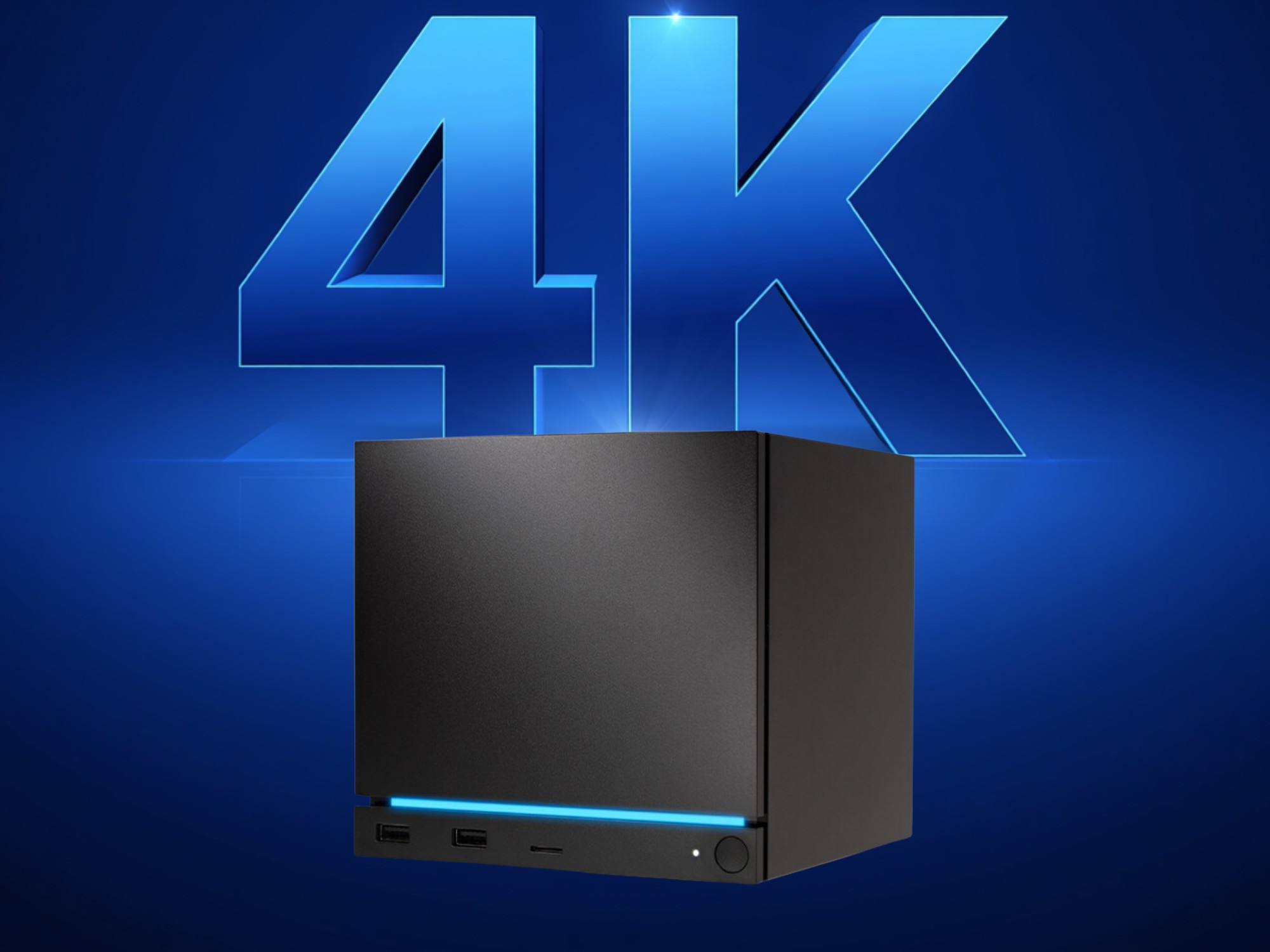
Valve Steam Machine 4K performance claims have been toned down after early reviews raised questions about what the compact gaming PC can realistically deliver. The device was initially promoted as a console-style system capable of 4K gaming at 60 frames per second, but Valve has now adjusted its wording to set more cautious expectations.
The Steam Machine store page previously highlighted “4K gaming at 60 fps.” That claim has since been changed to “up to 4K gaming with FSR 4.1.” While the revision may look minor at first glance, it signals an important shift. Valve is no longer presenting 4K at 60 fps as a standard experience across the board.
Early testing suggests that the Steam Machine can handle some lighter, older, or better-optimized games at 4K, but many modern AAA titles appear to be a tougher challenge. For more demanding games, 1080p and 1440p are likely to be the more practical targets, especially for players who want smoother frame rates.
This matters because PC gamers often expect higher and more consistent performance than console players, particularly when spending over $1,000 on gaming hardware. While 30 fps can still be acceptable on some living-room consoles, it is a harder sell for a PC-style device aimed at Steam users.
FSR will play a major role in how Valve presents the Steam Machine’s 4K capabilities. AMD’s upscaling technology allows games to render at a lower internal resolution before being sharpened and displayed at 4K. This can significantly improve performance while still producing a higher-resolution image on a 4K TV or monitor.
Valve’s mention of FSR 4.1 suggests the company is leaning heavily on upscaling to help the Steam Machine reach its advertised resolution goals. The newer version is expected to offer cleaner image quality, though it remains unclear whether it will be fully ready when the hardware launches.
The bigger challenge for Valve may be value. The 512GB Steam Machine is priced at $1,049 without a controller, putting it well above mainstream consoles. For many buyers, that price will invite direct comparisons with the PlayStation 5, which can deliver strong performance in major games for much less money.
In some examples, such as Forza Horizon 5, Sony’s console can offer similar or better frame rates at a lower cost. That makes Valve’s compact PC harder to justify for players who mostly want a simple living-room gaming experience.
Still, the broader console market is changing. Rising memory and storage costs have already pushed some hardware prices upward, with the Xbox Series X now starting at $749 in certain markets. If Sony follows with another price increase, Valve’s Steam Machine could start to look more competitive, especially for players who value access to a large Steam library and PC-style flexibility.
However, Valve has admitted it was not in the best position to stockpile components such as RAM and storage. To improve availability, the company avoided a dual-channel DDR5 memory setup and instead chose a configuration that made it easier to source 16GB modules. Early impressions suggest this decision can slightly affect performance, particularly in CPU-heavy games.
The Steam Machine still has potential as a compact living-room PC, especially for players already invested in the Steam ecosystem. It offers a familiar game library, a console-like form factor, and the flexibility of PC gaming. But the updated marketing makes one thing clear: buyers should not expect every modern game to run at native 4K and 60 fps.
Valve’s revised wording is more realistic, but it also highlights the core issue. The Steam Machine is not just competing with gaming PCs; it is also competing with highly optimized consoles that are cheaper, simpler, and already built around 4K TVs. For the device to succeed, Valve will need to convince players that Steam access, upscaling technology, and PC freedom are worth the higher price.