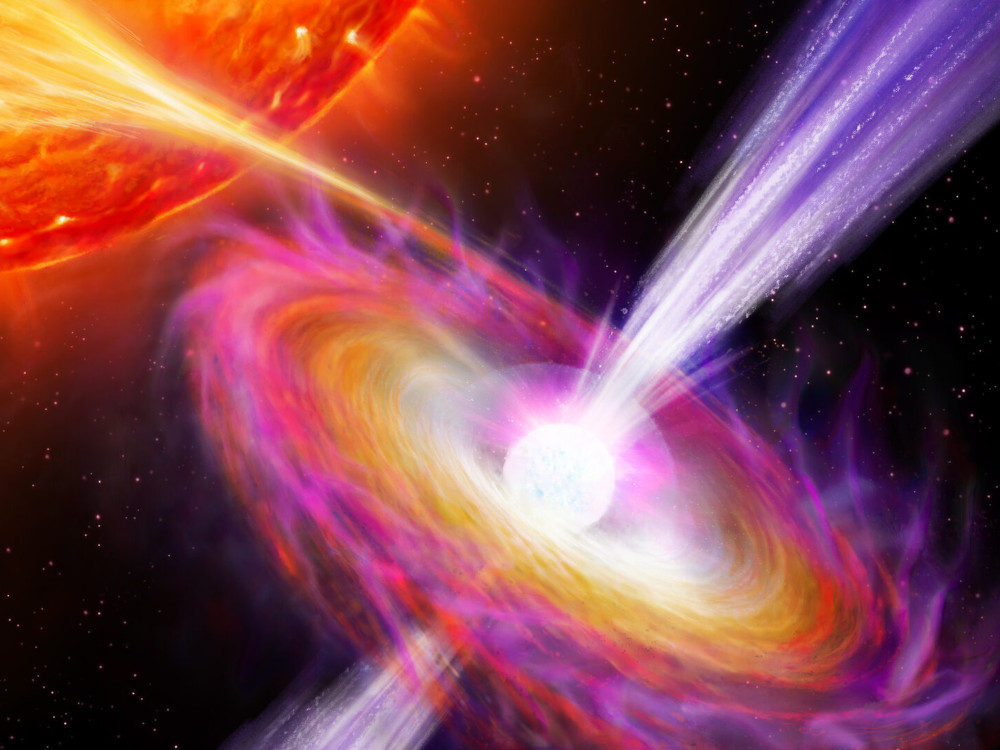
Imagine witnessing a celestial spectacle where a dense neutron star exerts immense gravitational pull on a neighboring star, stripping away its matter. This matter spirals toward the neutron star, triggering thermonuclear explosions as hydrogen or helium atoms fuse into heavier elements. Released with such force, these elements shoot out as jets, aligned with the neutron star’s axis of rotation, speeding through space at nearly 40 percent the speed of light. From rare metals like gold and platinum to uranium, these jets are a cosmic forge, enriching the universe—and even our own planet—with their elemental bounty.
Pairings of sun-like stars with neutron stars, while not exceedingly common with only 125 known to us, are repetitive sources of these immense ejections. Observation, however, remains a formidable challenge. The vast distances and transient nature of these jets, coupled with the need for a combination of observational techniques, complicates the process.
To detect the thermonuclear explosions, one must look to the X-ray emissions, which are tracked by satellite observatories such as ESA Integral. On the flip side, the jets themselves are perceptible only within the radio wave frequency. This necessitates a coordinated effort between satellite instruments and Earth-based radio telescopes to capture the phenomenon.
The maiden recording was an intensive endeavor: 30 hours of data collected over a span of three days, with the results pending until after meticulous analysis. The success of this pioneering process has marked a significant milestone in astrophysical observation.
Beyond this specific set of celestial bodies, the innovative method holds promise for exploring other powerful cosmological phenomena where strong gravitational forces and magnetic fields converge—be it in cosmic clouds, around black holes, or in other exotic space environments. By refining our ability to observe these high-velocity jets, we unlock the potential to gain deeper insight into elemental formation, the birth of solar systems, and the mysteries of cosmic structures, along with the fundamental principles of gravity and nuclear fusion.
Researchers and enthusiasts alike stand on the brink of discovery, ready to delve into the profound implications of matter flung nearly as fast as light itself—a journey that is sure to illuminate the darkest corners of our universe with new knowledge and understanding.