The James Webb Space Telescope may have just caught a glimpse of the universe’s very first generation of stars. Astronomers report spotting a distant stellar cluster, dubbed LAP1-B, roughly 13 billion light-years away. Early analysis suggests it could be a rare Population III candidate—stars forged from pristine hydrogen and helium shortly after the Big Bang, before heavier elements existed.
Population III stars are the ultimate cosmic originals. Sometimes nicknamed dark stars, they’re thought to have been incredibly massive—up to hundreds or even thousands of times the mass of the Sun—and blazingly luminous. Because they formed in an environment free of metals (in astronomy, “metals” means any element heavier than helium), their signatures should look very different from later generations of stars.
According to the research published in The Astrophysical Journal Letters, LAP1-B’s spectral fingerprint shows intense emission from high-energy photons, exactly the kind of signal astronomers expect from primordial stars. The team also estimates that individual stars in the cluster could be around 100 times the mass of the Sun, aligning with long-standing theoretical predictions for the first stellar generation.
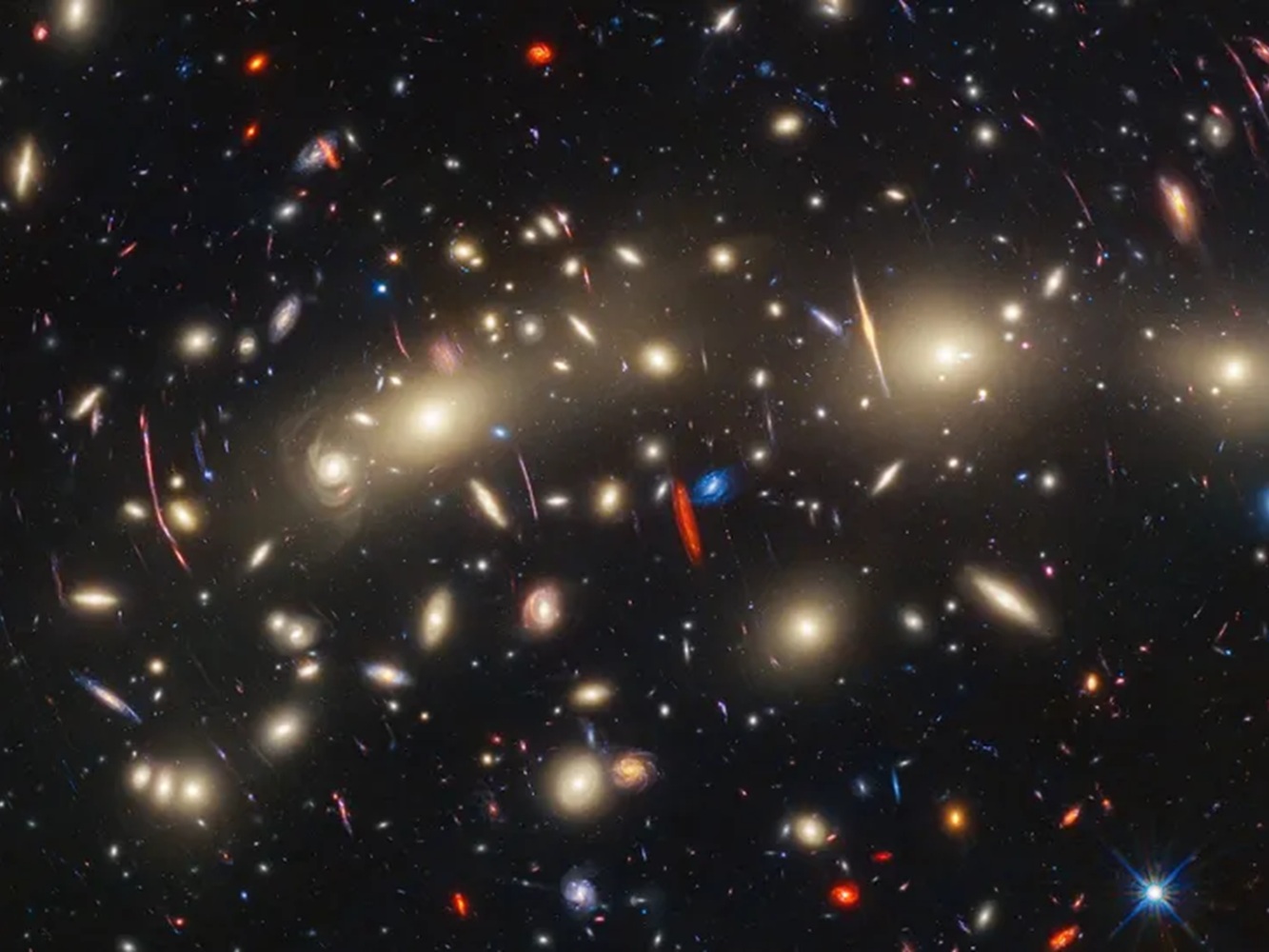
Seeing so far back in time isn’t easy—and that’s where physics lends a hand. Albert Einstein’s theory of general relativity predicts that massive objects can warp spacetime and bend light, acting as natural magnifying lenses. In this case, a galaxy cluster known as MACS J0416 amplified the faint glow from LAP1-B, allowing JWST to capture details that would otherwise be far too dim to detect.
What makes LAP1-B so compelling is how well it matches the checklist for Population III stars. The researchers say it meets all three major criteria used to identify these primordial objects:
– It formed in an environment with extremely low metallicity, predominantly hydrogen and helium.
– It appears to be a relatively low-mass cluster that hosts a few very massive stars.
– Its stellar masses line up with the expected initial mass function—the distribution of star sizes at birth—predicted for the early universe.
If confirmed, this would mark the first direct detection of primordial stars, opening a new window on the dawn of starlight and the birth of galaxies. These first stars likely played a crucial role in transforming the early cosmos—seeding space with heavier elements through supernovae, shaping nascent galaxies, and lighting up the universe after the cosmic dark ages.
The findings are still preliminary, and more observations will be needed to rule out alternative explanations. Follow-up spectroscopy, additional gravitational lensing models, and deeper imaging will help verify whether LAP1-B truly represents Population III stars or an unusual later-generation system that mimics some of the same signals.
Either way, the science payoff is enormous. By probing targets like LAP1-B, JWST is pushing into an era when the very first structures emerged from dark matter scaffolding, revealing how tiny fluctuations evolved into the galaxies we see today. Each new candidate brings us closer to answering one of astronomy’s biggest questions: when and how did the first stars ignite?
For now, LAP1-B stands as one of the most tantalizing clues yet—an apparent time capsule from just a few hundred million years after the Big Bang, magnified by nature and captured by the most powerful space telescope ever launched.