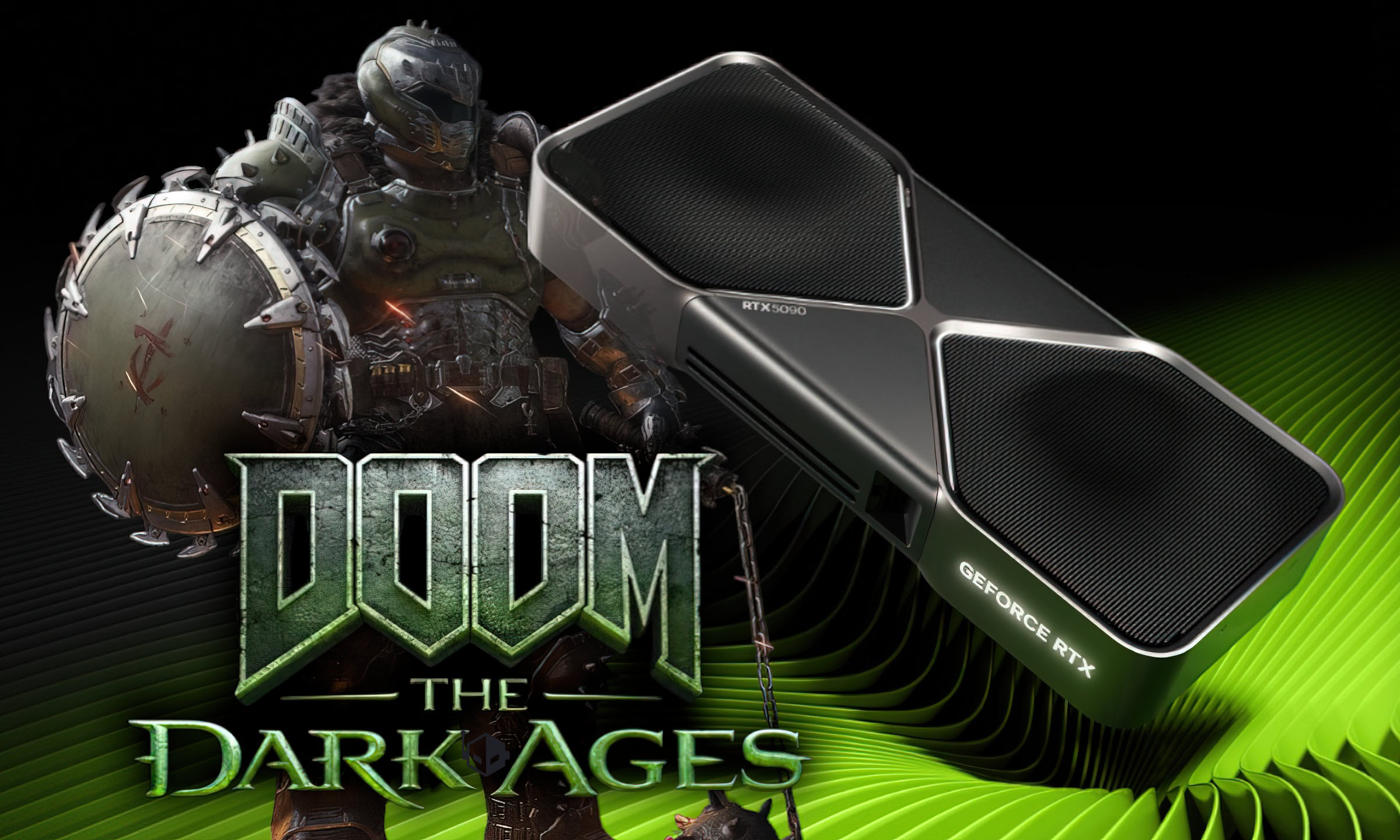
DOOM: The Dark Ages has just stepped up its game with the highly anticipated path tracing update, delivering a stunning visual boost bolstered by NVIDIA’s DLSS 4 technology. Known for its adrenaline-pumping demon-slaying action, this entry in the DOOM franchise takes the fast-paced thrills of previous titles like DOOM 2016 and DOOM: Eternal and enhances them with cutting-edge graphics.
With the introduction of Id Tech 8, the focus has been on increasing visual fidelity without sacrificing the speed and intensity that fans love. This update includes comprehensive path tracing, a feature that significantly enriches the game’s graphics, but requires powerful hardware to run smoothly.
While DOOM: Eternal first introduced ray tracing to the series, DOOM: The Dark Ages integrates it from the start. Utilizing NVIDIA’s latest RTX 50 series, players can experience the game at impressive frame rates, with the added benefits of NVIDIA’s MFG and DLSS 4x modes for even greater performance.
The path tracing update allows for detailed customization within the graphics configuration menu, including toggling Ray Traced Shadows and enabling or disabling Ray Traced Transparency and Path Traced Water Reflections. The game provides two Denoiser options: NVIDIA Real-Time Denoiser and DLSS Ray Reconstruction, catering to different GPU capabilities.
Testing results on a top-tier Intel Core i9-13900K paired with an NVIDIA GeForce RTX 5090 show significant performance metrics. Native resolution with ray tracing offers approximately 90 FPS, which drops to 35 FPS with path tracing enabled. However, employing DLSS and MFG modes can boost the experience back to high performance levels, achieving up to 200 FPS with DLSS Quality presets.
For gamers utilizing high-refresh-rate 4K screens, opting for DLSS 4 Performance or Balanced modes can push performance even further, maintaining visual quality while maximizing FPS.
Graphics comparisons reveal striking differences between path traced (PT) and ray traced (RT) visuals. PT enhances lighting and shadow details, creating more natural and immersive environments. Reflections on wet surfaces and light source details are also significantly improved with Ray Reconstruction enabled, showcasing the full potential of the update.
Overall, DOOM: The Dark Ages has reached new heights in visual sophistication, offering a truly enhanced demon-slaying adventure that will captivate both new players and long-time fans of the series.The visual experience of gaming has reached new heights with the integration of Path Tracing technology. When enabled, scenes instantly become more immersive and exquisitely lit. This enhancement goes beyond mere lighting; it introduces a sophisticated level of Global Illumination (GI) that avoids over-saturating surfaces not directly in the light’s path. Imagine more realistic interactions between light and objects, such as walls and weapons, offering a true-to-life depiction.
Path Tracing, coupled with Ray Reconstruction, significantly elevates the visual quality of statues, pillars, and light-reflective materials. In expansive open environments, the impact is even more dramatic. Shadows and GI work together to transform scenes on a larger scale, making them breathtakingly realistic.
One specific example showcases how flames are reflected accurately on nearby surfaces. While traditional Ray Tracing might only cast an orange hue on the ground, Path Tracing captures reflections in stunning detail.
Moving indoors, surfaces and objects benefit greatly when ray reconstruction is enabled. The level of detail becomes more pronounced, offering gamers a richer and more refined viewing experience.
In a large environment scenario, Path Tracing helps light sources stand out more vividly. This enhanced lighting showcases the capabilities of modern graphics technology.
Now, let’s talk about DOOM: The Dark Ages, a game that’s redefined visual excellence in fast-paced shooters. Leveraging the power of the Id Tech 8 engine, the game takes a significant leap in graphics quality. The introduction of Path Tracing is a game-changer for players with cutting-edge hardware, offering remarkable improvements in lighting, shadows, and reflections.
However, there’s a trade-off. Path Tracing demands a lot from your system, resulting in a performance hit of over 50% when settings are maxed out. Enter NVIDIA’s DLSS 4 technology. With its upscaling and frame generation capabilities, the latest RTX 50 GPUs still deliver impressive FPS, often exceeding 200 in MFG 4x mode with minimal lag, thanks to Reflex. Even the RTX 40 series shows robust performance in DLSS 4 “Performance” mode. While older GPUs like the RTX 30 and RTX 20 series lack frame-gen support, DLSS upscaling helps them achieve over 100 FPS.
This is just the beginning for Path Tracing in DOOM: The Dark Ages. Future updates promise further improvements in performance. For those seeking the ultimate gaming experience, Path Tracing combined with DLSS 4 represents the future of immersive gameplay. Enjoy the revolution in visual fidelity today!