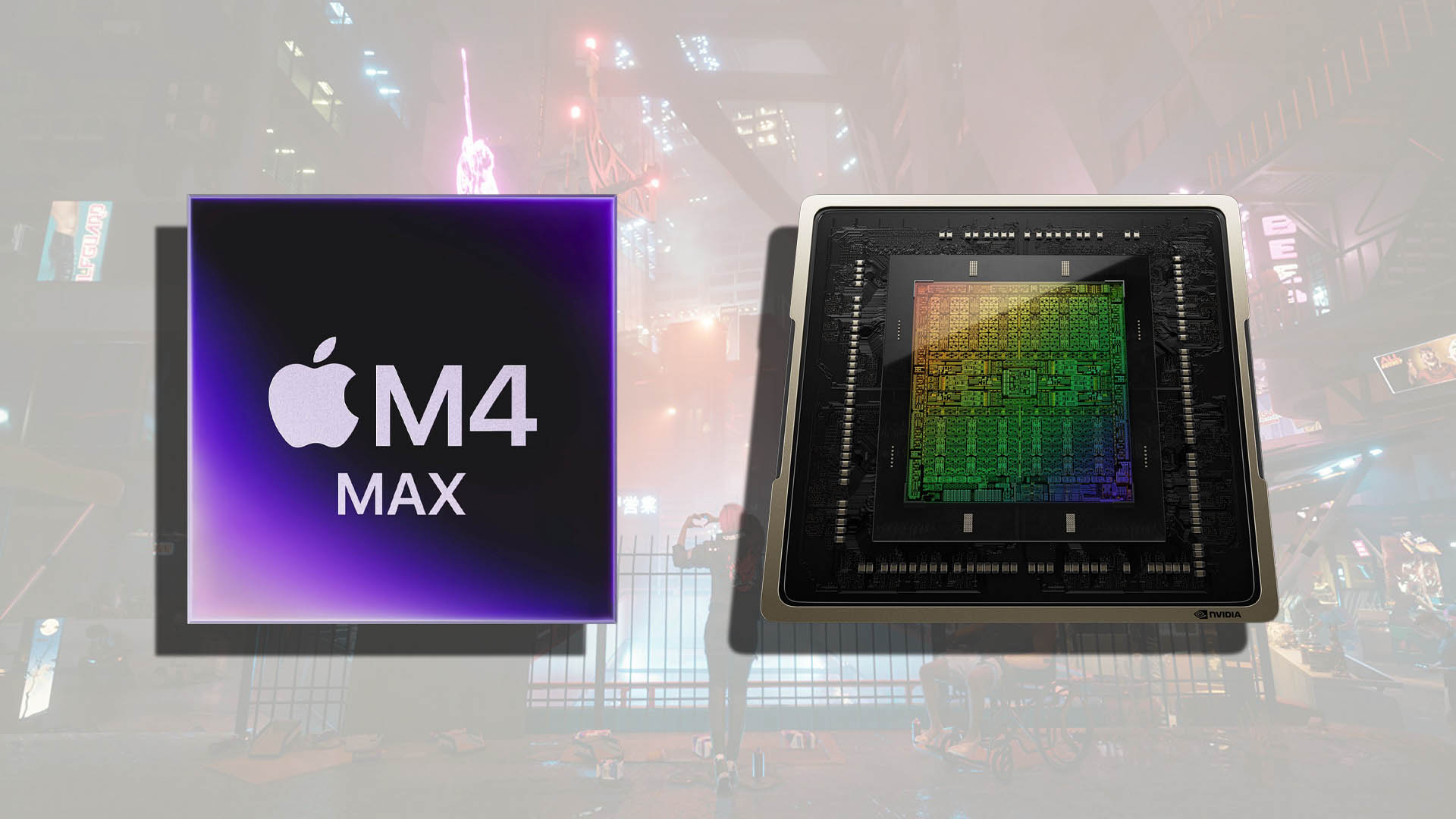
The latest face-off in the world of portable computing pits NVIDIA’s RTX 5090 against Apple’s M4 Max, both claiming supremacy in their realms. On one hand, we have the RTX 5090, currently the fastest mobile graphics processor available. On the other, Apple’s M4 Max is touted as the quickest internal GPU in a portable device. With Cyberpunk 2077: Ultimate Edition now accessible on both Windows and macOS, it’s the perfect time to explore which silicon truly excels.
In a recent test conducted while running on battery power, the M4 Max delivered a mere 10 frames per second (FPS) in Cyberpunk 2077 at maximum settings without any upscaling. Previously, the M4 Max was shown hitting 120 FPS in the same game; however, this was achieved with upscaling and interpolation techniques, which inflate performance figures. For this comparison, the M4 Max was paired with a MacBook Pro and pitted against an Alienware Area-51 laptop equipped with NVIDIA’s RTX 5090.
Playing graphically intense games like Cyberpunk 2077 on battery power is typically not recommended, as such games demand substantial energy. This test aimed to measure the ‘performance per watt’ capabilities of both chips rather than raw power. With everything cranked up and no tricks to boost framerates, the M4 Max averaged 10.72 FPS, while the RTX 5090 managed a 43.7 percent superior framerate at 15.41 FPS.
In terms of ‘performance per watt,’ the M4 Max scored 0.21, just slightly trailing the RTX 5090’s 0.22. Power consumption was another critical factor, with the M4 Max averaging 52W compared to the RTX 5090’s 70W. Given that the RTX 5090 can handle up to 175W, there’s little doubt that it outshines the M4 Max in pure power tests. However, in terms of efficiency, the M4 Max has the edge, particularly when the Alienware Area-51 is connected to a power source.
While only the RTX 5090’s average power limit was recorded during these tests, if we were to factor in the CPU’s energy consumption, the M4 Max emerges as a more promising piece of silicon. Despite the focus on efficiency rather than framerate performance, these observations offer a fascinating glimpse into the strengths and limits of both technologies.