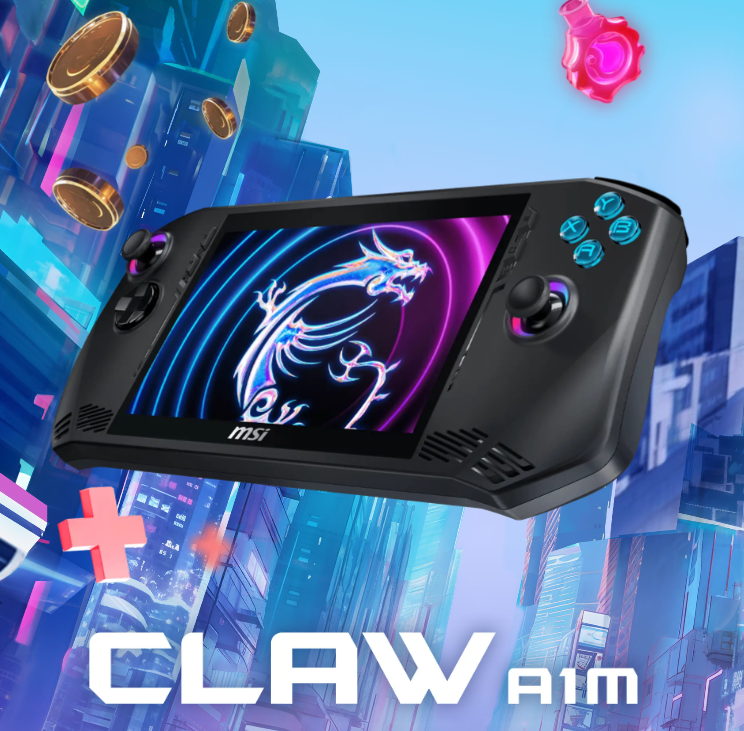
Gamers anticipating new handheld devices had their eyes on the MSI Claw, a contender purported to disrupt the portable gaming scene. The excitement was partly due to its Intel Core Ultra 7-155H and Core Ultra 5-135H options, veering from the typical choice of AMD APUs in handhelds like the ROG Ally, Steam Deck, and Lenovo Legion Go. However, the MSI Claw’s introduction may be signalling some concerns for Intel’s readiness in the gaming handheld sector.
After the launch, multiple reviews surfaced, offering a critical look at the device’s performance. Though the design of the MSI Claw promised a high-end experience, it appears to fall short in comparison to devices powered by AMD’s 8840U chip, particularly in terms of frame rate production. When operating at maximum power, the MSI Claw offered approximately 37% fewer frames per second and even trailed AMD’s offering by 47% when matching power budgets, consuming an additional 5 watts.
This performance disparity was highlighted across various games, though there was a slight lead for the Claw on average frame rates in the game Returnal. Despite this, it still could not maintain a lead in maintaining consistent low frame rates, with the additional power draw raising questions about its efficiency.
When the conversation turns to power idleness, the MSI Claw is noted to idle at 7 watts. There is potential for improvement if Intel can reduce this idle power consumption, but even so, it might not be enough to close the performance gap. For instance, at a 10-watt power draw, the Claw’s frame rates drop to single digits, a stark comparison to the Steam Deck’s prowess at the same power level with a maximum TDP of 15 watts.
Intel may enhance the device’s performance with driver updates in the future, but previous experiences with Intel graphics drivers, like those seen with the GPD Win 2 or 3, may leave users weary. The task of finding the right driver to simply get games to run can be frustratingly akin to a game of chance on Intel-powered devices.
Nonetheless, Intel’s commitment to improving its graphics drivers and contributing to the competitive GPU ecosystem is a potential beacon of hope. Past launches of Intel’s desktop GPUs show a trend towards better performance over time, although they still remain within mid-range performance levels compared to some competitors.
From a design perspective, opinions on the MSI Claw’s aggressive look may vary, but as things stand, its performance raises substantial concerns, particularly when considering its price point. Gamers might be better served by investing in competitors like the ROG Ally, Steam Deck, or Lenovo Legion Go, which offer not only better performance but also increased reliability and possibly, less hassle with graphics drivers.
In the interim, while keeping an eye on possible improvements from Intel, consumers in the gaming handheld market might prioritize proven performance and stability over potential and promises. The MSI Claw’s release has certainly brought attention to the need for Intel to step up its game if it is to truly compete in the portable gaming arena.


