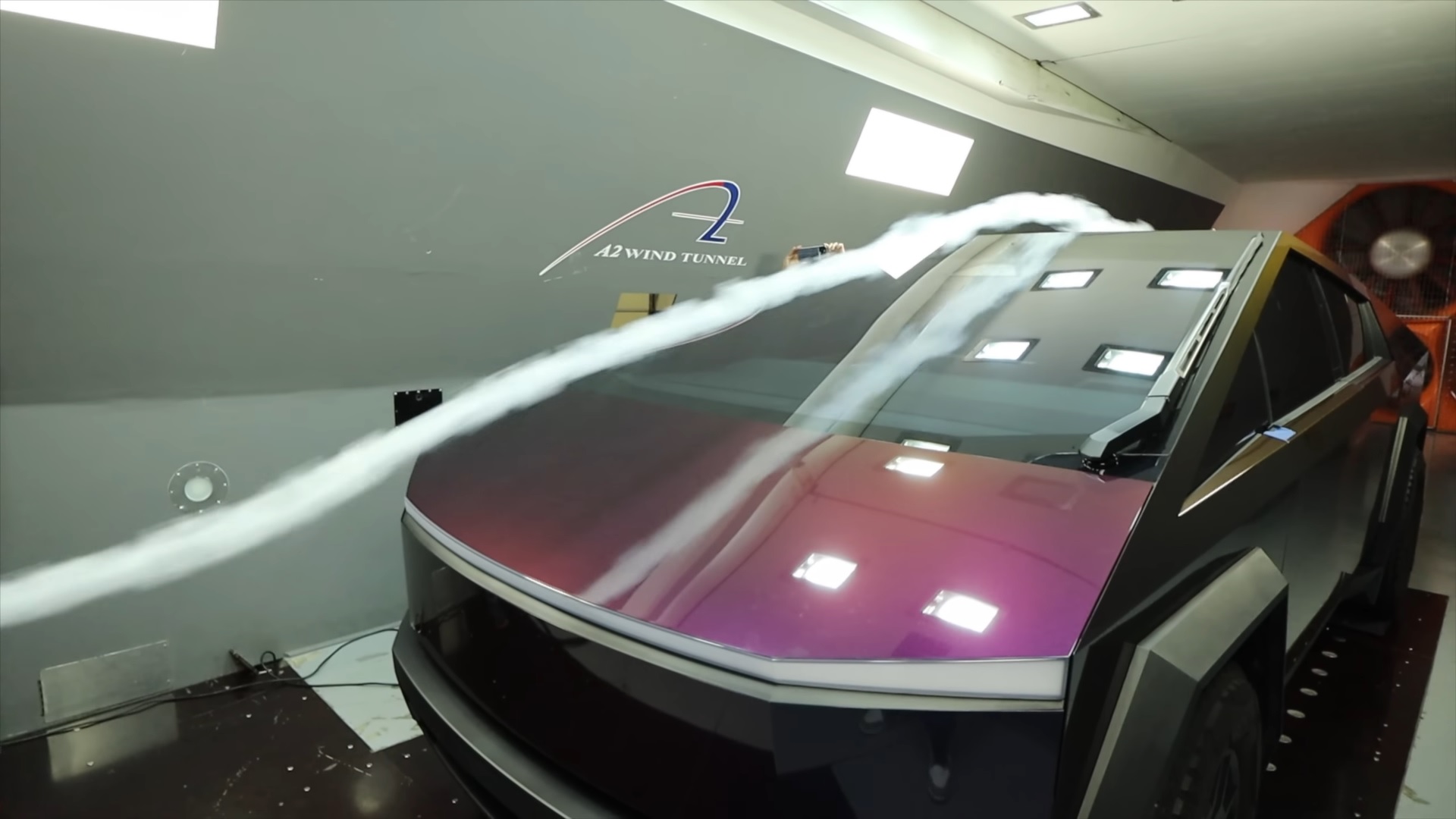
Aerodynamic efficiency in vehicles is a critical performance metric, with manufacturers often striving to achieve low drag coefficients for better fuel economy and reduced environmental impact. Tesla’s Cybertruck, with its distinctive design and futuristic appeal, has been a topic of much discussion, particularly its aerodynamic claims. Recent independent testing has provided a closer look at the actual drag coefficient of the Cybertruck, compared to Tesla’s official figures.
The significance of a vehicle’s drag coefficient cannot be overstated. Essentially, it quantifies how smoothly a vehicle can travel through the air. The lower the drag coefficient, the less resistance the vehicle faces and the less energy it needs to maintain speed, thus improving efficiency and reducing fuel consumption or, in the case of electric vehicles, extending their range.
When considering Tesla’s Cybertruck, its official claim posited a drag coefficient of 0.34, which would outperform other trucks in its segment, such as the Ford F-150 Lightning, reported to have a drag coefficient of 0.44. However, independent testing paints a different picture.
The wind tunnel tests executed by a third-party researcher showed that the Cybertruck’s aerodynamics are most efficient when the vehicle is in its low-height driving mode, features closed tonneau cover and trunk, and has the side mirrors removed. According to these tests, the Cybertruck has a drag coefficient of 0.387 in this optimized low-height state.
In contrast, higher driving modes showed increased drag coefficients of 0.405 and 0.442 for medium and high settings, respectively. It was also found that with the tonneau cover open, even in the most aerodynamic low-height mode, the drag coefficient escalated to 0.424, with slight variations depending on the state of the trunk.
Overall, the findings indicated an average drag coefficient of 0.384 for the Cybertruck, approximately 13% higher than Tesla’s advertised figure. Interestingly, this figure aligns fairly well with a previously simulated test result of 0.39, suggesting that the official numbers may have been somewhat optimistic.
It’s worth noting that experimental results, such as those from wind tunnel testing, can vary depending on the setup and calibration of the testing facility, and each wind tunnel may produce slightly different results. Furthermore, the shape and size of the vehicle’s frontal area significantly influence its drag coefficient, and the Cybertruck’s unconventional design makes its aerodynamic performance a subject of particular interest.
As we examine the aerodynamic attributes of vehicles like the Tesla Cybertruck, we are reminded of the complex balance between form and function. Design choices can have a substantial impact on the vehicle’s performance and efficiency, and it’s clear that accurate, real-world testing is indispensable in understanding these effects. For prospective owners, this information could influence their expectations and decision-making process, especially regarding range and efficiency claims.
For those interested in vehicle aerodynamics, it is essential to recognize the value of meeting performance claims, since they often relate to the vehicle’s operational costs and environmental impact. The Tesla Cybertruck’s aerodynamic performance offers a fascinating case study into how revolutionary designs integrate with the principles of aerodynamics to achieve both functionality and aesthetic appeal.


