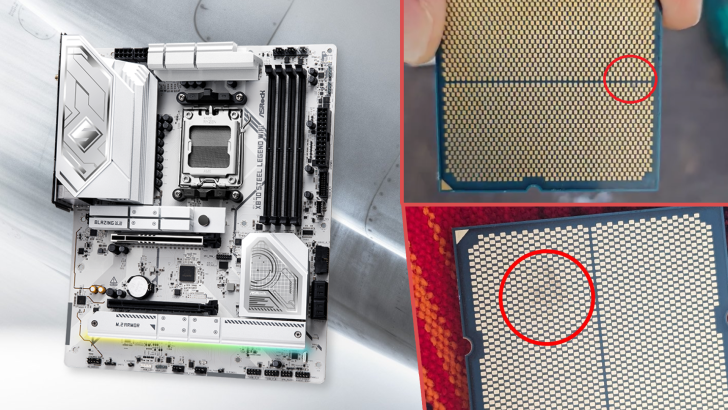
Another unfortunate incident has surfaced regarding the Zen 5 Ryzen 9000 series CPUs. This time, it’s a non-X3D processor that met its demise on an ASRock motherboard. The renowned tech enthusiast, Tech Yes City, recently shared the story of his Ryzen 9 9950X unexpectedly biting the dust while being paired with an ASRock X870 Steel Legend board.
The issue has become unsettlingly common, with ASRock motherboards reportedly being responsible for the untimely demise of nearly 200 Ryzen 9000 CPUs. While other motherboard brands have also had similar issues, ASRock appears to be leading this troubling trend. Considering potential unreported cases, the numbers could be even higher.
In a video, Bryan from Tech Yes City pointed out visible damage on his CPU, highlighting greyish pins that display burn marks—possibly a result of excessive voltage. Another user shared a similar experience with the Ryzen 7800X3D, which survived after some cleaning despite initial burn marks.
This puzzling scenario has repeated itself across the Ryzen 9800X3D lineup as well, leaving many CPUs either functional or completely dead. ASRock suggests debris inside the socket might be to blame. However, given the scale of the problem, questions remain about whether user error is genuinely a plausible explanation.
Notably, one user observed alarming power consumption on a Ryzen 7 9800X3D setup with an ASRock X670E Steel Legend motherboard. After a BIOS update, the motherboard reportedly pushed 170W to the CPU, suggesting a potential issue with ASRock’s BIOS updates. Unfortunately, for many users, this realization came too late, with a significant number of Ryzen 9800X3D units already affected.
The statistics are concerning. Of the reported deaths, 157 involve the Ryzen 7 9800X3D, predominantly linked to ASRock boards. Similarly, out of the 8 cases concerning the Ryzen 9950X3D, 7 involved ASRock motherboards. Additionally, 16 reports concern the non-X3D Ryzen 9000 CPUs, with 15 linked to ASRock.
These figures indicate a troubling pattern, suggesting ASRock motherboards are a consistent part of the problem. The tech community eagerly awaits further investigation and resolution regarding these ongoing issues.


