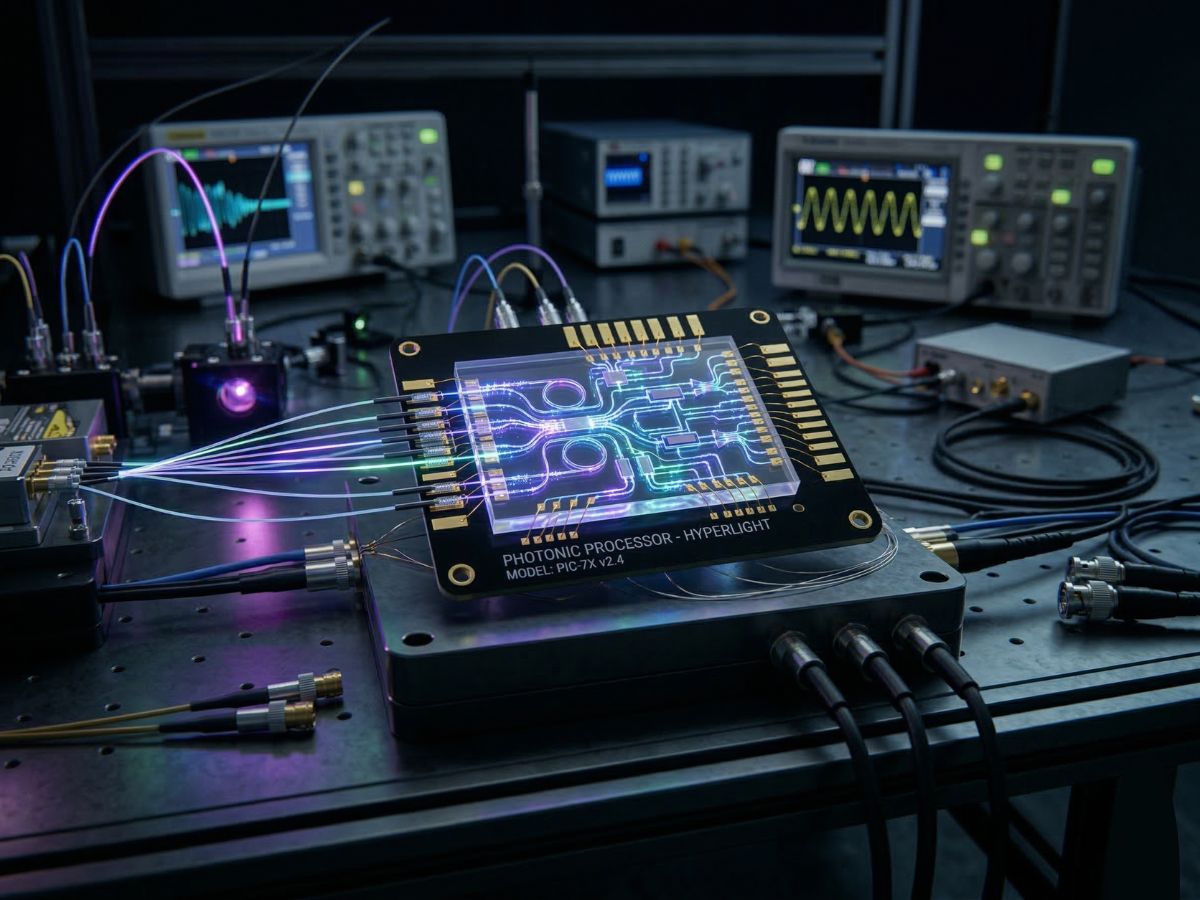
Researchers at the University of Sydney have created an ultra-compact “light-based” processor that could help solve one of the biggest problems facing modern AI: the soaring energy cost of computation. As machine learning models get larger and more complex, today’s electronic chips are increasingly strained by power demands and the heat produced when they move electrically charged particles through circuits. This new approach replaces much of that electronic effort with something faster and far more efficient—photons.
Instead of relying on electricity to perform calculations, the team built a nanoscale photonic processor that computes with light. The breakthrough comes from an advanced design method powered by detailed computer simulations, allowing researchers to precisely model how light waves behave and interact inside complex three-dimensional structures. With that roadmap, they can assemble tiny physical “building blocks,” each smaller than the wavelength of light, and treat them as tunable data points.
The result is a remarkably dense computing platform, reaching about 400 million parameters per square millimeter. Even more impressive is its size: the key nanostructures span only tens of micrometers, making the processor roughly comparable to the width of a human hair. That compact scale matters because it opens the door to packing serious AI capability into extremely small hardware footprints—without the typical power-and-heat penalties.
What makes the chip especially interesting for artificial intelligence is how it performs the math. As light travels through the chip’s intricate nanostructures, the geometry itself carries out the operations needed for machine learning. In other words, the “shape” of the material becomes part of the computation. Since photons move through the system at light speed and the process avoids many of the resistive losses found in electronics, calculations can be completed in trillionths of a second.
To test the concept in a real-world scenario, the researchers used the photonic neural network to classify more than 10,000 biomedical images, including scans of the chest, breast, and abdomen. In physical experiments, the system reached around 90% accuracy. In simulations, it climbed as high as 99%, highlighting the potential performance gains as designs and manufacturing methods continue to improve.
Beyond speed, the bigger story is sustainability. Data centers and AI infrastructure already consume vast amounts of energy, and the environmental footprint is expected to rise as AI adoption accelerates. By embedding AI computation directly into nanoscale photonic structures and drastically cutting the energy required for processing, this kind of scalable photonic chip could become a key piece of future computing—supporting advanced machine learning while reducing heat, power consumption, and the overall cost of running next-generation AI systems.