Intel’s next-generation desktop CPU platform is shaping up to be a meaningful upgrade for anyone who cares about memory performance, and a new embedded PC showcase may have just offered an early clue about what to expect.
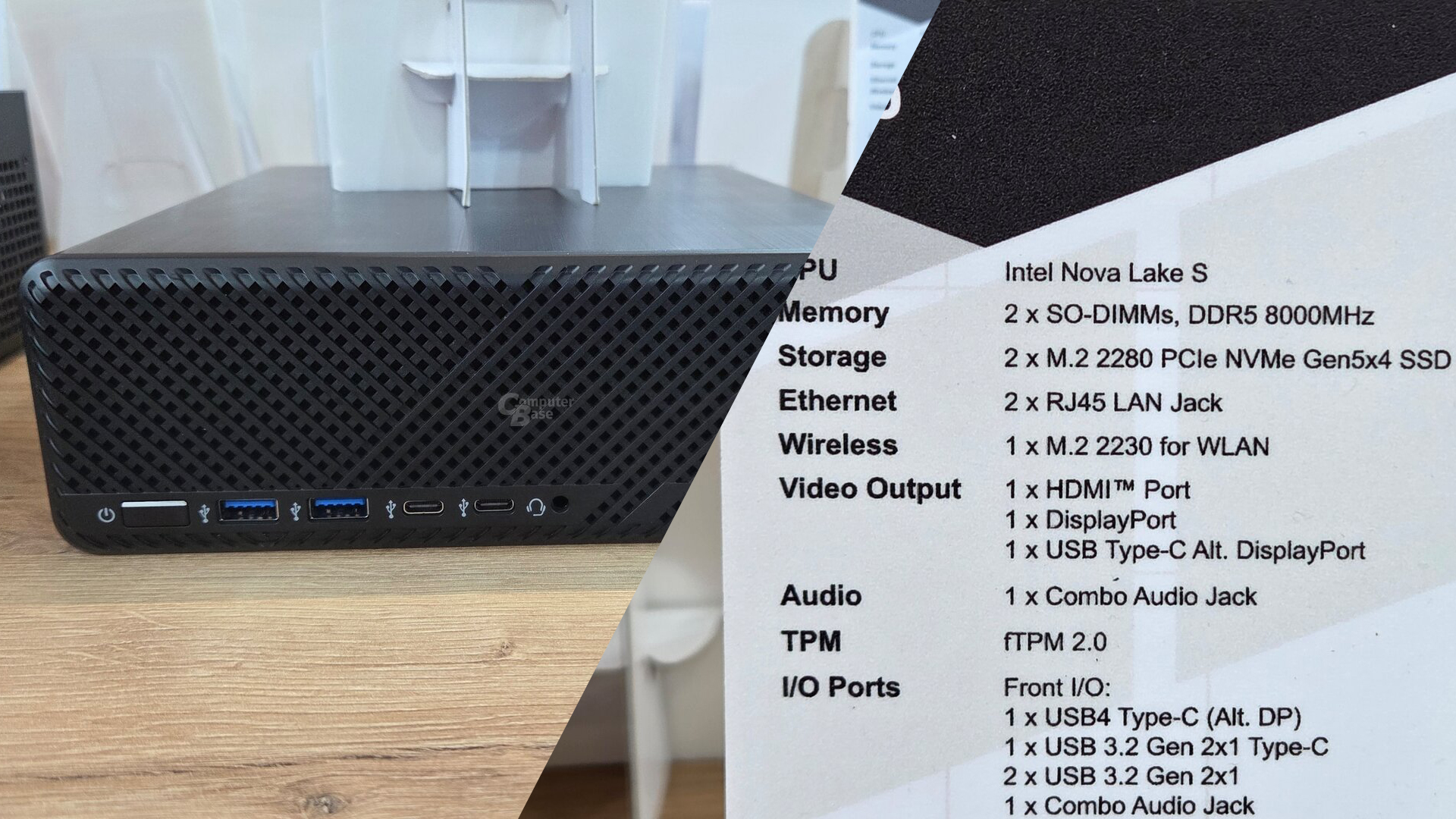
At Embedded World 2026 in Germany, PC maker ECS displayed a mockup of an upcoming embedded system called the Liva P300. The unit is said to be based on Intel’s Nova Lake-S (also referred to as the Core Ultra 400S desktop-class lineup). Even though the device on display is described as a mockup—meaning it likely wasn’t running a final, real Nova Lake processor—the printed spec sheet alongside it is still noteworthy because it points to a major improvement in native DDR5 support.
According to the information shown, Nova Lake-S is expected to support DDR5-8000 out of the box. If that holds true in shipping systems, it would be a clear jump over current-generation Intel desktop parts. For perspective, Arrow Lake currently tops out at DDR5-6400 officially, while an Arrow Lake refresh is widely expected to raise that ceiling to DDR5-7200. Moving from 7200 MT/s to 8000 MT/s would represent another significant step forward in Intel’s default memory support—something enthusiasts often have to rely on manual tuning and high-end kits to achieve reliably.
The ECS listing doesn’t go deep into processor details like the specific SKU, exact core configuration, or clock speeds. However, the Liva P300’s power design does offer another small hint about the platform’s direction. The mockup is shown with a built-in 120W power supply, though it’s suggested that higher-power versions could move closer to 240W. That matters because top-tier Nova Lake-S chips are rumored to reach as high as 175W TDP, while lower-power 65W models would be far more at home in compact embedded-style PCs like this one. If ECS is targeting broad compatibility, it’s reasonable to expect Liva P300 variants built around the more efficient Nova Lake-S options.
Timing-wise, Intel is expected to introduce the Nova Lake series in the second half of 2026. If that schedule holds, early embedded systems built around the platform could start appearing in early 2027.
For PC builders and performance-focused users, the headline is simple: if Nova Lake-S truly brings native DDR5-8000 support, it could make high-frequency memory easier to run without heavy tweaking—potentially improving responsiveness and bandwidth in workloads that benefit from faster RAM, while also signaling a stronger memory controller than what we see in today’s lineup.


