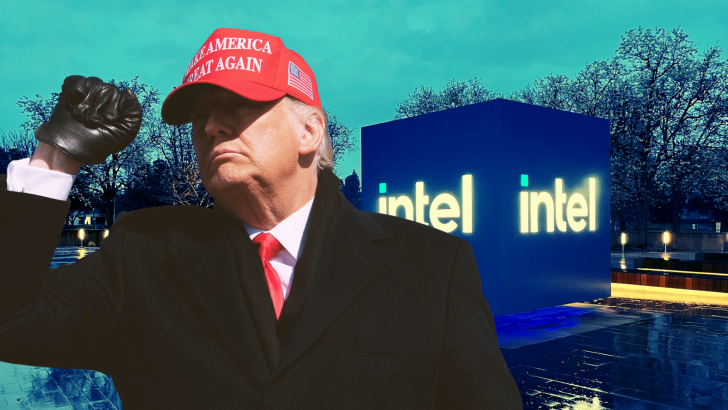
President Trump has publicly praised Intel for reaching a major manufacturing milestone: volume production on its 18A process, a “sub-2nm class” technology that Intel is positioning as its most advanced node yet. The endorsement is notable not just for what it says about Intel’s engineering progress, but also for how dramatically the political tone around the company—and its CEO, Lip-Bu Tan—has changed in a short period of time.
Only a few months ago, Intel found itself under intense scrutiny after concerns were raised about Tan’s past investment exposure to Chinese companies. That scrutiny spilled into public criticism, adding to the pressure of leading a company already navigating a difficult turnaround. Intel’s foundry ambitions had been questioned, the business was dealing with internal disagreements over strategy, and the new CEO faced skepticism from multiple directions.
Since then, the narrative has shifted. In a recent Truth Social message, President Trump highlighted Intel’s Panther Lake plans and specifically called out the 18A process as a cutting-edge American manufacturing win. Trump also mentioned meeting with Lip-Bu Tan, signaling that communication between Intel’s leadership and the U.S. government has warmed considerably—and that Intel’s role in rebuilding domestic semiconductor manufacturing is being treated as strategically important.
A key part of the shift, according to the post’s details, was Tan’s direct outreach to Commerce Secretary Howard Lutnick. Because Intel’s U.S. expansion is tied to CHIPS Act support, the Commerce Department has been closely tracking Intel’s commitments and progress on advanced chip production. That engagement reportedly helped set up a meeting with President Trump and reset the relationship at a critical time.
Another major factor was a reported 10% U.S. government stake in Intel. The post frames this as a breakthrough that gives the government deeper visibility into how Intel executes its manufacturing roadmap and how CHIPS-related funding translates into real production capacity. It also connects that stake to $8.9 billion in pledged investment via grants—positioned as both a balance-sheet boost and a way to reduce uncertainty around incentive programs that have faced political debate.
With the U.S.–Intel alignment strengthened, Intel’s 18A progress—and the upcoming Panther Lake launch built on that process—has become a symbol of momentum. The optics of a U.S. president celebrating Intel’s manufacturing progress suggest that Intel is being treated as a cornerstone of America’s advanced-node ambitions, competing in the same conversation as other top global foundries.
The post also claims the renewed commitment helped open doors to broader industry interest. It mentions deals involving NVIDIA and SoftBank and suggests that companies such as Apple, Qualcomm, and Microsoft are exploring manufacturing arrangements with Intel across both front-end and back-end semiconductor services.
There’s an important nuance here: 18A may not be the final destination for external foundry customers. The post indicates that Intel’s future nodes—18A-P and 14A—are expected to play a bigger role in strengthening Intel’s competitiveness in the global foundry market. If Intel executes on those roadmaps while maintaining government and industry confidence, the company could turn what was recently a politically and financially complicated situation into a long-term manufacturing advantage.
In the middle of shifting geopolitics, domestic industrial policy, and chip supply chain pressure, Lip-Bu Tan’s early tenure is being framed as a rapid pivot: from controversy and uncertainty to visible backing at the highest levels and a clearer runway for Intel’s advanced process technology plans.


