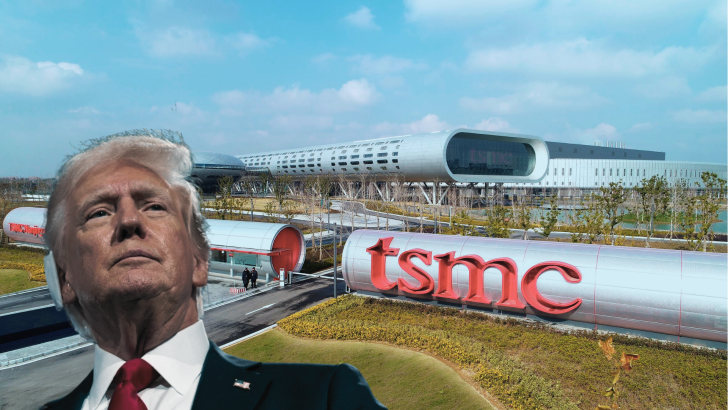
In a bold move, former President Donald Trump has announced plans to impose tariffs on semiconductors manufactured in Taiwan. This decision aims to encourage domestic production of critical technologies and shift reliance away from foreign sources. During a recent House Republican conference, Trump stated that taxing imported chips would compel companies like TSMC to establish facilities in America, rather than continuing production abroad.
Trump criticized the CHIPS Act, introduced during President Biden’s administration, labeling it as a mere financial distribution plan with no meaningful incentive for boosting the US semiconductor industry. According to Trump, substantial investments in companies like TSMC have not led to an increase in domestic production, which he sees as a missed opportunity for America.
He suggested that upcoming tariffs could range significantly, potentially escalating to as much as 100%. Such a measure could shock the semiconductor industry, which heavily relies on Taiwanese chips for mainstream devices. This development might drive up costs, affecting consumer electronics prices and potentially hampering market growth in the US. TSMC’s advanced technologies, like their 3nm processes, could become less accessible, impacting tech giants relying on these innovations.
It’s worth mentioning that the CHIPS Act has stimulated some movement towards local manufacturing, with TSMC already operating a facility in Arizona and planning further expansions to advance to a 2nm process. TSMC’s efforts suggest a willingness to participate in the US semiconductor landscape, even as it continues operations in Taiwan.
Whether these tariffs will indeed bolster America’s technological self-reliance remains to be seen. The intricate balance between incentivizing domestic manufacturing and maintaining affordable tech products is a complex challenge that the tariff proposal will certainly test.