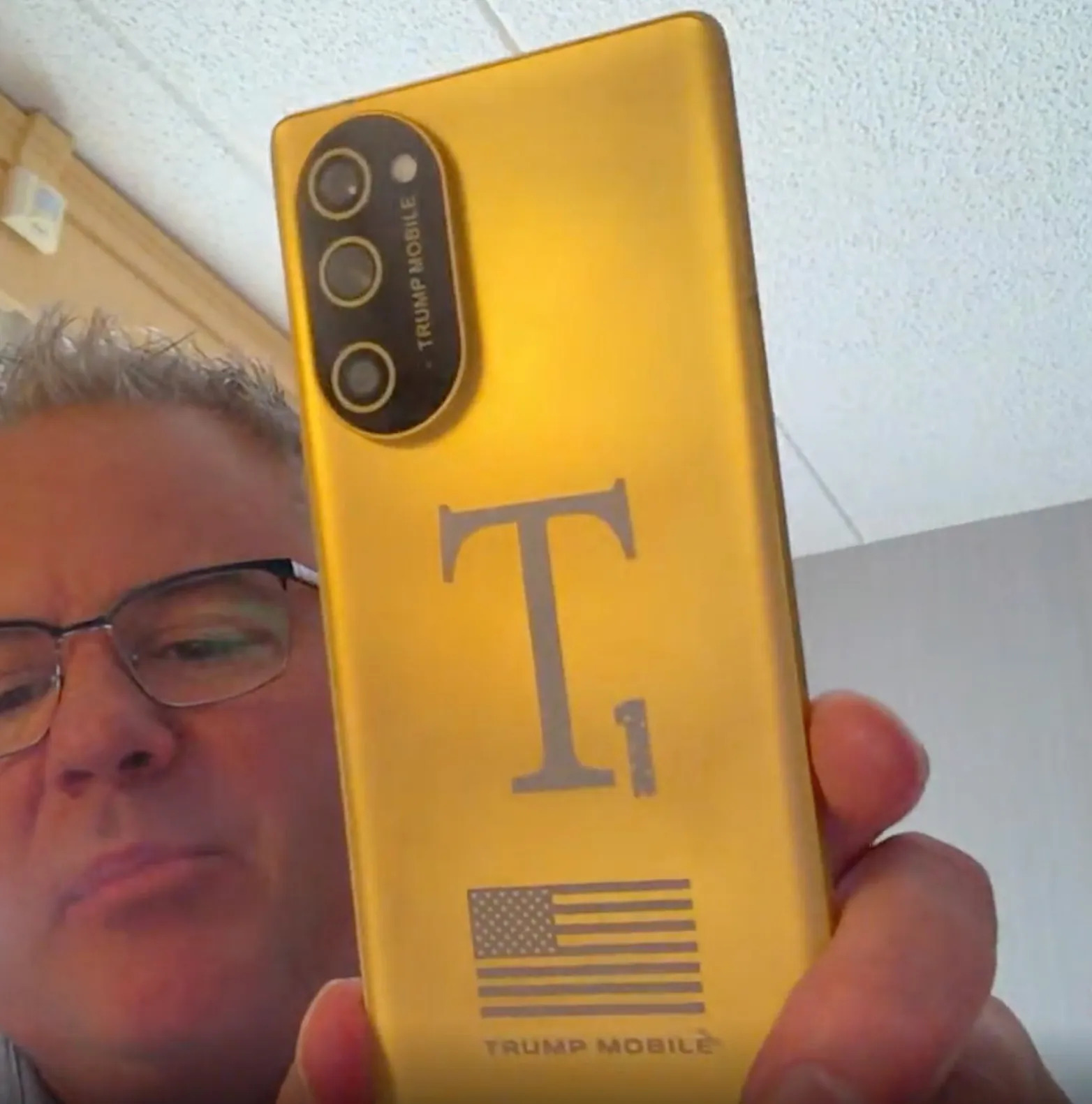
Some products invite political debate. Others are so visually loud that politics fades into the background for a moment and you’re left judging the object purely on design. Trump Mobile’s T1 Phone lands squarely in that second category, and its near-final look is turning heads for all the wrong reasons.
Trump Mobile operates as an MVNO, meaning it uses the network infrastructure of major carriers while selling service under its own branded name. Back in June 2025, the company announced the $499 “made-in-America” T1 Phone, positioning it as a patriotic, premium-sounding alternative in a crowded smartphone market. The claim immediately drew skepticism from supply chain observers, who noted that fully manufacturing a modern smartphone in the United States is extraordinarily difficult due to how deeply smartphone components and assembly rely on Asia-based supply chains.
Not long after, further scrutiny suggested the T1 wasn’t a ground-up new device at all, but rather a re-skinned handset strongly resembling the China-made T-Mobile REVVL 7 Pro 5G—an example frequently priced far below the T1’s announced cost. Despite the fanfare, the phone has also faced repeated delays and still hasn’t launched in a normal, widely available way.
Now a near-production-ready version of the Trump Mobile T1 Phone has surfaced, and it appears to be a noticeable departure from the original device shown in 2025. One of the biggest changes is that the oversized “T1” logo on the back is reportedly being removed in the final version. The hardware itself also looks revised: the screen appears to be a “waterfall” display with curved edges, and it seems closer to the 6.78-inch size that was teased earlier. Around back, the earlier triangular camera styling is gone, replaced by a vertical triple-camera arrangement inside a dedicated camera island.
The reported specifications are also more substantial than many expected. The near-final T1 is said to include 50MP cameras for both the main rear sensor and the front-facing selfie camera, a Qualcomm Snapdragon 7-series processor, a 5,000mAh battery, and 512GB of base storage. On paper, those are attention-grabbing numbers in the midrange-to-upper-midrange space, especially the storage capacity.
But higher specs can shift expectations—especially pricing. With the hardware seemingly upgraded, the originally advertised $499 price may not hold for everyone. As described, that price may be reserved for customers who previously placed a $100 deposit. Availability is said to depend on certification, with shipping expected once carrier approval is completed, potentially by mid-March.
Even with improved internals, the design is where the T1 draws the most criticism. The gold-toned finish comes off less like a refined, premium metallic and more like an aggressively shiny statement color that overwhelms the rest of the phone. Add in the American flag graphic and multiple “Trump Mobile” branding placements—both on the camera area and again near the bottom—and the back of the device can feel busy rather than sleek. The mix of tones and typography doesn’t appear especially cohesive, either, which further pushes the look toward “promotional” rather than “polished consumer electronics.”
In the end, the Trump Mobile T1 Phone is shaping up to be a story of two halves. The rumored near-final specs suggest a more capable device than many assumed at first glance. Yet the overall aesthetic—dominated by loud gold, layered branding, and a visually crowded rear panel—risks turning the phone into a conversation piece instead of an object people want to carry every day. For a smartphone competing in 2026, where clean design and subtle premium cues are often what win shoppers over, the T1’s biggest challenge may not be what’s inside the phone, but what people see the moment it’s pulled out of a pocket.