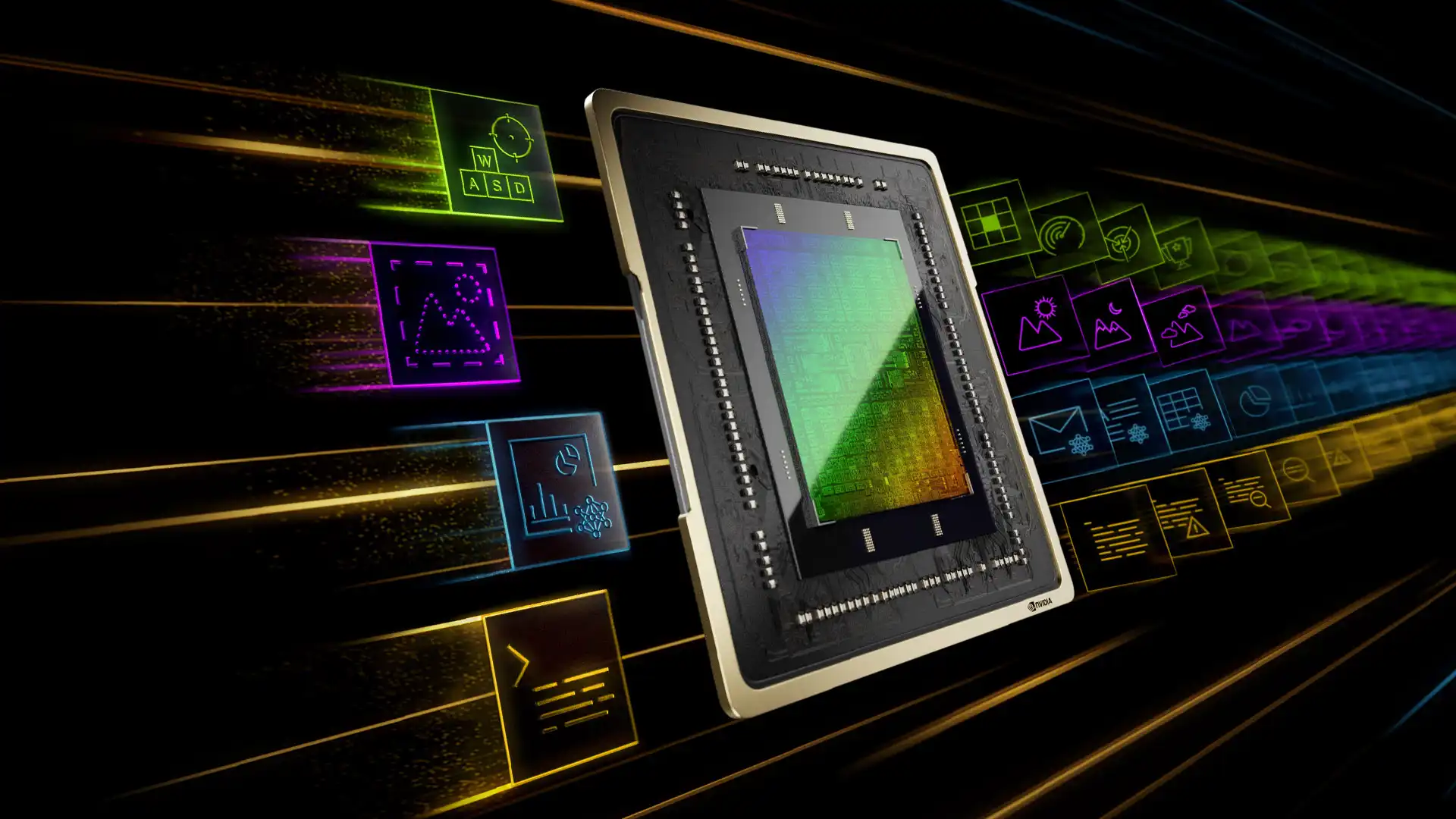
NVIDIA is pioneering the integration of artificial intelligence (AI) with graphics processing units (GPUs), heralding a new era of gaming and graphical excellence. With innovations like DLSS 3.5 and Ray Reconstruction, consumers are about to experience unprecedented visual fidelity. As AI infiltrates every aspect of technology, major companies like Microsoft and Amazon are incorporating AI to enhance computing and consumer experiences. NVIDIA, a leader in AI computing applications, is set to transform graphics processing with AI enhancements.
The intersection of AI and graphics is set to change how developers convey their creative visions. NVIDIA’s commitment to AI-enhanced graphics marks an evolution in the traditional approach to graphical rendering. The company is known for its previous ray-tracing technology that relied on various components to produce clear imagery, supporting features like DLSS 2. However, this older method had limitations, particularly in supporting image upscaling.
Enter “Ray Reconstruction,” NVIDIA’s innovative technique to reimagine ray-tracing. This AI-powered method uses a unified denoiser approach, employing multiple AI models to manage dynamic signals like moving shadows and light reflections. This development results in performance leaps beyond traditional denoisers, optimizing the ray tracing process and making it more accessible while also enabling older games to be graphically updated for today’s standards.
On the horizon, NVIDIA, as discussed by John Burgess at the High-Performance Graphics event, reveals future AI graphics endeavors for consumer-level GPUs such as RTX for GeForce and RTX for Workstations. Beyond post-processing enhancements like DLSS, AI could assist with numerous rendering tasks, a sentiment echoed by insights from Intel’s TAP.
NVIDIA is also innovating with Neural Texture Compression, NeuralVDB, and Neural Radiance Cache models. Neural Texture Compression uses a small MLP (Multi-Layer Perceptron) network to achieve a 4-16x increase in texture compression compared to standard methods, benefiting GPUs with limited VRAM. NeuralVDB handles compressed volume data, offering a substantial 10-100x compression ratio, simplifying complex simulations. Neural Radiance Cache employs a neural network to encode radiance data, significantly upgrading sample quality in path tracing renders.
Moving past ray tracing into the realms of shading performance and real-time rendering, NVIDIA introduces Neural Appearance Models (NAMs). Presented during the SIGGRAPH 2024 keynote, NAMs leverage AI to realistically render material appearances, surpassing traditional render methods’ efficiencies. Utilizing an encoder-decoder architecture, two MLPs, and optimized algorithms, NAMs provide what could be an exponential enhancement in rendering quality and speed, boasting up to 16K texture resolution and potentially reducing rendering times by 12-24 times.
These advancements by NVIDIA are not just incremental, they are transformational for the realm of graphic computation. As AI continues to evolve, the potential also grows for developers to create stunning visual experiences with a level of detail and efficiency previously unattainable. This marks a turning point in how we perceive, create, and interact with digital graphics. As consumers witness these technologies unfold, they will experience a leap in visual perception, making the virtual world more immersive and lifelike than ever before.NVIDIA’s envisioning of AI’s future in graphics reveals a spectrum of possibilities that could redefine our visual experiences. As we delve into this topic, let’s glean some insights into what this technology behemoth predicts for AI and its interplay with graphical enhancement.
One of the foundational tools in the AI graphic revolution is the Multilayer Perceptron (MLP). These seemingly simple structures possess an impressive ability to handle various tasks like data compression, approximating complex mathematics, and caching signal data – all of which are valuable in graphics rendering.
In terms of performance, MLPs stand out because they can keep pace with traditional rendering methods. This includes layer fusion and making the most of reduced precision and sparsity. The fact that MLPs are small in size means they can integrate seamlessly into current rendering pipelines without incurring significant costs.
However, it’s crucial to acknowledge the challenges that come along with this advancement. One such challenge is divergence, which refers to the potential issues when multiple threads in the GPU process separate neural networks for individual texel values. The core idea is that these threads are designed to operate in tandem, so overcoming both execution and data divergence is critical for cohesive operation.
AI’s potential in rendering was brilliantly demonstrated with an AI-created video that showcased a jeep traversing a rugged terrain, complete with a realistic dust trail and a credible response to the environmental conditions. This example, which required the computational power of tens of thousands of GPUs, was produced by employing an MLP that had been trained with a simple text prompt. As AI hardware continues to evolve, we can anticipate such high-level applications becoming accessible for consumer-grade GPUs.
There’s also an ongoing debate about the role of dedicated hardware, such as Neural Processing Units (NPUs), in relation to GPUs. One viewpoint suggests that an isolated hardware piece, not linked to a GPU, misses out on the beneficial ecosystem that complements neural networks. This ecosystem allows for a versatile application where programmable code can interact dynamically with tensor cores, facilitating the problem-solving process in a more integrated manner.
Future accelerators might also emerge within GPUs, offering further enhancements without necessitating new hardware, given that existing hardware is already equipped to accelerate the basic components for new developments.
The aforementioned advancements and discussions highlight how AI is not merely shaping the future of graphics but is poised to be the driving force behind unforeseen computational marvels. With technology like Neural Appearance Models and Ray Reconstruction leading the charge, it won’t be long before next-gen graphics reach the heights of our ambitions.
Investments in powerful hardware and continuous research hold the key to these developments, with NVIDIA at the forefront. The ongoing efforts in blending AI with graphics technology are set to revolutionize how we perceive and interact with digital visuals, setting the stage for a future where the line between the virtual and the real continues to blur.