ASRock NUC BOX-300 Mini PCs Debut With Intel Core 300 CPUs, 64GB DDR5 RAM, and Dual 2.5G LAN
ASRock has introduced its new NUC BOX-300 series, a compact mini PC lineup designed for everyday computing, office work, digital signage, light multitasking, and space-saving desktop setups. The new series includes two models: the NUC BOX-320 and the NUC BOX-304. Both systems use Intel Core 300 “Wildcat Lake” processors and pack a surprisingly strong set of connectivity options into a tiny chassis.
The new ASRock NUC BOX-300 mini PCs appear to be positioned as more affordable, lower-power alternatives to the company’s higher-end NUC Ultra 300 BOX systems. Instead of targeting demanding creative or professional workloads, these new models focus on practical daily performance in a compact form factor.
The ASRock NUC BOX-320 is powered by the Intel Core 5 320 processor. This chip features six cores in total, made up of two performance cores and four efficiency cores. It should be suitable for web browsing, document editing, spreadsheets, video streaming, remote work, point-of-sale systems, and other common desktop tasks.
The more affordable NUC BOX-304 uses the Intel Core 3 304 processor. This CPU comes with five cores, including one performance core and four efficiency cores. It is aimed at lighter workloads and basic productivity, making it a better fit for users who need a compact PC for simple tasks rather than heavy multitasking or demanding applications.
Neither model is designed for gaming or graphics-heavy workloads. Both rely on integrated Intel graphics, which should be enough for video playback, display output, and very light visual tasks, but not for modern gaming, advanced 3D rendering, or intensive GPU-based work.
One of the most notable features of the NUC BOX-300 series is memory support. Both mini PCs can be configured with up to 64GB of DDR5-6400 RAM through a single SODIMM slot. That is a generous ceiling for this class of compact PC and gives users more flexibility for multitasking, browser-heavy workflows, business software, and long-term usability.
Storage support is also practical for a small system. The mini PCs include an M.2 2242 slot using PCIe Gen 4 x1 and an M.2 2280 slot using PCIe Gen 4 x2. There is also an M.2 2230 slot used for wireless connectivity, with WiFi 6E and Bluetooth 5.3 included.
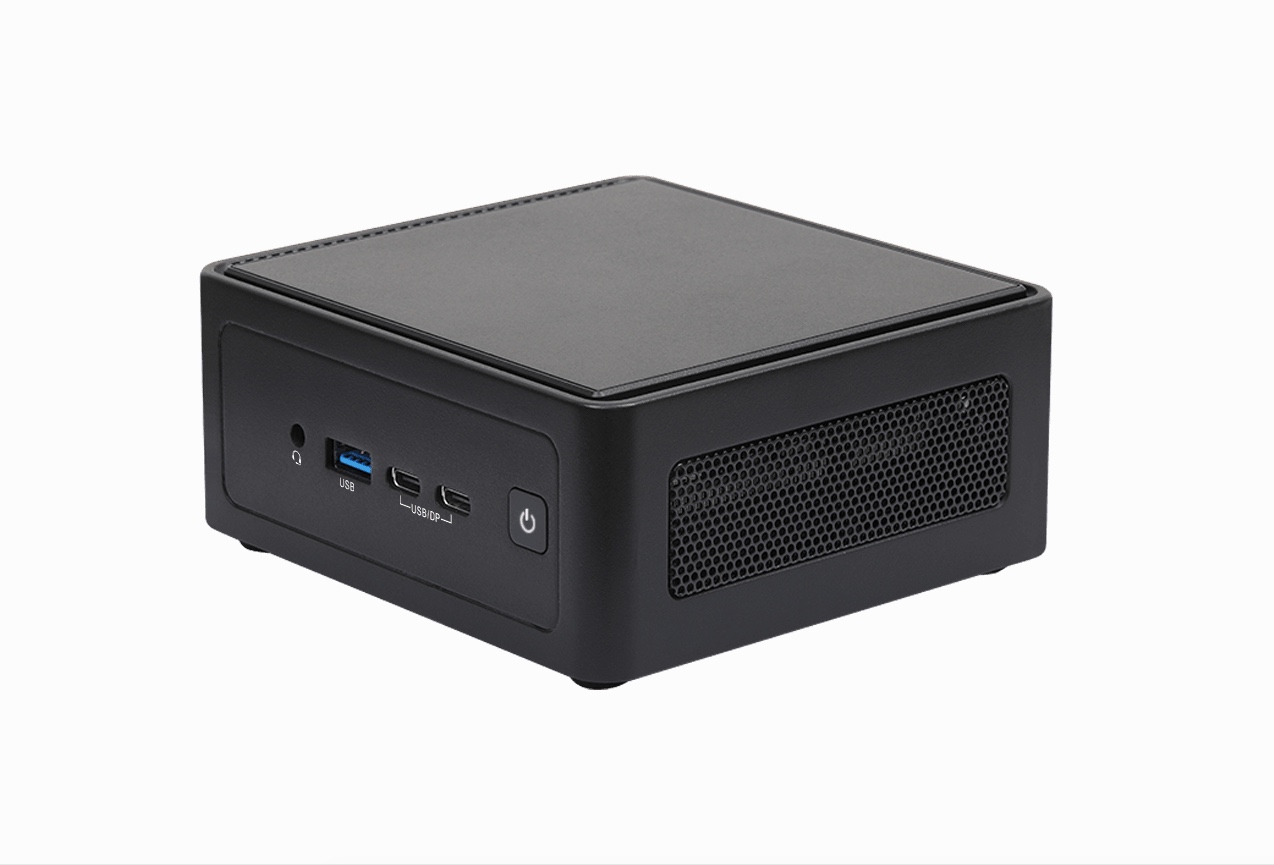
Connectivity is another strong point. The ASRock NUC BOX-300 series includes dual HDMI 2.1 outputs, allowing users to connect modern displays with ease. On the front, the systems offer one USB-A port and two USB-C ports with DisplayPort 1.4a support. Around the back, users get dual 2.5G Ethernet ports, dual HDMI, and additional USB-A ports.
The full I/O setup includes:
Dual HDMI 2.1
One USB 3.2 Gen 1 Type-A port
Two USB 3.2 Gen 2 Type-A ports
Two USB 3.2 Gen 2×2 Type-C ports with DisplayPort 1.4a
Dual 2.5G Ethernet
3.5mm audio jack
The inclusion of dual 2.5G LAN ports makes these mini PCs especially appealing for business users, network appliances, edge computing, compact server-style deployments, or users who want faster wired networking than standard Gigabit Ethernet.
Despite the solid feature set, the systems remain extremely compact. Both models measure 117.5 x 110 x 49 mm, or about 4.63 x 4.33 x 1.93 inches. Their total volume is only 0.63 liters, and each unit weighs around 1 kg, or 2.2 pounds. VESA mount support is also included, so the mini PC can be installed behind a monitor or mounted in tight spaces for a clean desk setup.
ASRock has not yet announced public pricing for the NUC BOX-320 or NUC BOX-304. Customers interested in these compact systems will need to contact the company or authorized sellers for availability and quotation details.
Overall, the ASRock NUC BOX-300 series is aimed at users who want a small, efficient, and modern mini PC with strong connectivity rather than high-end performance. With Intel Core 300 processors, up to 64GB DDR5 memory, WiFi 6E, Bluetooth 5.3, dual 2.5G Ethernet, and multiple display outputs, these mini PCs could be a practical choice for offices, schools, retail environments, home workstations, and compact productivity setups.