Bosgame E6 Eco Review: A Compact Intel Wildcat Lake Mini PC Built for Everyday Work
The Bosgame E6 Eco is a small, affordable mini PC aimed at users who want a quiet, compact desktop for office work, web browsing, media playback, light productivity, and basic business tasks. Priced at $379.99, this model sits in the entry-level mini PC category, but it brings a newer Intel Wildcat Lake processor, Wi-Fi 7, dual LAN, multiple display outputs, and room for additional storage.
Bosgame, founded in 2019, has been expanding its mini PC lineup with both AMD and Intel-based systems. The company also offers higher-performance AI PC models with newer Intel Core Ultra and AMD Ryzen AI chips, but the E6 Eco belongs to its more affordable ECOLITE family. Instead of chasing high-end gaming or workstation performance, this machine focuses on efficiency, low power use, and practical everyday computing.
The reviewed configuration includes an Intel Core 3 304 processor, 12 GB of memory, and a 512 GB NVMe SSD. At this price point, the Bosgame E6 Eco is clearly designed for users who need a simple desktop replacement, a compact office PC, a home media system, or a low-power machine for daily workloads.
The Intel Core 3 304 is the heart of the Bosgame E6 Eco. It is part of Intel’s Wildcat Lake Core Series 3 lineup and represents one of the most affordable options in the family. Wildcat Lake is designed as a cost-optimized and power-efficient platform, using technology derived from Intel’s newer architecture while reducing overall complexity to keep pricing under control.
The Core 3 304 features 5 cores and 5 threads. That includes one performance core and four low-power efficiency cores. The performance core can boost up to 4.3 GHz, while the efficiency cores can boost up to 3.3 GHz. The processor includes 6 MB of Intel Smart Cache and operates with a 15W base power, a 10W minimum assured power, and a 35W maximum turbo power.
This is not a processor built for heavy rendering, demanding multitasking, or serious gaming. Instead, it is tuned for common workloads such as document editing, spreadsheets, video calls, web apps, email, streaming, remote work, and business software. For those tasks, the Core 3 304 should be efficient and responsive enough, especially when paired with fast memory and NVMe storage.
Graphics are handled by Intel’s Xe3 integrated GPU. In this configuration, the chip includes one Xe3 graphics core clocked up to 2300 MHz. It supports up to 4K at 60 Hz output, making the Bosgame E6 Eco suitable for modern monitors, office displays, digital signage, and home entertainment setups.
However, the graphics hardware is limited compared with higher-end Intel chips. It does not include the full set of advanced gaming features found on more powerful integrated GPUs, and it is not intended for demanding 3D gaming. Still, Intel keeps support for newer driver-level features such as multi-frame generation up to 4x, depending on software and driver compatibility.
The processor also includes an NPU rated at up to 15 TOPS, while the GPU is rated at 9 TOPS. The NPU supports modern AI frameworks such as OpenVINO, Windows ML, DirectML, ONNX RT, and WebNN. This gives the E6 Eco some basic AI acceleration capability, although users looking for a dedicated AI-focused mini PC will likely want a more powerful processor.
Memory is one of the most important parts of this platform. Intel designed Wildcat Lake with affordability in mind, and one way to reduce total system cost is by using a single-channel memory layout. The Bosgame E6 Eco comes with 12 GB of soldered memory running at 6400-class speeds. The chips are installed directly on the board, so memory upgrades are not available.
For light productivity, 12 GB is a reasonable amount. It gives users more breathing room than an 8 GB system, especially for multitasking with browsers, office apps, communication tools, and cloud services. However, power users who keep many heavy applications open at once may still prefer a system with 16 GB or more.
Storage is handled by a 512 GB NVMe SSD. The included drive is a PCIe 3.0 x4 model rated for up to 2100 MB/s sequential read speeds and 1700 MB/s sequential write speeds. These numbers are not cutting-edge by today’s standards, but they are more than enough for fast boot times, quick app loading, and general productivity.
A major advantage is that the system also includes an additional M.2 slot. This second slot supports a PCIe 4.0 x4 2242 SSD, giving users an upgrade path if they need more capacity later. For a compact mini PC, having room for another SSD is a strong feature, especially for users who want to separate system files from media, project files, or backups.
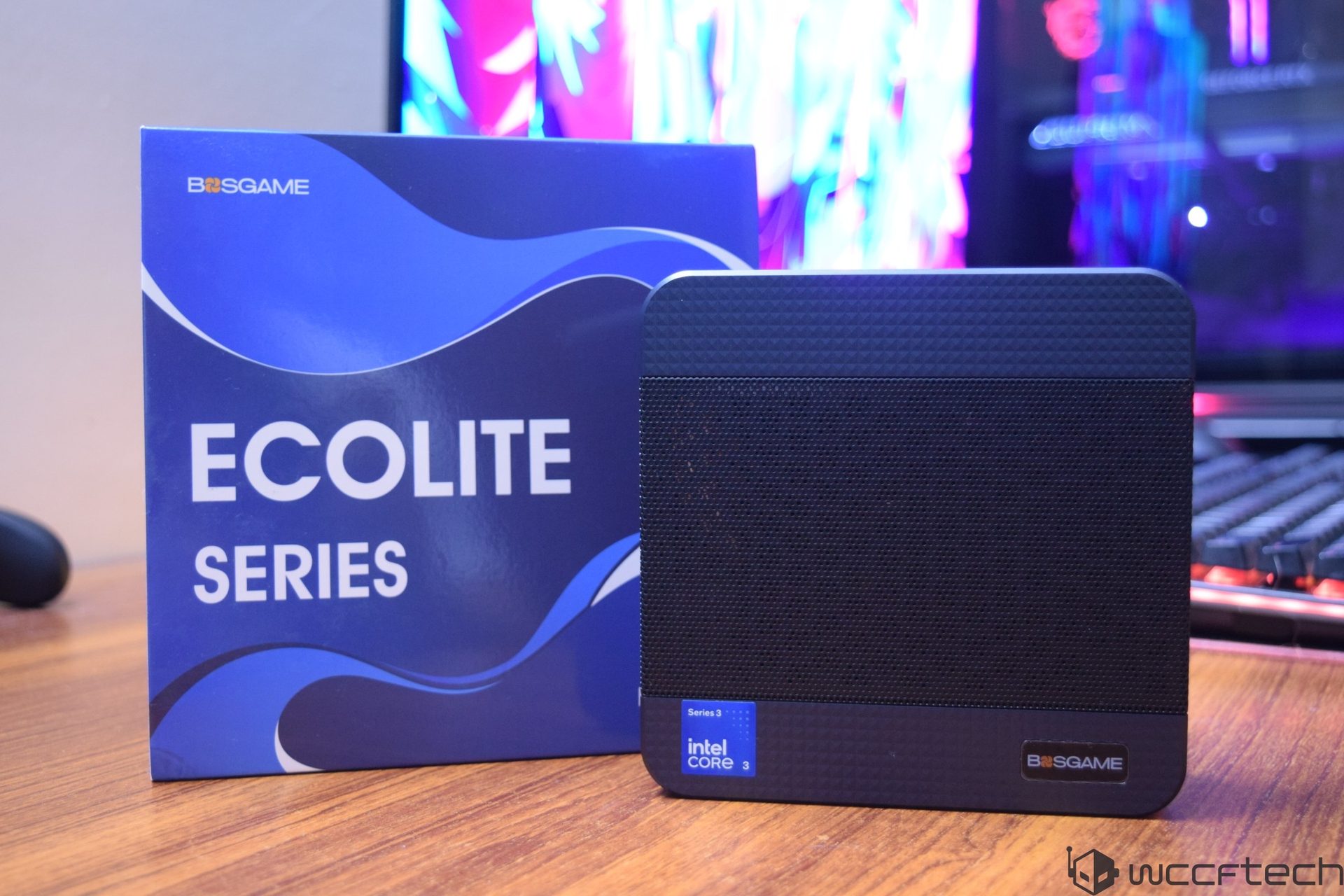
The Bosgame E6 Eco has a very compact body measuring 129 x 128 x 44 mm. Its metallic blue finish gives it a more stylish appearance than the plain black or gray boxes often seen in the mini PC market. The front and sides include large mesh areas to help with airflow, and the overall design puts a clear focus on cooling.
The system uses two fans, which is notable for such a small machine. Inside, the cooling solution includes two copper heat pipes, a finned heatsink, and a blower-style fan. There is also an internal plate with a system fan and an NVMe heatsink with thermal pads. This cooling setup should help the processor maintain stable performance during regular daily use while keeping temperatures under control.
The front I/O includes one USB-C 10 Gbps port with 4K 60 Hz display support, two USB 3.2 Gen 2 Type-A ports rated at 10 Gbps, a 3.5 mm audio jack, a power button, and an LED indicator. This gives users quick access to high-speed USB ports for external drives, accessories, and peripherals.
On the rear, the E6 Eco includes two USB 2.0 ports, one HDMI port, one DisplayPort, dual RJ45 LAN ports, and the DC power input. The dual display outputs make it easy to connect multiple monitors, while the dual LAN ports are useful for office networks, firewall setups, home labs, or users who want separate network connections.
Wireless connectivity is another highlight. The Bosgame E6 Eco comes with Wi-Fi 7 and Bluetooth 5.4, making it more future-ready than many budget mini PCs. Wi-Fi 7 support is especially appealing for users upgrading to newer routers or looking for faster wireless performance over time.
Opening the system requires removing four screws hidden under the rubber feet. A rubber pull tab helps lift the rear plate. Inside, the layout is compact but reasonably accessible. One M.2 slot is already populated by the included SSD, while the second M.2 slot is available for expansion. The Wi-Fi 7 module is also pre-installed.
To access the other side of the board, two additional screws need to be removed. The blue PCB can then be lifted out, revealing the soldered memory and the cooling assembly. While the memory cannot be upgraded, storage access is practical enough for users who want to expand the system later.
The BIOS on the Bosgame E6 Eco is fairly basic. Users can choose between Power Saver and Balanced modes, but there are not many advanced tuning options for the CPU or memory. It is also possible to adjust the amount of memory allocated to the integrated graphics, though similar settings can be managed through Intel’s graphics software.
This limited BIOS fits the target audience. The E6 Eco is not meant for enthusiasts who want deep voltage tuning or advanced performance tweaking. It is built as a simple, efficient, plug-and-play mini PC.
In the box, Bosgame includes the mini PC, an instruction manual, a power adapter, a power cable, and an HDMI cable. The power adapter is rated at around 65W, which is appropriate for a low-power system with a 35W maximum turbo processor.
The packaging is simple, with a blue cardboard design and basic system specifications listed on the back. The included HDMI cable is a useful addition, allowing buyers to get started without needing to purchase an extra display cable.
Performance expectations should be realistic. With one performance core and four low-power efficiency cores, the Intel Core 3 304 is not designed to compete with higher-end Core Ultra, Core i5, Ryzen 5, or Ryzen 7 mini PCs. Heavy workloads such as video editing, large code compilation, 3D rendering, and modern gaming are not its strength.
Where the Bosgame E6 Eco makes more sense is in everyday responsiveness. For browser-based work, Microsoft Office, streaming video, communication apps, point-of-sale use, schoolwork, office deployment, and light multitasking, the system has the right balance of efficiency and functionality. The fast SSD helps the system feel snappy, while 12 GB of memory gives it enough room for typical daily workloads.
The E6 Eco also has strong appeal as a low-power home server, network device, or compact workstation for light tasks. Dual LAN ports, Wi-Fi 7, Bluetooth 5.4, multiple USB ports, and dual display support give it more flexibility than many entry-level desktops.
The Bosgame E6 Eco is best for users who want a compact Intel mini PC for everyday computing without spending too much. Its strengths include a stylish and tiny chassis, modern wireless connectivity, dual LAN, expandable storage, multiple display options, and a power-efficient Wildcat Lake processor.
Its main limitations are also clear. The memory is soldered, the processor is entry-level, graphics performance is modest, and BIOS tuning options are limited. But those trade-offs are expected for a small, affordable mini PC focused on efficiency and basic productivity.
For $379.99, the Bosgame E6 Eco offers a practical package for office users, students, remote workers, home entertainment setups, and businesses looking for compact desktops. It is not a performance powerhouse, but as a quiet, efficient, and modern mini PC for daily work, it delivers a well-rounded experience.Bosgame E6 Eco review: Intel Wildcat Lake shows how efficient entry-level mini PCs are becoming
The Bosgame E6 Eco is a compact mini PC built around Intel’s Core 3 304 “Wildcat Lake” processor, and it is aimed at users who want a small, quiet, power-efficient desktop for everyday computing. It is not designed to replace a gaming PC or a workstation, but it does show how far Intel’s low-power platform has come compared with older N-series chips.
At the heart of the system is the Intel Core 3 304, a Wildcat Lake chip with one performance core and four low-power efficiency cores. This design makes it more capable than previous entry-level processors in single-core workloads while keeping power consumption impressively low. For office work, web browsing, media playback, light multitasking, and basic creative tasks, the chip delivers a usable and surprisingly efficient experience.
In CPU-Z, the Core 3 304 scored 332.2 points in single-core and 2767.1 points in multi-core testing. Some early single-core runs climbed past 500 points, but after stress testing, results generally settled closer to the 300 to 400-point range. Cinebench 2024 results were modest, with 105 points in single-core and 351 points in multi-core performance.
Geekbench results were more encouraging. In Geekbench 6, the Bosgame E6 Eco reached 2481 points in single-core and 6351 points in multi-core. In Geekbench 7, it scored 2214 points in single-core and 6117 points in multi-core. These results put it slightly ahead of similar Core 3 304 mini PCs tested in the same category. In 3DMark CPU Profile, the system achieved 1032 points in single-core and 3241 points in the max thread test.
PCMark 10 could not complete the full benchmark due to an OpenCL driver error, but its Essentials test showed respectable everyday performance. In practical use, that means the Bosgame E6 Eco feels suitable for general desktop tasks such as browsing, streaming, document editing, video calls, and light productivity workloads.
The numbers may not look exciting at first, but context matters. Wildcat Lake is designed to replace Intel’s older N-series lineup. Compared with chips like the N305, which has eight cores and eight threads, the Core 3 304 offers a major uplift in single-core performance and remains competitive in multi-core workloads while operating in the same low-power class. That makes the new mix of performance and low-power efficiency cores a meaningful step forward for entry-level mini PCs.
AI performance is another area where the Bosgame E6 Eco shows promise. Using Geekbench AI, CPU performance under the ONNX framework was acceptable, but the NPU result under OpenVINO showed a much stronger improvement. The built-in NPU is lightweight, but it is useful for local AI tasks that do not require a powerful dedicated GPU. For a small and efficient mini PC, this is a welcome addition.
Graphics performance is handled by a very small integrated GPU based on Intel’s Xe3 architecture. However, the Core 3 304 only includes one Xe3 GPU core, so expectations need to be realistic. This is not a gaming-focused graphics solution, but it is still interesting to see what a single Xe3 core can do at very low power.
In 3DMark, only a limited set of graphics benchmarks could run successfully, including Steel Nomad, Wild Life, and Fire Strike. The Steel Nomad result showed clear scaling: one Xe3 core scored around 139 points, while larger Xe3 configurations with many more cores delivered scores around ten times higher. This suggests near-linear scaling as more Xe3 cores are added.
Several modern graphics tests failed to run because the GPU lacks ray tracing hardware and support for certain advanced graphics features such as DXR 1.1, DirectX 12 Ultimate, and Vulkan ray tracing. Time Spy also failed due to missing SSSE3 support. That is not surprising given the size and power target of this chip. With only one GPU core, advanced ray tracing features would not be practical anyway.
Gaming performance is limited but not useless. Cyberpunk 2077 was tested at 720p on Low settings with XeSS Ultra Performance and frame generation enabled. In that setup, the game ran around 50 to 70 FPS. Without frame generation, performance dropped to roughly 28 to 33 FPS.
Skyrim Special Edition performed better. At 720p Low settings, it ran at around 60 FPS indoors and between 40 and 50 FPS outdoors. For an integrated GPU with just one Xe3 core, that is a respectable result.
Red Dead Redemption 2 at 720p Low with FSR Performance upscaling stayed around 30 to 35 FPS during nighttime testing. No Man’s Sky was also playable at 720p Standard settings with XeSS Performance mode, reaching over 60 FPS during spaceflight and dropping into the 40 to 50 FPS range on planets.
A Forza Horizon test at 720p Low settings with XeSS Ultra Performance produced around 30 FPS. With frame generation, performance could likely be pushed higher, but even a 30 FPS result from such a tiny integrated GPU is notable.
Other games tested included Baldur’s Gate III, LEGO Batman, Marvel Rivals, Counter-Strike 2, and Minecraft. Overall, the Bosgame E6 Eco is best suited for older games, lightweight esports titles, indie games, emulation, and classic PC titles. At 1080p Low settings, older games can often reach around 30 FPS. At 720p Low settings, some titles can reach around 60 FPS.
For video playback and daily graphics tasks, the single Xe3 GPU core performs well. Streaming, desktop acceleration, and routine media use are smooth, which is more important for the target audience than high-end gaming performance.
Power efficiency is one of the strongest parts of the Bosgame E6 Eco. Out of the box, the system is configured with a 25W PL1 and 35W PL2 power limit, with PL4 rated at 80W. In real-world use, however, the chip rarely crossed 20 to 25W.
During CPU-heavy workloads, the processor generally stayed between 16W and 18W, with brief spikes over 20W. Idle power draw was extremely low at under 2W, while video playback used around 2.5W to 3.5W. During gaming, the GPU consumed only about 5W to 6W, while the CPU used around 16W to 20W.
Thermals were equally impressive. Idle temperatures sat around 31 to 32 degrees Celsius, while peak temperatures reached only 69 degrees Celsius. That is cooler than some other devices using the same Core 3 304 processor, which can exceed 80 degrees Celsius under load. Bosgame deserves credit for giving this compact system a strong and quiet cooling solution.
Noise levels were also excellent. The mini PC stays whisper-quiet during typical use, making it suitable for offices, bedrooms, living rooms, and quiet workspaces.
The Bosgame E6 Eco also has several useful hardware features. It includes dual LAN ports, with one 10GbE port and one 2.5GbE port, which is excellent for networking enthusiasts, home servers, small office setups, or users who want fast wired connectivity. It also includes dual M.2 SSD slots, including one Gen4 slot, giving users more storage flexibility than many budget mini PCs.
The use of a standard M.2 SSD is another advantage. It makes storage upgrades easier and more practical than systems that rely on less flexible storage solutions. The chassis is compact, lightweight, and cleanly designed, making it easy to place almost anywhere.
The system also ships with a clean operating system experience, without unnecessary bloatware. That helps the mini PC feel faster and more focused right out of the box.
The main drawback is memory. The Bosgame E6 Eco comes with 12GB of RAM, which is usable for everyday work but can be consumed quickly with modern browsers, background apps, and multitasking. The CPU and GPU are also clearly built for entry-level productivity, not demanding workloads. Another limitation is that the system only includes one USB Type-C port.
Pricing is also affected by today’s higher memory costs. At a retail price of around $379, part of the cost is tied to the 12GB memory configuration. Without current memory price pressure, this type of mini PC would feel much more attractive closer to the sub-$300 range, or ideally around $250.
Even so, the Bosgame E6 Eco is a strong example of what Intel Wildcat Lake can deliver in a compact and efficient mini PC. It is not a machine for heavy multitasking, modern AAA gaming, or professional workloads, but it is very good for lightweight users who need a quiet, efficient, and capable everyday computer.
Its biggest strengths are low power consumption, good cooling, silent operation, dual networking, dual NVMe storage support, clean software, and surprisingly decent 720p performance in older games. The Intel Core 3 304 may be entry-level, but it offers a clear improvement over older low-power chips and gives the Bosgame E6 Eco enough performance for the needs of many everyday users.
For browsing, office work, media playback, light gaming, emulation, and home productivity, the Bosgame E6 Eco is a compact mini PC that makes a strong case for the next generation of affordable low-power desktops.