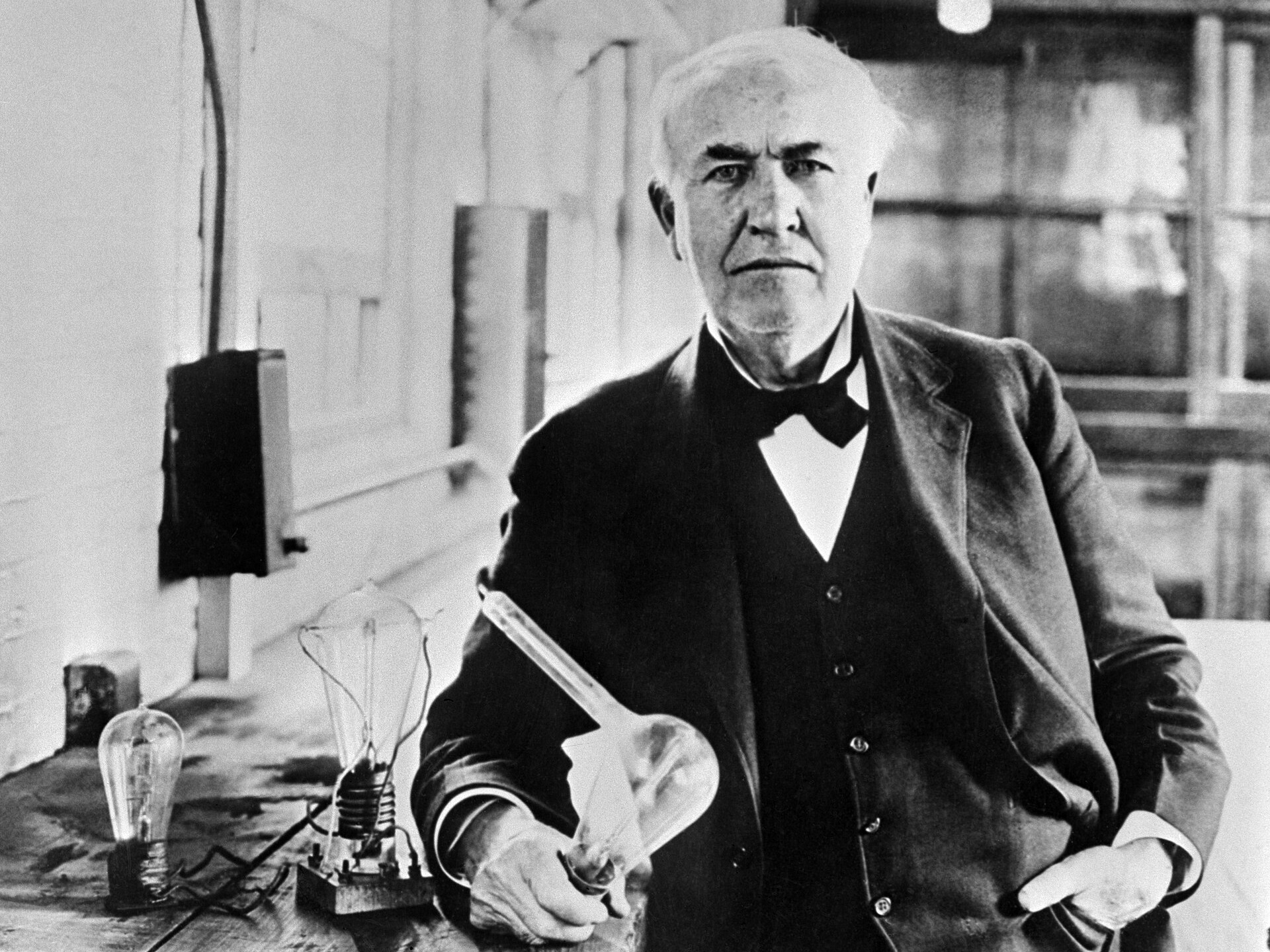
Thomas Edison is famously linked to the light bulb, but new research suggests his earliest lamps may have done something even more surprising: they likely produced graphene inside the bulb—more than a century before graphene became one of the most buzzed-about materials in modern science.
A team at Rice University, led by Lucas Eddy and James Tour, investigated whether the operating conditions of Edison-style bulbs from 1879 could naturally create graphene. While the researchers couldn’t examine original historical bulbs without damaging them, they recreated the early light bulbs as accurately as possible and ran experiments under matching conditions. The result was clear: the replica bulbs produced graphene.
Graphene is a single-atom-thick sheet of carbon arranged in a hexagonal pattern. It’s known for exceptional strength, high electrical conductivity, and impressive thermal performance—qualities that make it central to research in electronics, energy storage, coatings, sensors, and advanced composites. Today, graphene production is typically associated with sophisticated manufacturing methods, including chemical vapor deposition and flash Joule heating.
That last technique is where the story gets especially interesting. Flash Joule heating rapidly drives a powerful electrical current through carbon-containing material, heating it extremely quickly to transform its structure. If that sounds familiar, it’s because it closely resembles how early incandescent lamps worked.
Edison’s bulbs used filaments made from carbonized cotton or bamboo fibers. When electricity passed through the filament, it heated up until it glowed, producing light. According to the Rice University team, those same high-heat, electrically driven conditions could also reorganize the filament’s carbon. In the right environment, the amorphous carbon in the filament can transform into turbostratic graphene—graphene layers that are slightly rotated or misaligned relative to one another.
This “turbostratic” structure isn’t just a technical detail. Because the layers are twisted and interact less strongly than they do in tightly stacked graphite, the material can show distinctive behavior that researchers often find valuable, particularly for electronic properties.
To confirm what formed in the replica bulbs, the scientists used modern analytical tools, including Raman spectroscopy and transmission electron microscopy. The measured signatures aligned with graphene and looked notably different from ordinary graphite, supporting the conclusion that graphene formation can occur during the operation of these early incandescent designs.
Edison, of course, wasn’t trying to create cutting-edge carbon nanomaterials—he was trying to make reliable, mass-producible electric light. And without today’s measurement techniques, he had no real way to identify or isolate graphene even if it was present. Ironically, one of the clues that something unusual was happening may have been what he saw as a problem: the glass bulb darkening over time, a side effect that interfered with light output.
Beyond the novelty of imagining graphene being made in the 19th century, the study is a reminder of how often science advances in loops. With modern tools and modern understanding, researchers can revisit historic technologies and uncover unexpected processes that were hiding in plain sight. Edison’s breakthrough was about illumination—but inside those hot glass bulbs, the physics and chemistry may have been quietly previewing the future of nanotechnology.