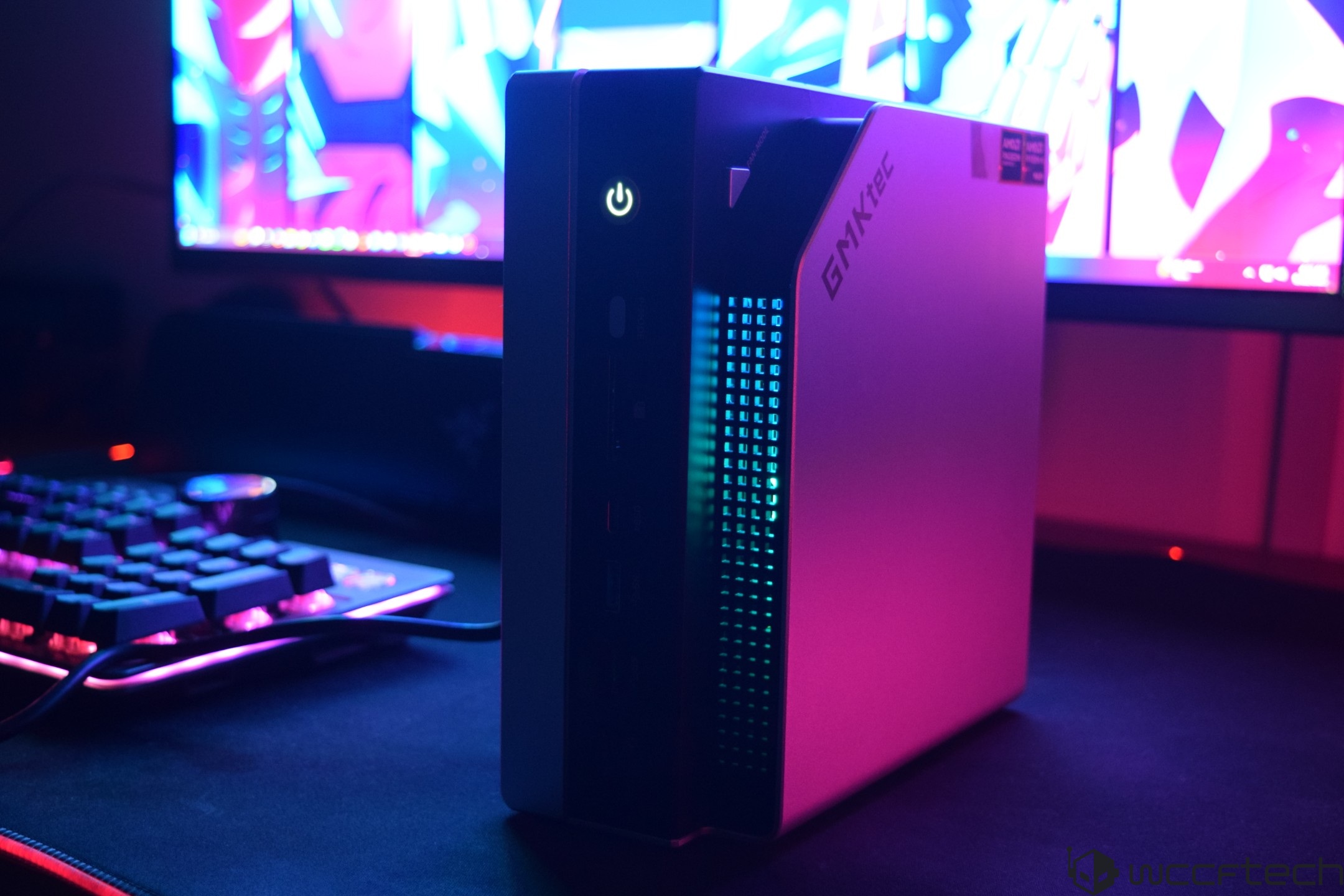
GMKtec’s latest flagship mini PC doesn’t just shrink a powerful workstation into a palm-sized box—it turns it into an AI-accelerated gaming and creation machine. The EVO X2 pairs AMD’s most ambitious mobile silicon to date with generous memory bandwidth, fast storage, and rich connectivity, all wrapped in a premium, compact chassis. Priced at $1499 US, it’s built for power users who want desktop-class performance without the desktop footprint.
GMKtec has a long history in small form factor PCs out of Shenzhen, working closely with major chip and software partners. The EVO X2 is the culmination of that experience: a small form factor design centered on AMD’s Ryzen AI MAX+ 395, codenamed Strix Halo—a chiplet-based SoC that supercharges everything we’ve seen from the Ryzen AI 300 series.
At the heart of the EVO X2 is the Ryzen AI MAX+ 395 APU with 16 cores and 32 threads built on TSMC’s 4 nm process. Unlike standard Strix parts that mix core types, this Halo-class silicon leans into high-performance Zen 5C cores across two 8-core CCX chiplets, each with 32 MB of L3 cache, for a total of 64 MB, plus 16 MB of L2. Base clock lands at 3.0 GHz with boost up to 5.1 GHz. Default TDP is 55W, but GMKtec lets you scale from a quiet 45W up to a punchy 120W target, giving you real control over thermals and performance.
Graphics get a massive upgrade with an RDNA 3.5 iGPU that packs 40 compute units—more than triple what you’d find on top-end Ryzen AI 300 APUs. It can hit up to 2.9 GHz and supports the latest APIs plus modern upscaling and frame generation tech including FSR 2, FSR 3, FSR 3 Frame-Gen, AFMF2, and latency reduction via Anti-Lag 2. It’s one of the fastest integrated GPUs available, turning the EVO X2 into a capable 1080p gaming and content creation rig without a discrete GPU.
AI acceleration is another headline feature. The XDNA 2 NPU delivers up to 50 TOPS on its own, and when you factor in the GPU and CPU, total AI compute reaches up to 126 TOPS. That kind of headroom is ideal for on-device inferencing, creative AI workloads, and rapidly iterating on LLMs without relying on cloud services.
Memory bandwidth is critical for an iGPU of this caliber, so GMKtec equips the EVO X2 with LPDDR5x operating at 8000 MT/s across a wide 256-bit bus, supplying up to 256 GB/s of bandwidth. Configurations start at 64 GB of LPDDR5x and scale to 96 GB or 128 GB. Because the Strix Halo platform lets you allocate large pools of system memory to the iGPU, you can dedicate up to 32 GB of VRAM on the standard configuration—and as much as 96 GB on higher-end builds—while always reserving at least 16 GB for the OS. That’s a huge advantage for AI models, GPU-accelerated workloads, and modern games that benefit from larger VRAM budgets.
Storage and connectivity are equally robust. The reviewed unit includes a 1 TB Crucial PCIe Gen4 SSD with a heatsink, and there are two M.2 Gen4x4 slots supporting up to 4 TB each, for a total of 8 TB. Front I/O gives you two USB 10 Gbps Type-A ports, one USB4 Type-C, an SD card reader, and a 3.5 mm audio jack. Around back, you get two USB 2.0 Type-A ports, one USB 10 Gbps Type-A, another USB4 Type-C, DisplayPort 1.4, HDMI 2.1, a second 3.5 mm audio jack, DC-in, and a Kensington lock slot. Dual USB4 and mixed HDMI/DP outputs make multi-monitor setups and high-speed external storage straightforward.
Fine-grained control is available in the BIOS and on-device. A simple “Power Mode Select” offers three profiles: Performance at 120W for maximum speed, Balanced at 85W for everyday use, and Quiet at 54W for low-noise operation. You can set a custom UMA frame buffer to allocate more memory to the GPU, tweak memory speeds (below the 8000 MT/s factory setting), and adjust fan curves. There’s also a physical fan mode button for quick changes without diving into menus.
Unboxing underscores the premium feel. The EVO X2 arrives in a large, well-presented package with a metallic, dual-tone chassis and a sleek silver front panel. Inside you’ll find the system, documentation and warranty booklet, HDMI cable, and a high-capacity 230W power adapter to fully support the 120W performance mode.
Specifications at a glance:
– Processor: AMD Ryzen AI MAX+ 395 (Strix Halo), 16C/32T, up to 5.1 GHz, 55W TDP (45–120W configurable), FP11 BGA
– Graphics: RDNA 3.5 iGPU with 40 CUs, up to 2.9 GHz; FSR 2/3, Frame-Gen, AFMF2, Anti-Lag 2 support
– AI: XDNA 2 NPU up to 50 TOPS; up to 126 TOPS total AI compute
– Memory: 64 GB LPDDR5x 8000 MT/s (96 GB and 128 GB options), 256-bit bus, up to 256 GB/s bandwidth; large UMA allocation for iGPU VRAM
– Storage: 1 TB PCIe Gen4 SSD included; dual M.2 Gen4x4 slots, up to 8 TB total
– Front I/O: 2x USB-A 10 Gbps, 1x USB4 Type-C, SD card reader, 3.5 mm audio
– Rear I/O: 2x USB-A 2.0, 1x USB-A 10 Gbps, 1x USB4 Type-C, DP 1.4, HDMI 2.1, 3.5 mm audio, DC-in, Kensington lock
– Cooling and control: User-selectable power modes, adjustable fan profiles, hardware fan mode button
– Price: $1499 US
Who is the EVO X2 for? Creators who need fast timeline scrubbing and GPU-accelerated exports, developers and AI enthusiasts running local LLMs or multimodal models, and gamers who want console-like simplicity in a tiny footprint. With a big iGPU, high AI throughput, fast LPDDR5x over a wide bus, and plenty of storage expansion, it’s a compelling small-form-factor workstation that blends portability with serious performance.
If you’ve been waiting for a compact PC that pairs next-gen AI capabilities with high-end integrated graphics and flexible power tuning, the GMKtec EVO X2 delivers the kind of balanced, bandwidth-rich platform that makes mini PCs feel anything but “mini.”GMKtec’s EVO X2 Mini PC doesn’t chase the tiniest footprint—it embraces a slightly chunkier chassis to deliver serious cooling and performance. The outer shell is plastic, but an internal aluminum frame adds rigidity and helps wick heat away from the powerful hardware inside. Four exhaust vents—one tucked under the top frame, two near the rear I/O, and one on the side—keep airflow moving so the system stays cool even under sustained loads.
Connectivity is a highlight. Up front, you get a power button, a Performance Mode toggle, a full-size SDXC card reader, a USB4 Type-C port, two 10 Gbps USB 3.2 Type-A ports, a 3.5 mm audio jack, and a top-mounted Fan-Mode button. Around back, there’s a 5525 DC-in connector, another 3.5 mm audio jack, a 10 Gbps USB 3.2 Type-A port, a second USB4 Type-C port, DisplayPort 1.4 (HBR3 at 8.1 Gbps), HDMI 2.1 (FRL at 8 Gbps), and two USB 2.0 ports. The Fan-Mode button cycles fan speeds for quick noise/thermals control; despite being labeled as a “Light Button” on the official page, we didn’t observe any change to the RGB lighting when pressed.
Servicing is straightforward. Remove two rubber feet at the bottom to lift the top cover. Inside, a robust aluminum frame surrounds a striking red PCB and an 80 mm RGB fan that cools the backside of the board and the dual SSD area. The rear of the PCB carries two PCIe Gen4 x4 M.2 slots—one populated with a 1 TB Crucial Gen4 drive—with support for up to 4 TB per slot. There’s also a MediaTek wireless module offering Wi‑Fi 7 and Bluetooth 5.4. The unoccupied M.2 slot is marked with the system’s v1.05 BIOS designation.
Flip to the other side and you’ll find the star of the show: AMD’s Ryzen AI MAX+ 395 (Strix Halo) SoC, flanked by high-speed LPDDR5x memory and the power delivery array. All of it sits under a beefy heatsink anchored by GMKtec’s Max 3.0 thermal design. Two blower-style fans feed a full copper heatsink with a large baseplate that spans the SoC’s three chiplets and the LPDDR5x modules, while additional contact points pull heat from the VRMs. Power delivery is equally ambitious, with at least 26 phases on the motherboard. The bold red PCB evokes a console-like design ethos with soldered memory and a center-stage SoC. RGB illumination is present but tasteful, adding a subtle glow without turning the system into a light show.
Performance is where the EVO X2 separates itself from typical mini PCs. The Performance Mode toggle lets you run the Ryzen AI MAX+ 395 at multiple power targets—54 W, 85 W, or a high-octane 120 W—so you can balance acoustics, thermals, and speed for different tasks.
– 3DMark CPU Profile confirms the EVO X2’s multi-thread muscle, scaling cleanly as power limits increase.
– In Blender’s monster, junkshop, and classroom scenes, the Ryzen AI MAX+ 395 steamrolls the “standard Strix” configuration. Despite only a 21.5% power increase and a 33.3% core-count advantage, it delivers an 80% uplift; push it to 120 W and it’s more than twice as fast.
– CPU-Z shows single-thread parity with Ryzen AI 9 HX 370 (both peaking around 5.1 GHz), but multi-core is a landslide: roughly 49% ahead at 54 W, 86% at 85 W, and 105% at 120 W.
– Cinebench 2024 tells the same story, with the EVO X2 beating the 70 W Ryzen AI 9 HX 370 even at its 54 W setting, and approaching a 2x lead at 120 W.
– Geekbench 6 reinforces these results with strong single-core and dominant multi-core scores.
– UL Procyon’s office suite shows solid gains, though typical productivity workloads are less sensitive to the extra cores and power than heavy content creation apps.
– The WinRAR benchmark benefits noticeably from the LPDDR5x-8000 memory and bandwidth, producing excellent archive performance.
AI acceleration also shines. In Geekbench AI, the EVO X2 takes the top spot when configured at its highest power setting, outpacing comparable systems built around Ryzen AI 9 HX 370 and Intel Core Ultra 9 285H. If you’re experimenting with on-device AI models, image generation, or accelerated inferencing, the combination of Strix Halo’s NPU, fast RAM, and thermal headroom gives the EVO X2 a clear advantage.
Taken as a whole, the GMKtec EVO X2 Mini PC is a compact workstation with desktop-class ambition. You get:
– Serious cooling with a copper heatsink and dual blowers to sustain 120 W performance
– Flexible power modes for quiet operation or maximum speed
– Modern connectivity including dual USB4, HDMI 2.1, and DP 1.4
– Dual PCIe 4.0 M.2 slots for up to 8 TB total storage
– Wi‑Fi 7 and Bluetooth 5.4 wireless
– Clean, subtle RGB accents
It’s a mini PC built for creators, developers, and power users who care more about sustained performance, expandability, and I/O than shaving every millimeter from the chassis. If you want a small desktop that can render, encode, compile, and crunch AI workloads without breaking a sweat, the EVO X2 belongs at the top of your shortlist.GMKtec EVO X2 Mini PC benchmarks: Strix Halo graphics flex, AI chops to match
Mini PCs keep getting more capable, and the GMKtec EVO X2 shows why. Powered by a Ryzen AI MAX+ 395 APU and AMD’s Strix Halo-class Radeon 8060S integrated graphics, this compact system posts eye‑opening gains over entry-level iGPUs, while also offering serious on-device AI performance. In UL Procyon AI tests, Intel’s latest Core Ultra chips still hold an edge thanks to their efficient NPU and GPU acceleration, but the EVO X2 counters with sheer compute and excellent graphics scaling.
Tested systems for context:
– GMKtec EVO X2 (Ryzen AI MAX+ 395, up to 120W)
– GMKtec EVO T1 (Core Ultra 9 285H, 70W)
– Beelink SER9 (Ryzen AI 9 HX 370, 70W)
– Geekom A9 MAX (Ryzen AI 9 HX 370, 70W)
AI performance and creator workflow
With a combined 126 TOPS of AI compute across the GPU and NPU, the EVO X2 handles local AI workloads confidently. Running local chatbots and Amuse felt responsive, and the option to assign dedicated memory to the GPU helps sustain throughput under heavier models and longer sessions. If you want a compact machine for on-device inference, image generation, or mixed AI/creator tasks, this spec plays well.
GPU compute and synthetic benchmarks
Strix Halo’s Radeon 8060S iGPU features 40 RDNA 3.5 compute units, delivering nearly 27 TFLOPs of FP32—roughly 3.6x the compute of the Radeon 890M’s 12 CUs. That architectural muscle translates into sizable leads across modern test suites:
– 3DMark Speed Way (ray tracing): around 4x faster than entry-level iGPUs, approaching RTX 4060/RTX 5050 territory
– 3DMark Steel Nomad (raster): close to a 4x uplift, again nearing RTX 4060/RTX 5050 levels
– 3DMark Port Royal (RT): up to 3.5x faster than entry-level options
– 3DMark Time Spy: more than 3.5x faster, edging past RTX 4060/RTX 5050 in this test
– 3DMark Fire Strike (DX11): crushes entry iGPUs and lands roughly 10–15% ahead of RTX 4060/RTX 5050
– 3DMark Night Raid: performance comes surprisingly close to flagship-class mobile GPUs
These results underline a key point: even though FLOPs alone don’t guarantee wins across every workload, the 8060S’s combination of cores, architecture, and clocks pays off in real tests.
1080p gaming results and power scaling
The EVO X2’s performance scales cleanly from 54W to 120W, with best results at the higher envelope. Across popular titles at 1080p, medium to high presets, and balanced or quality upscaling, the 8060S consistently outpaces Radeon 890M systems and the Arc iGPU in the Core Ultra 9 285H configuration:
– Cyberpunk 2077 (Medium, Balanced XeSS/FSR): Smooth and clearly ahead of entry iGPUs
– Forza Horizon 5 (Medium, Quality upscaling): Strong 1080p showing with headroom
– F1 24 (High): Competitive, fluid play at 1080p
– Horizon Zero Dawn (Favor Quality, FSR 2 Balanced): Excellent stability and frame pacing
– Metro Exodus (High, RT Normal): Up to 101 FPS at 1080p, a standout result for an iGPU
– The Callisto Protocol: Runs flawlessly at the tested settings
– Borderlands 4 (High, FSR 3 Quality): Around 60 FPS at native 1080p; enabling frame generation pushes well past 100 FPS. Entry-level iGPUs struggle to reach 30 FPS even with frame-gen on the same settings.
What it means for buyers
– If your priority is on-device AI acceleration in UL Procyon-style workloads, Intel’s newest CPUs still deliver excellent NPU/GPU synergy. The GMKtec EVO T1 with Core Ultra 9 285H showcases that well.
– If you want the most capable integrated graphics today for 1080p gaming, creative work, and GPU-accelerated AI, the GMKtec EVO X2’s Radeon 8060S iGPU is on another level versus 890M-class solutions and can nip at the heels of popular midrange discrete GPUs in several benchmarks.
– The EVO X2’s 126 TOPS, dedicated GPU memory option, and strong power scaling make it a compelling mini AI workstation that also doubles as a surprisingly potent 1080p gaming box.
Bottom line
The GMKtec EVO X2 marks a major leap for integrated graphics performance while still delivering credible AI compute in a compact form factor. Intel remains formidable in AI-specific benchmarks, but for all-around mini PC prowess—especially if gaming and GPU-heavy workloads matter—the Strix Halo-powered EVO X2 stands out with performance that often rivals discrete graphics.We cranked every setting to the ceiling at 1080p to see what AMD’s Radeon 8060S integrated GPU can really do—and it delivered. The results point to superb 1080p performance across modern titles and enough headroom to step up to 1440p, and even 4K, with a smart mix of high settings, upscaling, and frame generation.
Titles and presets tested included:
– Cyberpunk 2077 at High, 1080p, Quality upscaling, with and without Frame Generation
– F1 24 at Ultra High, 1080p, Quality upscaling, with Frame Generation
– Forza Horizon 5 at Ultra, 1080p, Quality upscaling, no Frame Generation
– The Callisto Protocol at Ultra, 1080p, Quality
– Horizon Zero Dawn at Ultimate, 1080p, Quality
– Metro Exodus Enhanced Edition at Extreme, 1080p, Quality
GMKtec EVO X2 Mini PC power and thermals
We also looked at how the GMKtec EVO X2 handles power and heat across its three BIOS-selectable TDP profiles: 120W, 85W, and 54W. Expect the 120W Performance mode to push temps into the mid-80s Celsius under sustained load. The 85W Balanced mode typically hovers in the mid-70s, while 54W keeps the chip under 70C and quiet for light-to-moderate workloads. As TDP increases, clocks scale up sharply, but to stay out of thermal throttle territory in the 120W profile, you’ll want the fans spinning fast. The system’s triple-fan setup does the job, but be prepared for a noticeable ramp in acoustics at the top two power modes.
Ryzen AI MAX+ brings the APU dream to life
“Future is Fusion” has finally arrived in a real, shipping device. The Ryzen AI MAX+ 395, known by its codename Strix Halo, isn’t a typical APU—it’s a halo-class SoC that fuses up to 16 Zen 5 CPU cores with a 40-Compute Unit Radeon 8060S GPU built on RDNA 3.5, and pairs it with cutting-edge I/O. The CPU side delivers strong multi-threaded throughput in a compact power envelope, while the GPU side tears through modern games at 1080p and scales cleanly to higher resolutions with upscaling and frame-gen.
A big part of the magic is memory. With a 256-bit LPDDR5X-8000 configuration, this SoC offers ample bandwidth and lets you allocate a very large pool of system memory to the GPU—up to 96 GB—so you’re not shackled by tiny VRAM limits. That’s a win for both gaming and on-device AI workloads, including larger LLMs. Looking ahead, expect similar GPU configurations coupled with even faster memory technologies like LPDDR6 and possibly a dedicated cache layer to further reduce bandwidth pressure.
Practical settings recommendations
– 1080p AAA gaming: Max settings in most titles, with Quality upscaling where needed
– 1440p AAA gaming: High settings are very playable; use Quality upscaling and Frame Generation on demanding titles
– 4K AAA gaming: Medium-to-High settings, Quality or Balanced upscaling plus Frame Generation
GMKtec EVO X2: small box, serious punch
The EVO X2 shows what a halo-class SoC can do in a tiny chassis. Despite its footprint, it’s loaded with modern connectivity: dual USB4, 2.5GbE, Wi-Fi 7 with Bluetooth 5.4, and all the essentials for a versatile desktop replacement or compact creator rig. The case has tasteful RGB, a dual-fan cooler for the SoC, and a dedicated fan for storage. Inside, you get two M.2 slots supporting up to 4 TB each. Memory is soldered, so choose wisely among 64 GB, 96 GB, or 128 GB configurations depending on your workload and how much you plan to allocate to the GPU.
Performance tuning is straightforward via BIOS, with a handy front-facing performance toggle. The 85W Balanced profile hits a sweet spot: it’s close to 120W performance without the same thermal and acoustic penalty. Even at 54W, the Ryzen AI MAX+ 395 outpaces many standard APUs running at 70–80W, making it a strong option for efficiency-focused setups.
Thermals and noise are the trade-offs at higher power. Expect 85C+ in 120W mode and around mid-70s in 85W mode under sustained load. The cooling system ramps aggressively to avoid clock drops toward the 3 GHz range, so you’ll hear it. If you want quiet, stick to 54W for everyday work and reserve 85W/120W for heavy gaming or AI tasks.
Value and use cases
The EVO X2 64 GB model is listed at $1,499, undercutting similarly specced laptops with the same SoC that typically run well over $2,000. Yes, a $1,500 DIY tower can be faster in some scenarios, but that misses the point. This mini PC is a highly integrated, single-chip powerhouse that can devote huge memory pools to the GPU, making it a compact AI workstation and a shockingly capable gaming machine all in one.
Bottom line
AMD’s Ryzen AI MAX+ 395 with Zen 5 and RDNA 3.5 is the clearest realization yet of a high-performance, all-in-one SoC for gaming, productivity, and AI. In a thoughtfully designed box like the GMKtec EVO X2, it proves that integrated can be premium—and that the future of small-form-factor computing is brighter and faster than ever.
Things we liked about the GMKtec EVO X2
– 16 Zen 5 cores in dual CCX layout for excellent productivity performance
– Radeon 8060S with 40 CUs makes this the fastest iGPU solution we’ve tested for gaming and AI
– Efficient chiplet architecture on TSMC 4 nm
– LPDDR5X-8000 with capacities up to 128 GB
– Compact mini PC with strong I/O: USB4, 2.5GbE, Wi‑Fi 7, BT 5.4
– Ability to allocate very large memory pools to the GPU for AI and games
– Outstanding iGPU gaming: rock-solid at 1080p, confident at 1440p, and workable at 4K with upscaling and frame-gen
– Triple-fan cooling with a dedicated SSD blower
Things to consider
– Runs hot at higher TDPs, exceeding 85C under sustained load
– Fans can get loud in 85W and 120W modes
– BIOS could offer deeper tuning options