Taiwan High Speed Rail Makes Spontaneous City Travel Surprisingly Easy With Bluetooth QR Tickets
Taiwan’s High Speed Rail, better known as THSR, is usually associated with fast long-distance trips across the island. But in Taipei, it can also work like a premium regional train, offering a quick and comfortable alternative to the crowded MRT for short urban journeys.
One of the most interesting parts of the experience is the ticketing system. Instead of standing in line or dealing with ticket machines, passengers can buy a spontaneous mobile ticket just minutes before departure using the THSR app. The system relies on Bluetooth to confirm that the passenger is near a ticket gate, then allows a fast ticket purchase and generates a QR code for entry.
For travelers, especially tourists, this makes THSR much easier to use than many high-speed rail systems. After installing the THSR app and creating an account, users can buy a non-reserved ticket directly at the station gate area. The process is quick, and payment can be completed through options such as Apple Pay if no credit card is stored in the app.
Bluetooth Ticketing Makes Last-Minute Travel Simple
The key requirement is Bluetooth. The THSR app uses nearby beacons to detect whether the passenger is close enough to the ticket gates. Once the system confirms the location, the user can select a destination and purchase a ticket.
This is useful for short, spontaneous trips, such as traveling between Taipei Main Station and Nangang. With practice, the purchase can be completed almost while walking toward the gate, as long as there is a stable internet connection.
After payment, the mobile ticket appears almost instantly. Tapping the ticket displays a QR code, which can then be scanned at the gate. THSR ticket gates support paper tickets, RFID cards, and QR codes, making the boarding process flexible.
The QR readers are fast enough for smooth daily use, although passengers may still need to slow down slightly to avoid reaching the barrier before it opens. Even so, the process is much faster than waiting at a ticket counter or navigating a vending machine in a hurry.
A Faster Alternative to the Taipei MRT
For short trips inside the greater Taipei area, THSR can be surprisingly practical. The ride from Taipei Main Station to Taipei-Nangang takes around eight minutes and costs 35 TWD, roughly about one US dollar.
That is slightly more expensive than taking only the Taipei MRT, but the difference may be worth it for passengers who want a faster, quieter, and more comfortable ride. In one example, traveling onward from Nangang to Nangang Exhibition Center required an additional MRT fare, bringing the total to 55 TWD, or about two US dollars.
For many commuters and visitors, that is still a reasonable price for saving time and avoiding crowded subway trains, especially during major events in Taipei.
Non-Reserved Cars Keep Travel Flexible
THSR offers non-reserved seating, similar to high-speed rail systems in Japan. Passengers with these tickets do not receive a guaranteed seat, but they can board designated non-reserved cars.
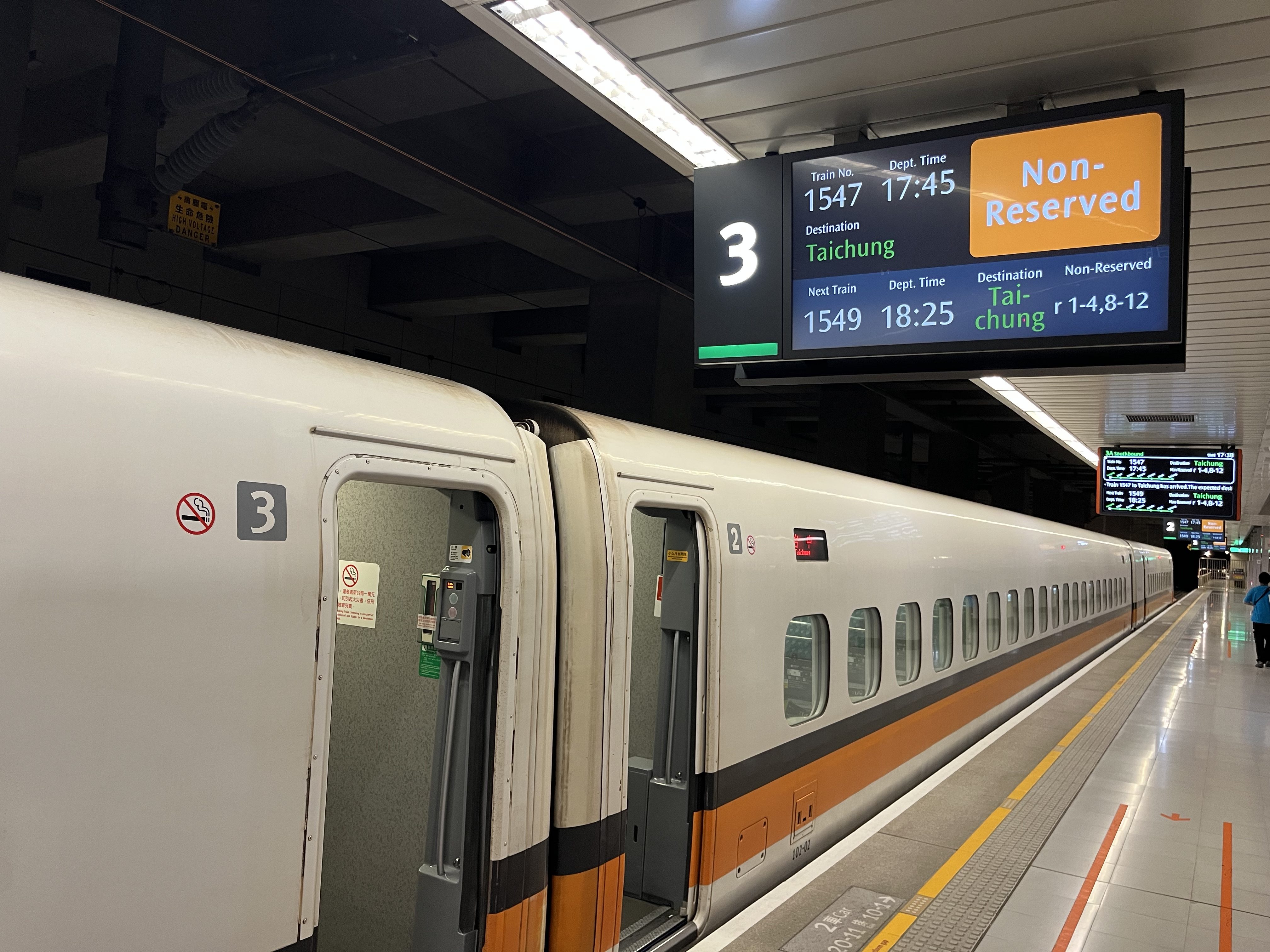
On many trains, non-reserved cars are typically cars 10, 11, and 12. Some stopping services, especially those operating more like regional trains between Taipei-Nangang and Taichung, offer additional non-reserved cars, including cars 1 through 4 and cars 8 and 9.
This makes the system more useful for local and regional travel, even though the trains themselves are full high-speed rail trainsets. On shorter segments near Taipei, seats are often still available, particularly when boarding near the end of the line.
Another useful detail is ticket flexibility. If a non-reserved ticket is not used, it can be canceled until the end of the day. Passengers can also take a later train, making the ticket more forgiving than many advance-purchase rail fares.
Comfort Is a Major Advantage
THSR may be used for short city trips, but it still feels like a long-distance high-speed rail service. The trains are spacious, clean, and comfortable. Seats generally face the direction of travel, which is a welcome detail for passengers who dislike riding backward.
Boarding is also efficient. Platforms are level with the train floor, reducing delays caused by steps and making it easier for passengers with luggage to enter and exit. Even though high-speed trains have fewer doors than metro trains, passenger flow remains relatively quick.
The station design also helps. Faster trains can pass slower stopping services, allowing THSR to run different service patterns without constantly delaying express trains.
Food, Drinks, and Convenience Stores Add to the Appeal
One major difference between THSR and the Taipei MRT is that eating is allowed on THSR trains. This makes a short ride more convenient, especially for travelers heading to meetings, events, or the airport.
Some trains have vending machines where passengers can buy drinks at reasonable prices. A soft drink may cost around 25 TWD, only slightly more than in the city. Snacks are also sold from a cart, and bento boxes are available for passengers who want a proper meal on board.
Stations often include convenience stores such as FamilyMart, including some located beyond the ticket gates. Passengers can buy fresh food before boarding and either eat in the station waiting area or take it onto the train.
This gives THSR a level of convenience that is hard to match on many urban rail networks.
Good Connectivity On Board
Mobile reception on THSR trains is strong, which is not surprising in Taiwan, where cellular networks are generally reliable. THSR also offers onboard Wi-Fi, adding another option for passengers who want to work, message, or browse during the trip.
For commuters and business travelers, this makes the train more than just transportation. It becomes usable time.
The System Is Popular, and That Creates Challenges
THSR’s convenience also shows one of its biggest problems: demand is extremely high.
On short segments near Taipei, getting a seat is often easy. From Banqiao toward central Taipei, for example, many passengers get off, giving others a better chance of sitting down. But from Taoyuan, especially because of its connection to the main international airport, trains can be much more crowded.
Standing is common on busy sections, particularly for passengers traveling without a seat reservation. Anyone traveling from the airport area or during peak periods may be better off booking a reserved seat in advance, although that reduces spontaneity.
At popular travel times and during holidays, THSR services can sell out. Trains may already run every 5 to 10 minutes during busy periods, but demand can still exceed available capacity.
Why THSR Is So Attractive
Taiwan High Speed Rail is successful because it combines speed, comfort, and reliability. Trains can reach speeds of up to 186 mph, making intercity trips dramatically faster than conventional rail or road travel.
Although some THSR stations are located outside city centers, the system remains highly competitive thanks to efficient transfers, frequent service, and comfortable trains. In the Taipei area, it can even serve as a premium shortcut for short-distance travel.
For tourists, the Bluetooth-based mobile ticket system is especially appealing. It removes much of the friction normally associated with high-speed rail travel. No long line, no ticket machine confusion, and no need to plan far ahead for a simple short trip.
A Smart Way to Travel Across Taipei
Using THSR between Taipei Main Station and Nangang may seem unusual at first. After all, high-speed rail is usually meant for long journeys. But in practice, it can be a fast, affordable, and comfortable way to move across the city.
The Bluetooth QR code ticketing system makes spontaneous travel easy. Non-reserved cars provide flexibility. The fare is still reasonable. Food is allowed. Mobile reception is strong. And the trains offer a level of comfort far beyond a typical metro ride.
For visitors in Taipei, especially those attending major events near Nangang, THSR is worth considering as an alternative to the MRT. It costs a little more, but the speed and convenience can easily make up for it.Taiwan High Speed Rail Review: Why a Bluetooth or QR Code Ticket Makes THSR a Smart Choice
Taiwan’s High Speed Rail is often seen as a long-distance travel option, but it can also be surprisingly useful for short trips around the Taipei metropolitan area. With digital ticketing, reliable departures, and fast connections between key stations, THSR can be a convenient alternative to crowded metro rides, especially during busy commuting hours.
One of the biggest advantages is the ticketing system. Using a Bluetooth or QR code ticket makes the journey simple and quick, removing much of the friction that can come with buying paper tickets or navigating ticket machines. For travelers who want a smooth, modern experience, the digital ticket option is one of the easiest ways to use Taiwan High Speed Rail.
The service is especially interesting on the busy east-west route through the Taipei area. THSR serves important stops such as Nangang, Taipei Main Station, and Taoyuan, giving passengers a fast way to move across the region. For anyone familiar with the Taipei Metro’s Bannan Line, which can become extremely crowded during peak hours, the high-speed rail option can feel like a welcome shortcut.
That said, THSR is still designed primarily for longer-distance travel. While it can save time on certain routes, the schedule is not always as frequent as a metro line. There can be larger gaps between trains, which means the Taipei Metro may still be the better choice depending on the time of day and your exact destination. For short urban trips, checking departure times before heading to the station is essential.
Rush hour can also be intense. Even though the journey itself is fast, trains can become crowded, and passengers may need to stand. However, because the travel time between stations is short, standing is often still manageable compared with a longer ride on a packed metro train.
More capacity is on the way. THSR is expected to receive new trains soon, but it may take around another year before the extra capacity is fully available for passengers. Once the additional trains enter service, THSR plans to offer about 25% more capacity during rush hour. That could make a noticeable difference for commuters and travelers using the system at peak times.
For passengers considering alternatives, Taiwan Railway also operates on a parallel route and serves more stations. It runs separately from the high-speed rail system, and an EasyCard can be used without issue. However, travelers should pay attention to the train category, as different services may vary in speed, stopping patterns, and overall travel time.
In testing, the route between Nangang and Taipei Main Station proved highly reliable. Across five rides on this section, plus an additional trip to Taoyuan, punctuality was perfect. There were no delays during the test, and previous experiences with THSR have also shown the system to be impressively dependable.
Overall, Taiwan High Speed Rail with a Bluetooth or QR code ticket is absolutely worth considering. It is fast, efficient, modern, and dependable. While it may not always replace the Taipei Metro or Taiwan Railway for every trip, it can be an excellent option for commuters, spontaneous travelers, and anyone looking for a faster way to move between major stations in northern Taiwan.
For peak-hour travel, the experience can still be crowded, but the convenience and speed make THSR a strong alternative. With future capacity improvements on the way, Taiwan High Speed Rail is likely to become even more attractive for both daily riders and visitors exploring Taiwan.